

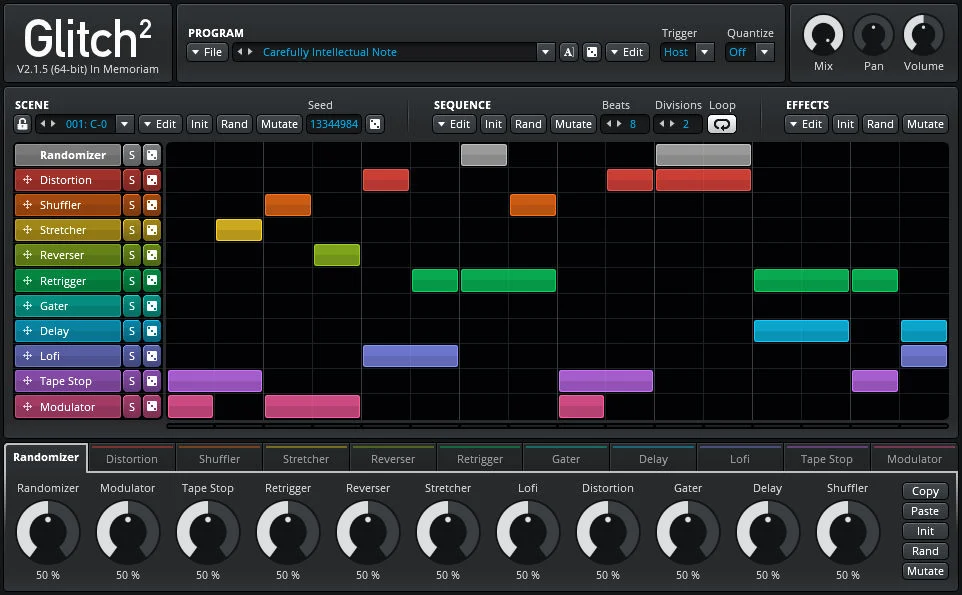
In a move that honors the life and enduring legacy of a pioneering figure in the digital audio community, Illformed has announced that its flagship audio effect plugin, Glitch 2, is now available as a free download for Linux, macOS, and Windows. This transition from a commercial product to freeware serves as a formal memorial for the software’s creator, Kieran Foster, known to the global music production community by his alias "dblue." Foster, who was a cornerstone of the Renoise development team and a visionary in the realm of "FSU" (an industry colloquialism for "F**k Stuff Up") audio processing, passed away recently, leaving behind a body of work that fundamentally altered the landscape of electronic music production.
The decision to release Glitch 2 for free ensures that Foster’s innovative tools remain accessible to a new generation of artists, mirroring the developer’s lifelong commitment to collaboration and the democratization of music technology. By removing the financial barrier to one of the most influential multi-effect sequencers in the VST (Virtual Studio Technology) market, Illformed maintains Foster’s vision of fostering creativity through chaotic randomness and technical precision.
The Legacy of Kieran Foster and the dblue Alias
Kieran Foster was more than a software developer; he was a cultural catalyst within the electronic music sphere. Under the moniker dblue, he became synonymous with the "glitch" aesthetic—a genre and production style characterized by the deliberate use of digital artifacts, stutters, and rhythmic malfunctions. His early work on the original Glitch (version 1.3) became a staple of the "bedroom producer" era in the mid-2000s. It was a time when experimental electronic music, spearheaded by labels like Warp Records and artists such as Aphex Twin and Autechre, was seeking new ways to manipulate digital sound.
Foster’s involvement with Renoise, a modern digital audio workstation (DAW) based on the "tracker" heritage, further solidified his reputation. Trackers represent a specific lineage of music software that uses a vertical timeline and alphanumeric commands, a workflow that Foster championed and refined. His peers at Renoise described him as a developer who "blessed us with his vision and talent," noting that his impact on electronic music was "atomic" and "confined by no genre."
The memorial statement released by his colleagues highlights Foster’s personality as much as his technical prowess. He was known for his helpfulness in community forums, his willingness to share the secrets of his craft, and his resistance to "trendwhorism"—a term used to describe the pursuit of fleeting market trends over genuine innovation. His work was defined by a curiosity about the "chaos of randomness," a philosophy that is deeply embedded in the architecture of Glitch 2.
Technical Architecture and Feature Set of Glitch 2
Glitch 2 is a multi-effect processor that utilizes a signature sequencer-based approach to audio manipulation. Unlike standard effects that apply a consistent process to an audio signal, Glitch 2 allows users to trigger various effect modules across a timed grid, synchronized with the host DAW’s tempo. This allows for the creation of complex, rhythmic transformations that would be incredibly time-consuming to program manually through automation.
The Multi-Track Sequencer
At the heart of the plugin is a sequencer capable of playing multiple effects simultaneously. This multi-track approach allows for the layering of distinct sonic treatments, enabling the user to create intricate textures. The sequencer features:

- Independent Timing: Each track can have its own timing settings, allowing for polyrhythmic glitches and complex syncopations.
- Global Controls: Users can adjust the overall mix, master volume, and global filter settings to glue the disparate effects together.
- Integrated Browser: A streamlined interface for managing presets and effect configurations, designed for rapid workflow.
Diverse Effect Modules
Glitch 2 houses a suite of modules that range from traditional studio tools to extreme experimental processors. These include:
- Retrigger: A classic "stutter" effect that repeats small slices of audio at various rates.
- Shuffler: A module that rearranges small segments of the incoming audio stream in real-time.
- Reverser: An effect that plays audio segments backward, a staple of the glitch genre.
- Tape Stop: Simulates the sound of a physical tape machine or turntable slowing down to a halt.
- Modulator: Provides frequency modulation (FM) and ring modulation for metallic, robotic timbres.
- Gater and Delay: Traditional rhythmic tools for creating space and percussive silence.
Randomization and Mutation
True to Foster’s fascination with chaos, Glitch 2 includes robust randomization features. The "Mutate" and "Randomize" functions allow producers to generate entirely new patterns and effect combinations with a single click. This feature has made the plugin a favorite for sound designers working in film and video games, where the need for "happy accidents" often drives the creative process.
A Chronology of Illformed Software
The journey of Glitch began in the early 2000s with the release of dblue Glitch 1.3. At the time, the plugin was a Windows-only freeware tool that gained viral popularity on music production forums. It was praised for its ability to instantly transform a simple drum loop into a complex IDM (Intelligent Dance Music) breakbeat.
In 2013, Foster released Glitch 2 as a complete rewrite of the original software. This version was significant for several reasons:
- Cross-Platform Compatibility: It introduced support for macOS and Linux, making it one of the few high-end commercial effects available for the Linux audio community.
- 64-bit Support: As the industry transitioned away from 32-bit systems, Glitch 2 provided the modern architecture necessary for professional stability.
- Refined UI: The interface was modernized to be more intuitive while retaining the "tracker-inspired" logic that long-time users appreciated.
For over a decade, Glitch 2 remained a paid product, maintaining a loyal user base despite the emergence of competitors from larger software houses. Its transition to freeware in 2024 marks the end of its commercial lifecycle but the beginning of its permanent status as a foundational tool for the global music community.
Industry Impact and the "FSU" Philosophy
The term "FSU" was popularized in the VST community to describe a specific category of plugins designed for extreme signal destruction. Kieran Foster was a pioneer of this philosophy. Before the arrival of Glitch, achieving "glitched" audio required tedious manual editing—cutting waveforms into millisecond-long fragments and rearranging them by hand.
Foster’s software automated this "destruction," allowing it to be performed live. This had a profound impact on the evolution of genres such as Dubstep, Glitch-hop, and Breakcore. The ability to "chaotically mangle" audio in a controlled, tempo-synced environment allowed producers to push the boundaries of what was considered "musical."
Furthermore, the inclusion of Linux support was a testament to Foster’s dedication to the open-source and alternative computing communities. By providing high-quality tools for Linux users, he supported a niche but passionate segment of creators who were often overlooked by major software developers like Waves or Universal Audio.

Community Response and Memorial Tributes
The announcement of Glitch 2 becoming freeware has been met with a wave of tributes from across the music industry. On the Renoise forums and social media platforms like X (formerly Twitter) and Reddit, users have shared stories of how Foster’s plugins defined their early careers.
"Kieran wasn’t just a coder; he was the architect of a specific sound that defined an era," noted one user on the Renoise memorial thread. "He gave us the tools to break the rules."
The developers at Renoise emphasized his kindness and his role as a mentor. They noted that he was "always ready to collaborate and critique for his friends and fellow musicians," often sharing not just the software he built, but the techniques behind his own music. This spirit of openness is what Illformed seeks to preserve by making Glitch 2 free for all.
Broader Implications for Software Preservation
The release of Glitch 2 as freeware also touches upon the growing conversation regarding software preservation in the digital arts. When independent developers pass away or companies fold, significant creative tools often disappear into "abandonware" limbo, becoming incompatible with modern operating systems or impossible to authorize.
By officially releasing the software for free and maintaining the download links on the Illformed website, the stewards of Foster’s legacy are ensuring that his work remains functional and legal to use. This serves as a model for how the industry can handle the digital estates of influential creators, prioritizing the cultural value of the software over residual commercial gains.
Conclusion and Availability
Glitch 2 stands as a monument to Kieran Foster’s ingenuity and his belief in the beauty of digital chaos. Whether used for subtle rhythmic variation or total sonic annihilation, the plugin remains as relevant today as it was upon its release. It continues to offer a unique workflow that encourages experimentation and rewards those willing to embrace the "atomic impact" of randomness.
For those looking to integrate this piece of music history into their toolkit, Glitch 2 is available for download on the official Illformed website. It supports VST and AU formats on Windows (XP or later), macOS (10.7 or later), and Linux (Ubuntu 12.04 or later). In accordance with the developer’s legacy, the software is provided as a gift to the community, inviting every musician to "make their own music better" through the vision of dblue.
