

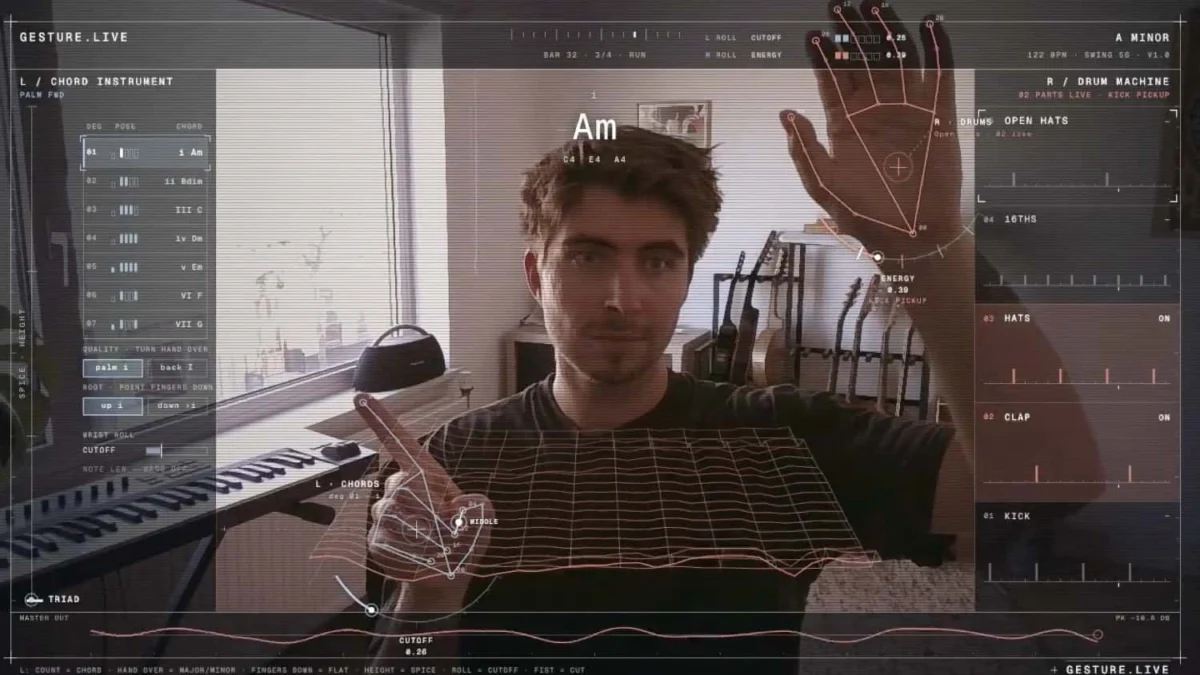
The landscape of digital music production has undergone a significant transformation with the release of gesture.live, a browser-based application developed by Robin van Soelen. By leveraging modern computer vision and web-based audio processing, the platform effectively converts a standard laptop or desktop webcam into a sophisticated gestural controller. This innovation represents a convergence of several high-level technologies, including the Web Audio API, Web MIDI, and advanced machine learning models designed for real-time hand tracking. Unlike traditional digital audio workstations (DAWs) that require external hardware controllers or physical contact with a keyboard, gesture.live allows users to manipulate sound through spatial movements, effectively turning the air in front of the camera into a three-dimensional interface for musical expression.
The application operates on a dual-hand control logic that mirrors the ergonomic layout of many physical instruments. The system is programmed to recognize the left hand as a chord generator, while the right hand is assigned to melodic leads, basslines, percussive elements, or effects processing. This separation of duties provides a structured framework for performance, allowing for a degree of polyphony and complexity that was previously difficult to achieve in a browser-based environment without significant latency.
The Technical Framework of Computer Vision in Music
To understand the significance of gesture.live, one must examine the underlying technology that allows a standard 720p or 1080p webcam to function as a high-precision musical sensor. The application likely utilizes a framework similar to MediaPipe or TensorFlow.js, which are Google-developed libraries capable of identifying and tracking 21 individual landmarks on a human hand in real-time. By calculating the relative positions of these landmarks—such as the distance between the thumb and forefinger or the elevation of the palm—the software can translate physical coordinates into MIDI (Musical Instrument Digital Interface) data.
This process involves a multi-layered computational pipeline. First, the video feed is processed to isolate the user’s hands from the background. Second, the machine learning model estimates the 3D coordinates of the joints. Third, these coordinates are mapped to specific musical parameters. For instance, the vertical (Y-axis) position of the hand might control the pitch or frequency of an oscillator, while the horizontal (X-axis) movement could govern stereo panning or filter cutoff. The depth (Z-axis), often determined by the perceived size of the hand in the frame, can be mapped to volume or resonance, providing a tactile sense of interaction despite the lack of physical feedback.
Historical Context and the Evolution of Gestural Control
The concept of gesture-based music is not entirely new, but its implementation in a free, zero-install browser format is a milestone in the democratization of music technology. The lineage of gesture.live can be traced back to the early 20th century with the invention of the Theremin by Lev Sergeyevich Termen in 1920. The Theremin allowed musicians to control pitch and volume by moving their hands near two metal antennas, sensing the capacitance of the human body.
In the late 20th and early 21st centuries, this concept evolved through hardware such as the Roland D-Beam, which used infrared sensors, and the Buchla Lightning, which utilized infrared-emitting wands. More recently, the release of the Microsoft Kinect and the Leap Motion controller provided developers with the depth-sensing capabilities needed to create more complex gestural instruments. However, these solutions required proprietary hardware and specific software drivers. The breakthrough of gesture.live lies in its accessibility; it removes the hardware barrier by utilizing the camera already built into almost every modern consumer electronics device.
The Role of Web Audio and Web MIDI APIs
The performance of gesture.live is heavily reliant on the maturity of the Web Audio API. This high-level JavaScript system allows for the processing and synthesizing of audio directly in the browser with low latency. Before the widespread adoption of this API, web-based music tools were often plagued by "jitter" and significant delays between a user’s action and the resulting sound. By utilizing a dedicated audio thread, the Web Audio API ensures that the synthesis remains stable even when the browser is performing heavy computational tasks like hand tracking.
Furthermore, the integration of the Web MIDI API allows gesture.live to function as a controller for other software. This means that a user is not limited to the internal sounds provided by van Soelen’s application. Instead, they can route the hand-tracking data to professional-grade software like Ableton Live, Logic Pro, or hardware synthesizers. This flexibility transforms gesture.live from a standalone novelty into a legitimate tool for a professional studio environment.
Accessibility and Educational Implications
One of the most significant implications of gesture.live is its potential for inclusive music-making. For individuals with physical disabilities that limit their ability to grip a drumstick or press small keys on a piano, gestural control offers a more viable path to creative expression. The "low floor, high ceiling" design of the application—meaning it is easy to start using but offers deep complexity for those who master it—makes it an ideal tool for music therapy and special education.
From an educational standpoint, the application provides a visual and physical representation of music theory. Students can "see" the relationship between hand height and pitch, or hand spread and chord density. Because the application requires no financial investment beyond a basic computer, it serves as an equalizer in classrooms where funding for expensive musical instruments may be lacking.
Technical Challenges: Latency, Lighting, and Processing Power
Despite the advancements represented by gesture.live, the platform faces inherent challenges common to all computer vision systems. The primary hurdle is latency—the time elapsed between a physical movement and the auditory response. While the Web Audio API minimizes audio latency, the "camera-to-screen" latency is dependent on the frame rate of the webcam and the processing speed of the user’s CPU. Most standard webcams operate at 30 frames per second (fps), which introduces a theoretical minimum delay of approximately 33 milliseconds. For professional percussionists or high-speed melodic runs, this delay can be perceptible.
Environmental factors also play a critical role. Computer vision models require consistent lighting to accurately distinguish hand landmarks. In low-light environments, the "noise" in the video signal can lead to "glitching" or erratic jumps in the MIDI data. Furthermore, because the application runs in a browser, it must compete for system resources with other open tabs and background processes. Users with older hardware may experience frame drops, which directly affects the smoothness of the musical performance.
Industry Reaction and Market Impact
The music technology community has reacted with cautious optimism toward the rise of browser-based gestural tools. While traditionalists argue that nothing can replace the haptic feedback of physical keys or strings, a new generation of "bedroom producers" and experimentalists are embracing these tools for their portability and unique performance aesthetics.
Industry analysts suggest that tools like gesture.live are part of a broader trend toward "spatial computing" in music. As companies like Apple and Meta push toward augmented reality (AR) and virtual reality (VR) environments, the ability to manipulate digital objects—and sounds—in 3D space is becoming a core competency for developers. Robin van Soelen’s work is a precursor to a future where the digital workstation is no longer a grid on a screen, but a 360-degree environment where sound is sculpted by hand.
Chronology of Development in Web-Based Music
The journey to gesture.live is marked by several key technological milestones over the past decade:
- 2011: Introduction of the Web Audio API, providing the first real-time audio processing capabilities in browsers.
- 2015: The Web MIDI API becomes a W3C Recommendation, allowing browsers to communicate with external musical hardware.
- 2017: The launch of TensorFlow.js brings machine learning to the browser, enabling real-time image and gesture recognition.
- 2020-2022: A surge in remote collaboration tools during the global pandemic drives interest in accessible, browser-based creative software.
- 2024: The release of gesture.live by Robin van Soelen, synthesizing these previous advancements into a streamlined, user-friendly instrument.
Future Outlook and Potential Enhancements
Looking forward, the potential for gesture.live and similar applications is vast. Future iterations could incorporate "pose estimation," allowing the software to track the movement of the user’s entire body, effectively turning a dance performance into a musical composition. Integration with WebGPU—a new web standard for hardware-accelerated graphics and computation—could further reduce latency and allow for more complex machine learning models to run smoothly on lower-end devices.
There is also the possibility of social integration. Imagine a collaborative environment where multiple users from across the globe join a single browser session, their webcams tracking their movements to perform as a virtual ensemble. By eliminating the need for specialized hardware, van Soelen has opened the door to a more communal and experimental form of digital art.
In conclusion, gesture.live is more than just a free web application; it is a proof of concept for the future of human-computer interaction in the arts. By utilizing the existing hardware in our pockets and on our desks, Robin van Soelen has bridged the gap between complex computer vision and intuitive musical expression. As web technologies continue to evolve, the distinction between "software" and "instrument" will continue to blur, making the power of musical creation accessible to anyone with a camera and an internet connection.
