

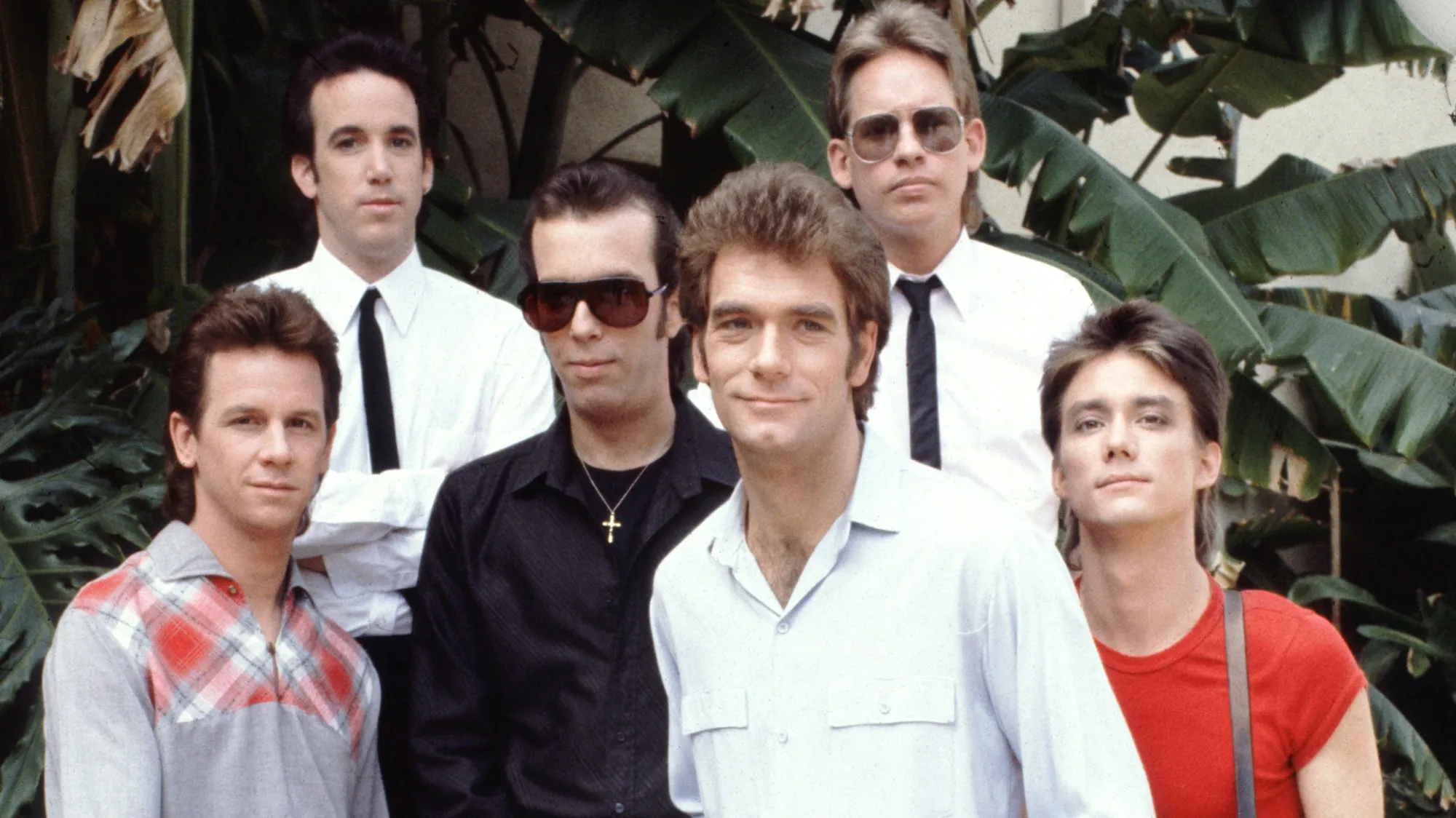
On August 24, 1985, the American pop-rock landscape reached a significant milestone as Huey Lewis and the News ascended to the top of the Billboard Hot 100 with their hit single, “The Power of Love.” Serving as the flagship theme for the blockbuster film Back to the Future, the track not only secured the band’s first number-one hit on the all-genre chart but also solidified the era’s burgeoning synergy between the recording industry and Hollywood’s high-concept cinema. The song’s journey from a hesitant creative proposal to a global anthem remains one of the most successful examples of cross-media marketing in the 20th century.
The Genesis of a Collaboration: Spielberg, Zemeckis, and the News
The origins of “The Power of Love” were rooted in a specific creative vision held by the producers and directors of Back to the Future. Director Robert Zemeckis, screenwriter Bob Gale, and executive producer Steven Spielberg approached Huey Lewis in late 1984 with a unique proposition. They envisioned the film’s protagonist, Marty McFly, portrayed by Michael J. Fox, as a fervent fan of Huey Lewis and the News. The character’s musical aspirations and personal style were modeled after the blue-collar, high-energy rock aesthetic that Lewis had popularized with the 1983 multi-platinum album Sports.
Despite the high-profile nature of the request, Lewis initially expressed reservations. In various retrospective interviews, Lewis noted that he was unfamiliar with the mechanics of writing for film and was particularly wary of creating a literal "theme song." His primary concern was the potential for the song to feel forced or dated if it were required to share the movie’s title. Lewis reportedly told the filmmakers that he did not want to write a song titled “Back to the Future.” In a show of creative flexibility, Zemeckis and Spielberg assured him that the title was irrelevant; they simply wanted a "Huey Lewis song" that captured the spirit of the film. Lewis eventually agreed, promising to submit the next piece of music he and his bandmates composed.
Songwriting and Personal Inspiration
The resulting track, “The Power of Love,” was co-written by Huey Lewis, Chris Hayes, and Johnny Colla. Musically, the song was a departure from the more traditional bar-rock sounds found on Sports, incorporating the polished synthesizers and driving electronic percussion that defined the mid-1980s. Lyrically, however, the song avoided any direct references to time travel, DeLorean automobiles, or the film’s 1955 setting.
Lewis has since revealed that the inspiration for the lyrics was deeply personal rather than cinematic. In 1985, Lewis was navigating the early years of fatherhood and marriage, having married in 1983 and welcomed two children in quick succession in 1984 and 1985. The lyrics, which explore the transformative and occasionally unpredictable nature of romantic and familial devotion, were a reflection of his own domestic life. This universality contributed significantly to the song’s broad appeal, allowing it to function as a standalone pop hit independent of its association with the film.
A Tale of Two Tracks: The Battle for the Single
While “The Power of Love” became the primary anthem for the film, it was not the only contribution Huey Lewis and the News made to the soundtrack. The band also composed and recorded “Back in Time,” a track that leaned more heavily into the movie’s plot, mentioning characters like Doc Brown and the specific mechanics of the narrative. Lewis found the process of writing “Back in Time” to be surprisingly straightforward, noting that writing to a specific plot was easier than the abstract emotional work required for “The Power of Love.”
A brief internal conflict arose regarding which song should be promoted as the lead single. Studio executives at Universal Pictures and music industry veterans initially favored “Back in Time” due to its direct ties to the movie’s branding. However, music supervisor Bone Howe recognized the commercial potential of “The Power of Love.” Howe argued that the latter possessed the "hook" and emotional resonance necessary for heavy rotation on Top 40 radio and MTV. His intuition proved correct; while “Back in Time” became a fan favorite and a staple of the film’s end credits, “The Power of Love” became the cultural phenomenon that drove soundtrack sales.
Chart Performance and 1985 Market Context
The summer of 1985 was one of the most competitive periods in pop music history. When “The Power of Love” began its ascent in July, it faced stiff competition from established icons and rising stars. On the week it reached number one, it displaced “Shout” by Tears for Fears. Other notable hits in the top ten during that period included Bryan Adams’ “Summer of ’69,” Aretha Franklin’s “Freeway of Love,” and Tina Turner’s “We Don’t Need Another Hero (Thunderdome).”
The song’s rise was bolstered by the unprecedented success of Back to the Future, which premiered on July 3, 1985. The film spent eleven weeks at number one at the box office and eventually became the highest-grossing film of the year, earning over $210 million domestically and $381 million worldwide. This "blockbuster effect" created a feedback loop: the movie drove audiences to the record stores, and the constant radio play of the single served as a three-and-a-half-minute advertisement for the film.
“The Power of Love” held the top spot on the Billboard Hot 100 for two consecutive weeks. It also reached number one on the Billboard Top Rock Tracks chart and found significant success internationally, reaching the top ten in the United Kingdom, Canada, and Australia.
Critical Reception and Industry Recognition
The industry response to “The Power of Love” was overwhelmingly positive, marking a high point for Huey Lewis and the News. The song earned the band an Academy Award nomination for Best Original Song at the 58th Oscars, though it ultimately lost to Lionel Richie’s “Say You, Say Me” from the film White Nights. Additionally, the track earned a Grammy Award nomination for Record of the Year in 1986.
Critics praised the song for its "clean" production and Lewis’s earnest vocal delivery. The accompanying music video, which featured a cameo by actor Christopher Lloyd in character as Doc Brown and a performance at a fictional club called "Uncle Marvin’s," became a staple of MTV programming. The video further blurred the lines between the film’s universe and the band’s public persona, featuring Lewis’s real-life bandmates in a setting that felt like an extension of the movie’s Hill Valley.
Broader Impact and Cultural Legacy
The success of “The Power of Love” signaled a shift in how Hollywood utilized pop music. While films like The Graduate and Saturday Night Fever had previously demonstrated the power of a curated soundtrack, Back to the Future and Huey Lewis and the News demonstrated how a contemporary rock act could be integrated into a film’s DNA. This success paved the way for other 1980s soundtrack behemoths, such as Kenny Loggins’ contributions to Top Gun and Berlin’s “Take My Breath Away.”
For Huey Lewis and the News, the song served as a bridge between their breakthrough album Sports and their 1986 follow-up, Fore!. The latter album would produce several more hits, including “Jacob’s Ladder” and “Stuck with You,” but “The Power of Love” remained their most recognizable signature song. It also provided Huey Lewis with a memorable cameo in the film itself; he appeared as a high school band audition judge who ironically rejects Marty McFly’s heavy-metal rendition of “The Power of Love,” telling him the music is "just too darn loud."
Decades later, the song remains a fixture of 1980s nostalgia. It has been featured in numerous television shows, commercials, and video games, and remains a staple of classic hits radio. In the context of musical history, the song represents the peak of "heartland rock" being polished for a global pop audience.
Conclusion: The Enduring Resonance of August 1985
The achievement of August 24, 1985, was more than just a chart statistic for Huey Lewis and the News. It represented a moment of perfect alignment between talent, marketing, and cultural timing. By refusing to write a literal "movie song" and instead focusing on a universal theme of human connection, Huey Lewis created a piece of media that outlived the immediate promotional cycle of the film that birthed it.
As Back to the Future continues to be celebrated as a masterpiece of American screenwriting and direction, “The Power of Love” stands as its sonic counterpart. The song’s legacy is a testament to the idea that the most effective commercial collaborations are those that allow artists the freedom to remain authentic to their own experiences. For Lewis, the power of love was not found in a time-traveling car, but in the growth of his own family—a sentiment that continues to resonate with listeners nearly forty years later.
