

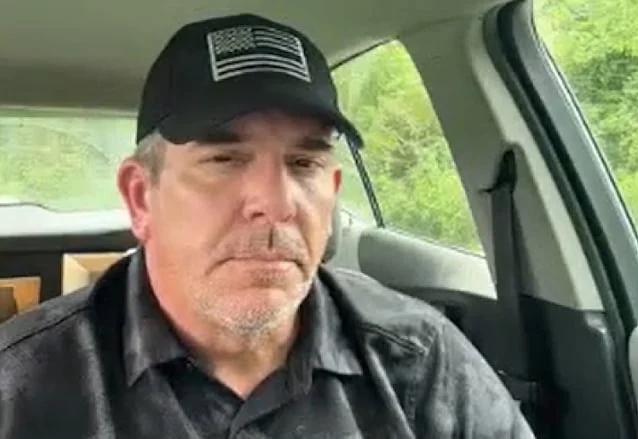
In a poignant and candid interview with Bill Bailey on the Today’s Boondoggle Podcast, James Niggemeyer, the former Columbus, Ohio police officer whose decisive actions on December 8, 2004, are credited with preventing further loss of life, has revisited the harrowing incident that ended his career. Niggemeyer, who famously entered the Alrosa Villa nightclub alone and without backup to confront a gunman, shared profound insights into the events of that night and the lasting emotional toll it exacted. His account offers a stark look at the courage required in the face of extreme violence and the often-unseen consequences for those who serve on the front lines of public safety.
Niggemeyer recounted how, after three years of continuing his patrol duties following the tragic events, the city of Columbus, acting on medical advice, ultimately determined that he could no longer serve as a first responder. The emotional burden of the night, particularly the direct confrontation with the perpetrator and the witnessed aftermath, proved too significant. Consequently, he was transferred to the robbery section, transitioning to a role as a detective. This shift, while a testament to his continued dedication to law enforcement, marked a profound change in his professional life, directly stemming from the singular event that defined his public service.
The Call to Action: A Solitary Response
The fateful call came in just before 10:15 p.m. on December 8, 2004. Niggemeyer, whose shift commenced at 10 p.m., was preparing to depart the substation. His assigned district, being the most remote from the substation, necessitated an earlier departure to account for his longer commute. This personal routine inadvertently placed him as the first officer to leave the substation that evening, a fact that would become critically significant as the unfolding tragedy at the Alrosa Villa demanded an immediate, unassisted response.
"When that call went out as an active shooter at the Alrosa Villa," Niggemeyer recalled, "I had happened to already have left the substation." His standard procedure of leaving early to manage his longer drive meant he was already en route when the dispatch for an active shooter at the Alrosa Villa was broadcast. This timing, he explained, was crucial.
Niggemeyer also detailed the specific armament he carried that evening. "I carried a Remington 870 shotgun across my cruiser," he stated. This particular weapon was not standard issue for all officers; only two cruisers in the precinct were equipped with them. The rationale behind this was tied to the nature of their patrol districts. Niggemeyer’s district, being more rural, frequently encountered situations requiring the use of a shotgun, such as putting down injured deer resulting from vehicle accidents. In contrast, officers in more urban sectors had less need for such a firearm. The Remington 870 held personal significance for Niggemeyer, having been the shotgun he used for hunting since he was 12 years old. This deep familiarity and proficiency with the weapon played a pivotal role in his actions. "I knew that gun inside and out," he emphasized. "So a lot of people ask me, ‘Why’d you use a shotgun instead of your pistol?’ Well, one, I’m more familiar with the shotgun, and two, I’m better shot with the shotgun. So that’s a question I get asked a lot." This statement underscores the calculated decision-making process under duress, rooted in years of experience and trust in his chosen tool.
The Descent into Chaos: Entering the Alrosa Villa
Upon arriving at the Alrosa Villa, Niggemeyer found himself the sole law enforcement officer on the scene. The initial reports had indicated an active shooter, but the full scope of the horror was yet to be revealed. "When I got [to Alrosa Villa] and was the only officer there, there were fans telling me where to go," he said. Unfamiliar with the nightclub’s layout, he relied on the directions provided by the panicked patrons.
He entered the building through the rear door, a decision that led him directly into a critical juncture of the unfolding massacre. "And I saw the hostage in there, or the suspect in there holding a hostage," Niggemeyer recounted. "We didn’t know he was holding a hostage. That had not come out on the radio." This detail highlights the critical information gap that existed in the initial moments of the response. The suspect, identified as Ian "Dimebag" Darrell Abbott’s killer, Nathan Gale, was still armed and brandishing his weapon.
The ensuing moments were characterized by an intense focus, a phenomenon Niggemeyer described as "tunnel vision." "But between hunting my whole life and military and police training, it was just a culmination of everything I had been through in my life," he explained. "And you hear the words ‘tunnel vision’, but it was true – I had true tunnel vision. Literally, everything was black except for the suspect and the hostage. It was a true tunnel vision. I literally didn’t hear or see anything else. I can’t even tell you what people were screaming." This visceral description illustrates the heightened state of awareness and the selective sensory processing that can occur during extreme stress.
Niggemeyer attributed his ability to act decisively to this confluence of life experiences. "Training – in the police department, we had just done active shooter training a couple of months prior," he noted. However, he acknowledged a critical difference between the training scenarios and the reality he faced. "Of course the active shooter training we had did, we had did it with groups of four, not on our own." The reality of being the sole responder in such a dire situation was a stark departure from the simulated environments.
The presence of the hostage significantly influenced his immediate decision to engage. "But I don’t know if the situation would’ve been different had he not been holding a hostage," Niggemeyer mused. "But because he was holding a hostage and he had the hostage in a headlock, I just felt like I couldn’t sit and wait on backup." The imminent threat to the hostage’s life, coupled with the absence of immediate backup, created a critical decision point. "So, yeah, it was just a lifetime culmination. And I knew that weapon really well and what it was capable of doing." His proficiency with the Remington 870 and the immediate threat to life propelled him to act, a decision he has never regretted.
The Aftermath: Realization and Recognition
The immediate aftermath of the incident was a blur of official procedure and escalating news. "It wasn’t till after [that I found out], because, like I said, we had just left roll calls and I had never been [at the Alrosa Villa]," Niggemeyer stated when asked about his awareness of the victim’s identity. He had no prior knowledge of the band performing that night, nor a particular affinity for the genre of music. "I grew up in the country. I was more of a country music fan, more what my family listened to – my dad, my grandparents – and more classic rock, I call it, which would be your AC/DC’s and SCORPIONS and FOREIGNER’s and then more music in the ’80s and ’90s-type rock. So I was never a metal fan, but I had heard of PANTERA, METALLICA, things of that nature."
His focus was solely on the immediate threat and the subsequent investigative process. "When it was all over with, an officer took my gun from me for evidence, and then I was escorted into a cruiser and then I was actually driven away from the scene," he described. His direct involvement at the scene was brief, lasting "probably… not more than two minutes after it was over with."
The realization of the victim’s identity, and the profound impact of that identity on the music world, came gradually. "And it wasn’t until probably, I’d say maybe a half hour after the incident to when I found out who was shot that night. It was just through radio chatter that I had heard it," Niggemeyer explained. The news quickly spread globally, with cell phones and media outlets confirming the identity of the slain musician. "And then, of course we all had cell phones and things, and it was breaking news worldwide. So, yeah, no clue until maybe a half hour after." The magnitude of Dimebag Darrell Abbott’s stature within the metal community was a revelation that followed the immediate crisis.
The Lingering Scars: A Career Cut Short
The two decades since the Alrosa Villa shooting have been a period of profound personal reckoning for James Niggemeyer. While he had experienced traumatic events during his military service, including witnessing a fatal accident during training, and had responded to numerous violent scenes as a police officer, the act of taking a life marked a distinct turning point. "This was the first time that – ending a person’s life, you don’t know how it’s gonna affect you," he confessed.
The psychological impact was severe. "I was hospitalized for panic attacks. That was the thing that got me the most, was the panic attacks, and then the constant nightmares," he revealed. The inability to disengage from the trauma was palpable. "It really took me a long time that my brain just wouldn’t shut down." He described debilitating episodes: "I’d just be here on a normal day, like talking to you, and I’d just go into a full-blown panic attack, and I couldn’t breathe."
These mental health struggles inevitably manifested physically, leading to his medical retirement from the police department. "So, yeah, it ended my career, something that I did, everybody tells me extremely well, ended up ending my career," he stated, a note of wistful resignation in his voice. Despite the personal cost, his conviction remains unwavering. "But I don’t regret it for a minute. I’m glad I was able to stop him before a lot more people were hurt."
Niggemeyer acknowledged the destabilizing effect the incident had on his life. "But it certainly didn’t… It kind of set my life on a spiral. But that’s part of the job. You sign up for it. You just have to deal with it, I guess." His candid admission offers a rare glimpse into the enduring challenges faced by law enforcement officers and military personnel who have been directly involved in life-or-death situations.
A Chronology of the Alrosa Villa Tragedy
- December 8, 2004, shortly after 10:00 p.m.: Multiple panicked 911 calls begin to flood dispatchers, reporting an active shooter at the Alrosa Villa nightclub in Columbus, Ohio.
- During a DAMAGEPLAN concert: A man, later identified as Nathan Gale, storms the stage and opens fire on the band. Seven individuals are wounded, and four are killed in the initial assault, including guitarist "Dimebag" Darrell Abbott.
- Minutes after the first 911 call: Officer James Niggemeyer, patrolling nearby, becomes the first responder to arrive at the scene.
- Niggemeyer’s entry: He enters the nightclub through the rear entrance.
- Additional officers arrive: Five more officers arrive shortly after Niggemeyer and enter through side doors.
- Scene description: Reports indicate dead and wounded individuals on the floor, ongoing gunfire, and hundreds of patrons attempting to flee.
- Niggemeyer locates the gunman: He spots the suspect, Nathan Gale, near the rear of the stage.
- Hostage situation develops: Gale retreats from other approaching officers and takes a hostage, immobilizing him in a headlock and holding a gun to his temple. This critical development was not initially broadcast over police radio.
- Niggemeyer’s engagement: Positioned approximately 20 feet from the suspect, Niggemeyer, armed with his Remington 870 shotgun, fires a single, well-aimed shot.
- Immediate cessation of violence: The shot instantly kills the gunman, ending the active threat. Gale was found to be carrying 35 rounds of ammunition at the time of his death.
- Post-incident: Evidence from Niggemeyer’s shotgun is collected. He is escorted from the scene by fellow officers.
- Discovery of victim’s identity: Approximately 30 minutes after the incident, Niggemeyer learns through radio chatter and subsequent breaking news that "Dimebag" Darrell Abbott was among the fatalities.
- Years following the incident: Niggemeyer continues his police career for three years but is medically retired due to the psychological toll, including panic attacks and severe nightmares.
Broader Implications and Societal Impact
The tragic events at the Alrosa Villa in 2004 serve as a stark reminder of the unpredictable nature of violence and the immense bravery of first responders. Officer Niggemeyer’s account highlights the critical role of individual decision-making in high-stakes situations, often made under conditions of extreme duress and with incomplete information. His story also brings to the forefront the often-overlooked psychological burden carried by those who confront such violence directly.
The fact that Niggemeyer, despite his heroic actions, was unable to continue his career as a first responder underscores the profound and lasting impact of traumatic events. His experience resonates with a broader understanding of Post-Traumatic Stress Disorder (PTSD) and the challenges faced by individuals in professions that routinely expose them to life-threatening scenarios. The medical retirement, while a consequence of his trauma, also represents a system’s recognition of the limits of human endurance in the face of extreme psychological stress.
The support Niggemeyer received, including messages from "Dimebag" Darrell Abbott’s fans and a letter from the gunman’s mother expressing understanding, speaks to the complex human emotions that surround such tragedies. The mother’s communication, in particular, illustrates a profound empathy and recognition of Niggemeyer’s difficult position, highlighting a shared grief and an understanding that his actions were taken within the context of his duty.
The legacy of that night is multifaceted. It is a testament to the courage of Officer James Niggemeyer, whose decisive action undoubtedly saved lives. It is also a somber reflection on the devastating consequences of gun violence and the long-term, often invisible, scars it leaves on individuals and communities. Niggemeyer’s willingness to share his story, despite the pain it evokes, contributes to a vital public discourse on mental health, the sacrifices of law enforcement, and the enduring need for support systems for those who serve. The incident remains a significant point of reference in discussions about active shooter response protocols and the psychological well-being of first responders.
