

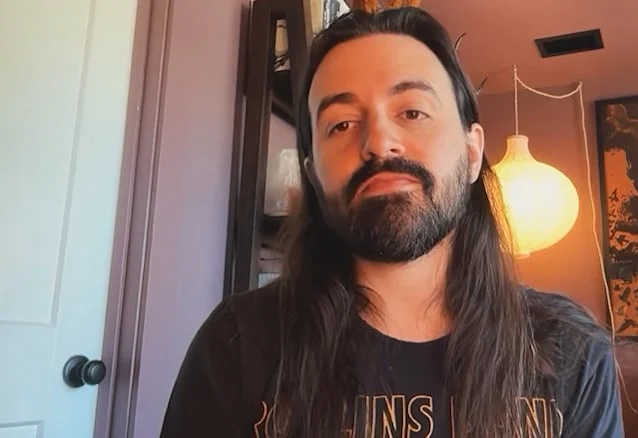
In a candid interview with Bryce Maopolski, development manager for HeartSupport, a nonprofit dedicated to providing music-based mental health support, former Slipknot drummer Jay Weinberg has detailed his profound journey of recovery and emotional healing following his unexpected dismissal from the iconic metal band in November 2023. The conversation, facilitated by the organization known for its work within the music scene, offered a deeply personal look into Weinberg’s experience of navigating a significant life transition while grappling with both professional upheaval and physical recovery.
Weinberg, who had been a formidable presence behind the drum kit for Slipknot since 2013, described his emotional state at the time of his departure as feeling like a "tangled ball of rusted barbed wire." This vivid metaphor underscored the intense internal struggle he faced. He emphasized the crucial role of seeking professional help, acknowledging his need for expertise and guidance to navigate the complexities of his situation. "Needing the expertise that I didn’t have for sure, the know-how, the ability to see life on a trajectory that brought some or that maybe quelled some anxieties and frustrations or that challenge or whatever and live a more peaceful, happy life, all of that I viewed as the center of what was gonna require untangling that rusted over ball of barbed wire," Weinberg shared.
His proactive approach to mental well-being led him to seek therapy in Tennessee, where he resides. This wasn’t his first foray into therapy; he recalled a previous experience in his early twenties on the East Coast that, while somewhat helpful, didn’t feel like a perfect fit. However, his renewed commitment to seeking support in late 2023 and early 2024 proved to be a turning point. A significant catalyst in this process was the suggestion of a trusted friend, who also happened to be the officiant at his wedding. This deep personal connection fostered a sense of comfort and trust, allowing Weinberg to openly communicate his need for assistance during what he described as a "particularly challenging" period. The therapist recommended by his friend ultimately provided the breakthrough he had been seeking, described as an "unlocking of a door, like a door that I’d tried many keys trying to open and it just wouldn’t."
The drummer stressed the importance of perseverance in his search for professional help. He noted that the initial search for a mental health professional might not always yield immediate results, but he found that "keeping at it" was instrumental. He now maintains a weekly therapy session, which he credits with significantly aiding him in "sorting through thoughts, sorting through those challenging things and processing events and life circumstances that are difficult to process, to make sense of." This ongoing process is particularly vital in moments when life feels incomprehensible, preventing individuals from feeling isolated or "crazy."
Navigating Life’s Complexities: Professional Upheaval and New Beginnings
Weinberg’s candid reflections extend beyond his professional departure. He also spoke about the concurrent arrival of significant life changes, most notably becoming a parent for the first time a few months prior to the interview. He acknowledged that this joyous event brings a "whole new angle to life," a sentiment he had anticipated based on the experiences of other parents. This juxtaposition of professional loss and the profound responsibilities of new parenthood highlights the multifaceted nature of his personal evolution.
He also addressed the inherent pressures faced by artists, particularly musicians, who regularly expose themselves to public scrutiny. "As artists, as musicians, of putting yourself on display for critique, for judgment, for all those things that being an artist, you kind of open your life up to," he explained. This realization, coupled with an admission that he doesn’t possess all the answers naturally, has led him to embrace seeking support from his community and trusted individuals during challenging times. This approach allows him to process his thoughts and life events with greater ease and thoroughness, even if it doesn’t provide immediate solutions to life’s inherent difficulties.
The Confluence of Physical and Emotional Recovery
Adding another layer of complexity to his transitional phase, Weinberg underwent outpatient surgery in November 2023 to repair a torn labrum in his left hip and address a misshapen part of his femur. This physical rehabilitation occurred mere weeks after his dismissal from Slipknot. He described the experience of being on his couch, recovering from surgery, and simultaneously processing his professional departure as an immense "mental and physical grind."
"When you find yourself in a transitional phase, especially in my life, especially having a significant transitional phase occur at the same time as I had to have a physical surgery to correct some issues.," he stated. "And I had hip surgery and was on my couch with my thoughts alone, to endure all of that concurrently was… I mean, talk about a mental and physical grind every moment of every day just to feel like a normal person."
This period of concurrent physical and emotional recovery, though arduous, proved to be a significant learning experience. Weinberg views his current state not as one of complete resolution, but as an ongoing commitment to health and well-being. "None of this is, like, ‘I’m fixed and I’m all better.’ I just view it as this is part of being a healthy person, of tending to not just the physical rigors of what it is that I enjoy putting myself through," he remarked.
A Decade with Slipknot: A Retrospective
Jay Weinberg joined Slipknot in 2013, stepping into the significant role of drummer, succeeding the band’s original and highly influential drummer, Joey Jordison. His tenure with the band spanned three studio albums: " .5: The Gray Chapter" (2014), "We Are Not Your Kind" (2019), and "The End, So Far" (2022). All three albums achieved considerable commercial success, with the latter two topping Billboard’s rock albums chart. " .5: The Gray Chapter" also garnered three Grammy nominations.
Weinberg’s discovery of Slipknot occurred during his pre-teen years, a passion ignited by his father. His admiration for the band was so profound that the opportunity to audition as Joey Jordison’s replacement in Los Angeles was a momentous occasion. For the initial months following the release of " .5: The Gray Chapter," Slipknot deliberately withheld the identities of their touring drummer and bassist, a move that was eventually revealed by a former drum technician.
Prior to his decade-long commitment to Slipknot, Weinberg honed his drumming skills with notable bands such as Against Me! and Madball, showcasing a diverse range of musical experience.
The Official Statement and Immediate Aftermath
The official announcement of Jay Weinberg’s departure from Slipknot came on November 5, 2023, via a brief statement on social media. The band stated, "we have decided to make a creative decision and to part ways with Jay." This announcement was met with considerable surprise and speculation within the fan base.
Six days later, on November 11, 2023, Weinberg broke his silence on Instagram, expressing his profound shock and disappointment. He revealed, "I was heartbroken and blindsided to receive the phone call," adding that the news of his departure was learned by most fans shortly after he did. His final performance with the band took place on November 3, 2023, at the Hell & Heaven festival in Toluca, Mexico, marking the end of an era for both the musician and the band.
In February 2024, Slipknot announced the recruitment of Eloy Casagrande, formerly of Sepultura, as their new drummer, solidifying the lineup for their future endeavors.
The Broader Implications for Artists and Mental Health
Jay Weinberg’s open discussion about his mental health journey, particularly in the context of a high-profile band departure, carries significant weight. It underscores the often-unseen emotional toll that professional transitions can have on individuals, especially those in the public eye. His experience with HeartSupport highlights the growing importance of specialized organizations that cater to the mental well-being of individuals within the music community, a sector that frequently faces unique pressures.
The narrative also serves as a powerful testament to the efficacy of seeking and engaging with mental health support, even when the initial search proves challenging. Weinberg’s willingness to share his vulnerability and his strategies for coping with difficult circumstances can serve as an inspiration and a point of reference for others facing similar adversies. His emphasis on the ongoing nature of mental health care, rather than viewing it as a finite fix, aligns with contemporary understanding of psychological well-being as a continuous practice.
Furthermore, his reflections on the pressures of artistic performance and public judgment offer a valuable perspective on the psychological landscape of creative careers. By normalizing the need for external support and acknowledging the complexities of life’s unpredictable events, Weinberg contributes to a broader conversation about resilience, self-care, and the importance of community in navigating life’s inevitable challenges. The concurrent experience of physical recovery and professional upheaval, while intensely difficult, ultimately provided him with a profound understanding of holistic well-being and the interconnectedness of mind and body. This journey, as he articulates, is not an endpoint but an integral part of his ongoing practice of living a healthy and fulfilling life.
