

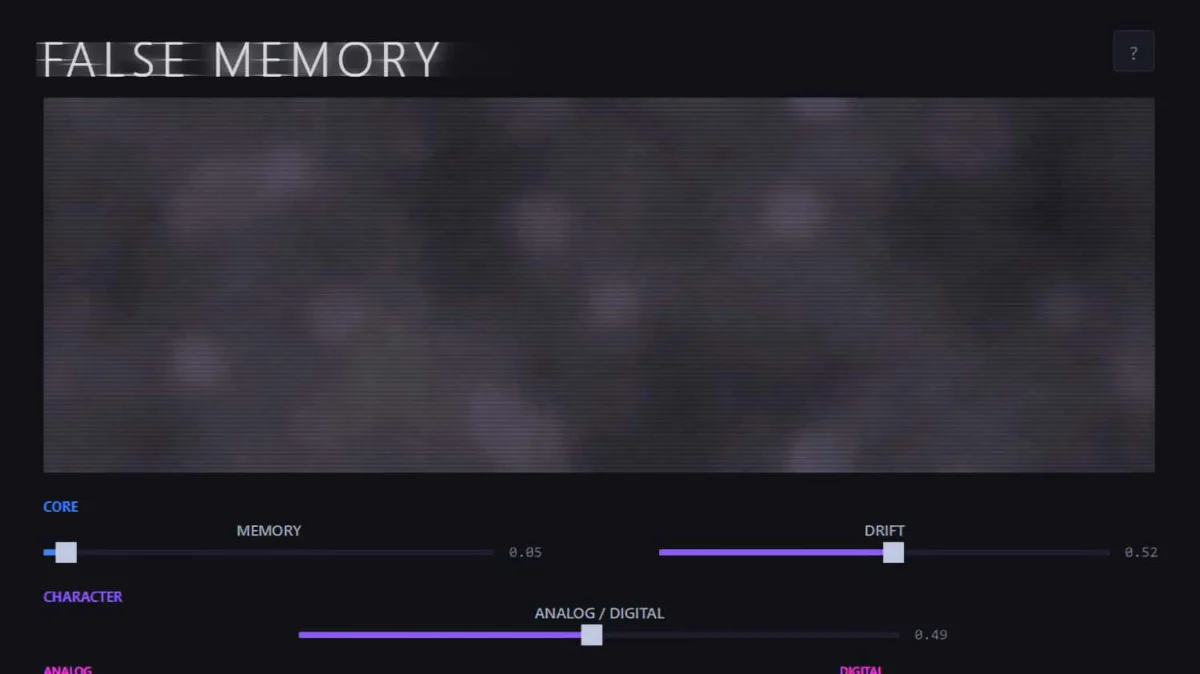
The digital audio workstation (DAW) ecosystem has seen a significant shift toward tools that prioritize character and organic instability over clinical perfection. Joining this movement, developer All The Machines has officially released False Memory, a specialized effects plugin designed to emulate the progressive degradation of audio signals in real time. Available across macOS, Windows, and iOS, the tool represents a bridge between traditional analog saturation and modern digital artifacting, offering sound designers and music producers a streamlined interface for complex sonic destruction.
False Memory functions primarily as an "audio disintegration" engine. Unlike standard distortion or bit-crushing plugins that apply a static layer of grit, False Memory is engineered to simulate the temporal and physical decay of sound. The plugin utilizes a dual-path architecture that allows users to blend between two distinct philosophies of degradation: an analog-modeled path and a digital-modeled path. This hybrid approach caters to the growing demand for "lo-fi" aesthetics in genres ranging from ambient and vaporwave to industrial and experimental film scoring.
Technical Architecture and Processing Engines
The core of False Memory lies in its parallel processing paths. The developer has implemented a single "Analog/Digital" control that acts as a crossfader between these two internal engines. This design choice simplifies the user experience while hiding a complex set of DSP (Digital Signal Processing) operations beneath the surface.
The analog path focuses on the imperfections inherent in physical media, such as magnetic tape and vintage circuitry. This includes non-linear saturation, low-pass filtering that mimics the loss of high-frequency fidelity over time, and the introduction of harmonic warmth. Conversely, the digital path explores the aesthetic of "failure" in the digital realm. This involves quantization errors, aliasing, and the stuttering artifacts associated with low-bitrate data compression or failing hardware buffers.
By blending these two engines, users can create "impossible" textures—sounds that possess the warmth of an aging cassette tape but are simultaneously fractured by digital glitches. This versatility is a hallmark of the All The Machines design philosophy, which emphasizes the creative potential of signal error.
Deep Dive into Control Parameters
Beyond the central blend control, False Memory provides a suite of parameters designed to fine-tune the "disintegration" effect. Each control is mapped to specific behavioral traits of decaying audio:
-
Pitch Drift: This parameter simulates the mechanical instability of playback devices. In the analog domain, this mimics "wow and flutter"—the subtle (or extreme) pitch fluctuations caused by uneven motor speeds in tape machines or turntables. In the digital context, it can introduce jitter-like instabilities that unsettle the harmonic foundation of the input signal.
-
Degradation Intensity: This acts as the primary "drive" for the disintegration process. At lower settings, it adds a subtle patina of age; at higher settings, it can completely erode the source material until it is unrecognizable, leaving behind only the rhythmic or melodic ghost of the original audio.
-
Spectral Smearing: One of the more advanced features of the plugin, spectral smearing uses FFT (Fast Fourier Transform) processing to blur the boundaries between frequencies. This creates a "washy" effect similar to extreme reverb or the sound of audio being stretched beyond its limits. It is particularly effective for turning percussive hits into atmospheric pads.
-
Residual Echoes: To provide a sense of space and temporal persistence, False Memory includes a specialized delay module. These are not standard clean delays; they are integrated into the degradation loop, meaning each successive echo becomes more degraded than the last. This creates a feedback loop of decaying sound that mirrors the "disintegration loop" techniques popularized by ambient composers like William Basinski.
-
Evolving Processing and Randomization: To avoid the "static" feel that often plagues digital effects, the plugin includes an evolving processing engine. This introduces slow-moving modulations that ensure the effect changes over time, preventing the human ear from identifying a repeating pattern. For users seeking instant inspiration or chaotic results, a parameter randomization feature allows for the generation of entirely new presets with a single click.

The Context of Audio Degradation in Modern Music
The release of False Memory occurs during a period where "imperfection" has become a valuable currency in music production. For much of the 1990s and 2000s, the goal of digital audio development was the elimination of noise, distortion, and pitch instability. However, as high-fidelity digital recording became the baseline standard, many artists began to find the results "sterile" or "lifeless."
This led to the rise of the "lo-fi" movement, which reclaimed the flaws of older technology as artistic choices. Tools like False Memory are the technological response to this cultural shift. By providing a controlled environment for "audio disintegration," All The Machines allows producers to apply the aesthetics of decay without the logistical hurdles of maintaining vintage hardware or the unpredictability of actual failing digital systems.
From a musicological perspective, the title "False Memory" suggests a preoccupation with nostalgia—the idea that our recollection of the past is often blurred, filtered, and distorted. The plugin serves as a literal tool for this metaphor, allowing a clear, modern recording to be "aged" instantly, imbuing it with a sense of history or "hauntology."
Market Positioning and Accessibility
All The Machines has taken a dual-pronged approach to the release of False Memory, targeting both the professional desktop market and the burgeoning mobile music production scene. The pricing structure reflects a commitment to accessibility:
- iOS Version: Priced at $3.99, the iOS version is available on the Apple App Store. It supports standalone operation as well as the AUv3 (Audio Unit v3) format, which allows it to be hosted within mobile DAWs such as AUM, Cubasis, and Loopy Pro.
- Desktop Version: Priced at €19, the macOS and Windows versions are available directly from the developer’s website. These are provided in standard native plugin formats (VST3, AU, AAX), ensuring compatibility with industry-standard software like Ableton Live, Logic Pro, and FL Studio.
The significant price difference between the mobile and desktop versions is a common trend in the industry, reflecting the different economic expectations of the App Store versus the professional plugin market. However, even at €19, the desktop version is positioned as a "boutique" affordable utility, making it an easy addition for producers looking to expand their sound design palette without a major financial investment.
Broad Implications for Sound Design and Post-Production
While primarily marketed toward musicians, False Memory has significant implications for film and game sound design. The ability to "smear" and "disintegrate" audio is a vital tool for creating tension in horror soundscapes, representing memory loss or psychological distress in cinematic narratives, or simulating damaged communication devices in science-fiction settings.
The "evolving processing" feature is particularly relevant for long-form media. In a film score, a static effect can become fatiguing; a plugin that subtly shifts its character over the course of several minutes provides a more "living" and immersive background. Furthermore, the inclusion of parameter randomization allows sound designers to quickly generate variations of a sound, which is essential for "folly" work and environmental textures in game development.
Chronology of Development and Future Outlook
All The Machines has established a reputation for creating tools that explore the fringes of digital signal processing. The development of False Memory follows a lineage of "character-focused" effects that prioritize vibe over transparency. While the developer has not released a formal roadmap for future updates, the current architecture of the plugin allows for potential expansions, such as additional "disintegration models" (perhaps focusing on vinyl or optical sound) or more complex modulation routing.
The release also highlights the continuing maturity of the iOS music ecosystem. By releasing the plugin simultaneously on mobile and desktop, All The Machines acknowledges that the "iPad musician" is no longer a niche hobbyist but a professional user who expects the same high-quality DSP available on a workstation.
Conclusion and Fact-Based Analysis
False Memory by All The Machines enters a competitive market of "lo-fi" and "degradation" plugins, standing alongside established tools like XLN Audio’s RC-20 Retro Color or iZotope’s Vinyl. However, its specific focus on "disintegration"—the progressive and temporal decay of sound—sets it apart from tools that simply add a layer of noise.
The technical implementation of parallel analog and digital paths provides a wide range of utility, while the aggressive pricing on iOS makes it an impulse-buy for mobile producers. In a broader sense, the plugin reflects a continued industry-wide fascination with the "ghosts" of analog technology and the unique, fractured beauty of digital error. As music production continues to move toward a "hybrid" future, tools that can convincingly bridge the gap between the organic past and the digital present, like False Memory, are likely to remain staples in the modern producer’s toolkit.
The plugin is currently available for purchase and download, marking a new chapter for All The Machines as they continue to refine their approach to creative audio destruction. Factual data regarding system requirements and specific DAW compatibility can be found on the developer’s official website, ensuring that users across all major platforms can integrate this "audio disintegration" effect into their existing workflows.
