

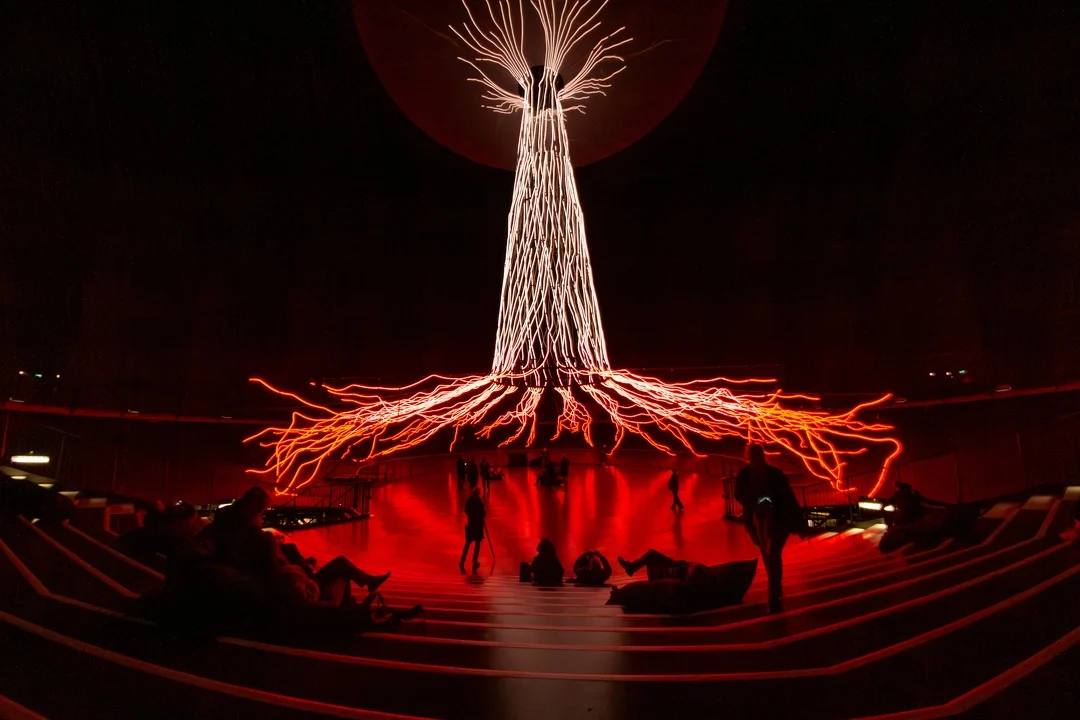
The Gasometer Oberhausen, Europe’s highest exhibition hall, has officially transitioned from the depths of the sea to the heights of the forest canopy with the launch of its latest landmark exhibition, Mythos Wald (Myth of the Forest). Following the unprecedented success of the Planet Ocean showcase, which drew more than 1.5 million visitors during its run, the industrial-monument-turned-cultural-hub has debuted a new immersive centerpiece titled Der Baum (The Tree). Developed by the renowned Linz-based creative studio Ars Electronica Solutions, this 35-meter-tall light and sound sculpture serves as the emotional and intellectual heart of the exhibition, which opened its doors to the public on March 20, 2026.
Designed to make the invisible biological processes of nature visible to the human eye, Der Baum represents a significant leap in the fusion of ecological science and digital art. The installation occupies the vast interior volume of the Gasometer, a structure that stands 117.5 meters tall and once served as a storage facility for blast furnace gas. By placing a monumental, glowing representation of a living organism within this steel industrial shell, the curators aim to provoke a dialogue regarding the relationship between human industry and the natural world.
A Technical and Artistic Marvel in the Ruhr Valley
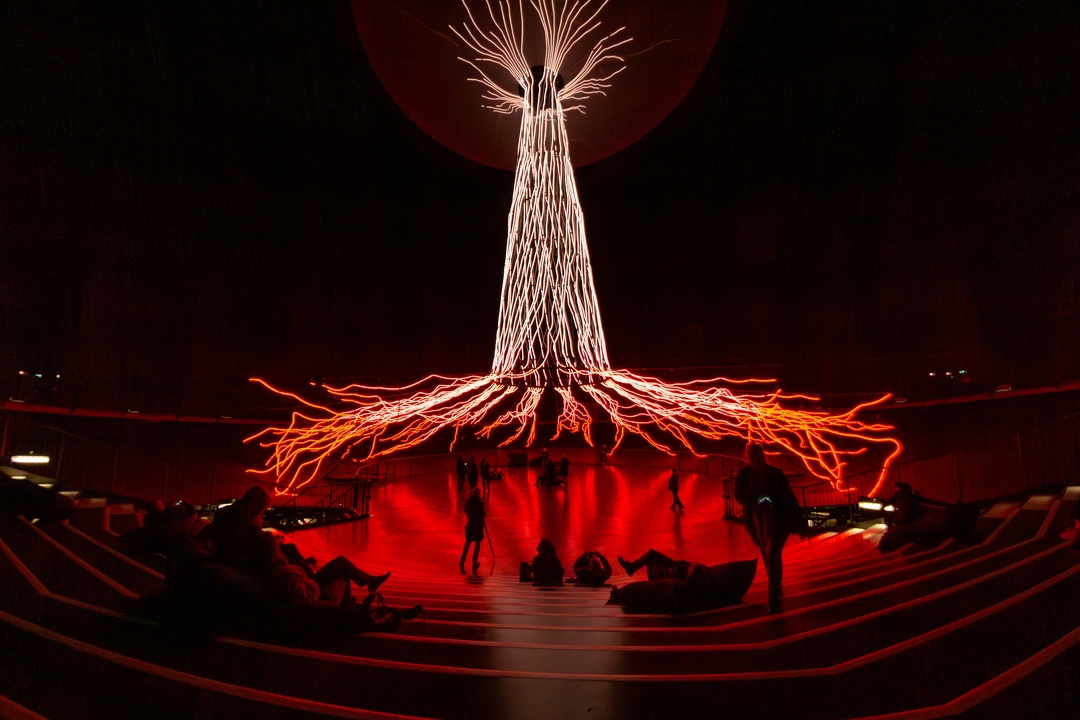
The scale of Der Baum is designed to match the cathedral-like proportions of the Gasometer. Standing at 35 meters, the installation is a complex lattice of light and matter that traces the anatomy of a tree from its subterranean root system to the delicate tips of its crown. The structure is composed of hundreds of meters of LED light strands that form a translucent, glowing skeleton of a tree. This skeletal framework is not merely a static sculpture but a dynamic medium for a 15-minute choreographed performance that cycles through various stages of a tree’s life and seasonal shifts.
One of the most technically sophisticated elements of the installation is the "canopy," which is shrouded in a specialized gauze. This material serves as a projection surface, allowing digital imagery to blend seamlessly with the physical LED structure. Through high-resolution projections, the "branches" appear to grow leaves, catch the glint of sunlight, or become heavy with digital snow. The integration of light, projection, and physical form creates a volumetric effect that allows visitors to feel as though they are standing inside a living, breathing organism.
The sensory experience is further heightened by a bespoke musical score composed by the acclaimed pianist and composer Rupert Huber. Huber, a long-time collaborator with Ars Electronica, designed the soundscape to harmonize with the visual chapters of the installation. The music utilizes the unique acoustics of the Gasometer—known for its long reverberation times—to create an atmospheric depth that underscores the themes of growth, connectivity, and environmental fragility.
Navigating the Exhibition: From Roots to Canopy
The narrative journey of Der Baum is divided into several thematic chapters, each lasting a few minutes. The experience begins at the base of the structure, where visitors are invited to explore the intricate root system. In nature, the "Wood Wide Web"—the complex fungal and root networks that allow trees to communicate and share nutrients—is hidden beneath the soil. Ars Electronica Solutions has brought this hidden world to the surface, using pulsing light patterns to simulate the flow of information and energy through the roots.
As the cycle progresses, the light travels upward through the trunk, mimicking the transpiration process where water and minerals move toward the leaves. One of the highlight chapters is titled Komorebi, a Japanese term that describes the phenomenon of sunlight filtering through the leaves of trees. During this segment, the installation bathes the interior of the Gasometer in warm, golden hues, while rapid flashes of light through the upper branches simulate the flickering of sunbeams on a summer afternoon.
Other chapters shift the atmosphere to reflect the stillness of a moonlit forest or the stark beauty of a winter landscape. By manipulating color palettes—from deep greens and earthy browns to ethereal blues and stark whites—the installation provides a comprehensive emotional survey of the forest’s various moods. This perspective, looking from the inside of the roots up toward the sky, offers a vantage point that is physically impossible in a natural forest, effectively using technology to enhance human perception of biological reality.
Scientific Foundation and Global Context
While Der Baum serves as the artistic focal point, the broader Mythos Wald exhibition provides the scientific and global context necessary to understand the current state of the world’s forests. Curator Jeanette Schmitz, who also serves as the Managing Director of Gasometer Oberhausen GmbH, emphasized that the exhibition is intended to be more than just a visual spectacle. According to Schmitz, the goal is to foster a deeper awareness of the Earth’s condition and to make complex ecological topics tangible for a broad audience.

The exhibition features extensive photographic and cinematic documentation of forest ecosystems across the globe. Key regions highlighted include:
- The Amazon Basin (Brazil): Focusing on the "lungs of the planet" and the critical role these rainforests play in global carbon sequestration and weather patterns.
- The Congo Basin: Exploring the biodiversity of Africa’s largest forest and the unique species that inhabit its dense interior.
- European Temperate Forests: Examining the history of forestry in the West, the impact of industrialization, and current efforts toward reforestation and rewilding.
Beyond biology, Mythos Wald explores the sociological and cultural dimensions of the forest. This includes the habitats of indigenous peoples who have lived in harmony with these ecosystems for millennia. By juxtaposing the indigenous understanding of the forest as a sacred, living entity with the modern industrial view of the forest as a resource, the exhibition encourages visitors to participate in a vital societal debate about sustainability and conservation.
The Gasometer as a Symbol of Transformation
The choice of the Gasometer Oberhausen as the venue for such an exhibition is deeply symbolic. For much of the 20th century, the Ruhr area was the industrial heart of Germany, defined by coal, steel, and heavy energy consumption. The Gasometer was a functional part of that machine. Today, the building’s transformation into a premier space for ecological art mirrors the region’s broader transition toward a post-industrial, green economy.
The installation Der Baum redefines the concept of "energy" within these steel walls. Where the building once stored gas to power industry, it now "stores" a digital representation of biological energy. As the curators noted, the installation presents energy not as a commodity to be extracted, but as a vibrant network of relationships between soil, water, light, and life. This shift in perspective is central to the exhibition’s message: that humanity must move from a model of exploitation to one of interconnectedness.
Impact and Future Implications
The success of the previous Planet Ocean exhibition has set a high bar for Mythos Wald. With over 1.5 million visitors, the Gasometer has proven that there is a massive public appetite for "edutainment"—exhibitions that combine high-level scientific information with immersive, Instagram-ready artistic experiences. Market analysts suggest that the "experience economy" in the cultural sector is increasingly driven by these large-scale, tech-integrated installations.
For Ars Electronica Solutions, Der Baum represents another milestone in their mission to bring "Deep Space" technology and artistic sensibilities into public spaces. Based in Linz, Austria, the organization has spent decades at the intersection of art and technology. This project in Oberhausen demonstrates their ability to scale their work to monumental proportions, creating an experience that is both intimate in its detail and overwhelming in its size.
Early reactions from environmental groups and educational institutions have been positive. Educators have noted that the immersive nature of the installation helps younger generations connect with environmental themes that can often feel abstract or overwhelming when presented solely through statistics or news reports. By placing the visitor literally "inside" the tree, the installation fosters a sense of empathy and wonder that is essential for long-term ecological engagement.
Conclusion
Mythos Wald and its centerpiece, Der Baum, are scheduled to run through the end of the year, with various educational programs, lectures, and guided tours planned to supplement the visitor experience. As the global community grapples with the accelerating effects of climate change and biodiversity loss, exhibitions like this serve as crucial touchstones. They remind the public of the beauty and complexity of the natural systems that sustain life on Earth, while simultaneously demonstrating how human creativity and technology can be used to celebrate, rather than destroy, the environment.
In the silent, cavernous space of the Gasometer, the glowing 35-meter tree stands as a beacon of this potential harmony. It is a reminder that while the industrial age may have left behind massive steel skeletons, the future belongs to those who can re-envision those spaces as sanctuaries for the natural world and the "Myth of the Forest."
