

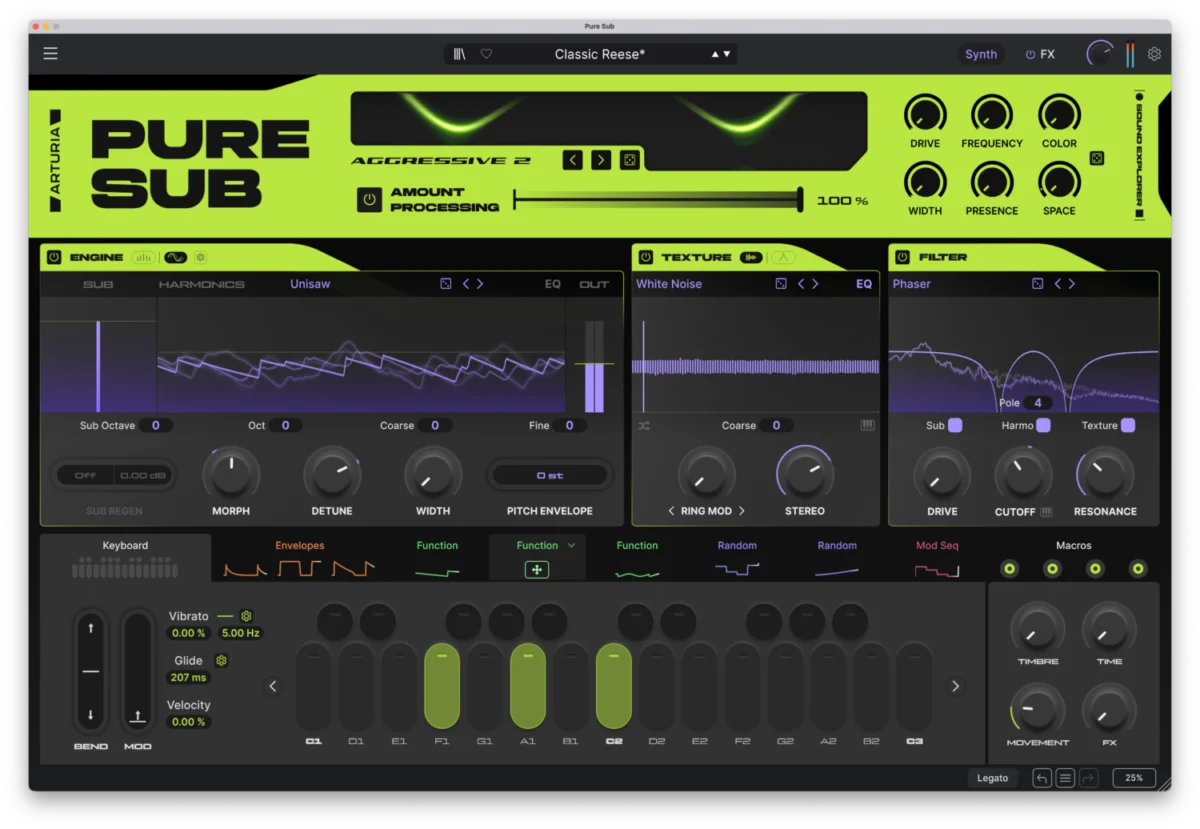
Arturia has officially announced the release of Pure Sub, a specialized software synthesizer engineered to meet the rigorous demands of contemporary low-end sound design. This new instrument enters a competitive market of virtual studio technology (VST) by focusing exclusively on the foundational elements of modern music: the sub-bass. By streamlining the complexities of low-frequency synthesis into a dedicated interface, Arturia aims to provide producers with a tool capable of generating everything from the clean, foundational 808-style hits found in hip-hop to the aggressive, modulated Reese basses prevalent in drum and bass and industrial techno. The release marks a strategic expansion of Arturia’s software lineup, moving away from the sprawling versatility of their flagship Pigments synthesizer toward a more focused, task-oriented utility.
The Architecture of Low-End Precision
The internal architecture of Pure Sub is predicated on a three-stage signal path, a design choice intended to give producers granular control over the different layers of a bass sound. This "tri-stage" approach separates the signal into Sub, Harmonics, and Texture modules. Each stage operates independently before being summed through a comprehensive processing chain, allowing for a level of clarity often lost when using traditional subtractive synthesizers for bass duties.
The Sub stage focuses on the fundamental frequency, providing the "weight" of the sound. Producers can choose from various waveforms, primarily sine and triangle variants, which are optimized for maximum low-frequency energy. The Harmonics stage allows for the introduction of overtones, which are essential for making bass sounds audible on smaller consumer speakers, such as smartphones or laptops, that cannot reproduce frequencies below 60Hz. Finally, the Texture stage introduces noise, grit, or organic artifacts, adding character and "air" to the sound, which helps it cut through dense musical arrangements.
Technical Specifications and Modulation Capabilities
Pure Sub is not merely a static oscillator; it features a robust modulation engine and integrated dynamics processing. Arturia has included a suite of filters specifically tuned for low-end management, ensuring that as harmonics are added, the fundamental sub-frequency remains stable and undistorted unless specifically desired. The instrument also supports MIDI Polyphonic Expression (MPE), a feature increasingly sought after by modern performers. MPE allows for per-note modulation of parameters such as filter cutoff or distortion drive, enabling expressive, evolving basslines that react to the nuances of a controller’s input.
The dynamics section of Pure Sub includes built-in compression and distortion algorithms designed to "glue" the three stages together. This internal processing is critical in bass design, as it prevents the phase cancellation issues that often occur when layering multiple separate plugins for sub and grit. By keeping the entire signal chain within a single environment, Pure Sub ensures phase alignment, which is the cornerstone of a "punchy" and professional low-end.
A Chronology of Arturia’s Software Evolution
To understand the significance of Pure Sub, it is necessary to look at Arturia’s trajectory over the past two decades. Founded in Grenoble, France, in 1999, Arturia initially gained fame for its "V Collection," a series of meticulously modeled emulations of classic hardware synthesizers like the Minimoog, Prophet-5, and Jupiter-8. These instruments utilized the company’s proprietary TAE (True Analog Emulation) technology.
In recent years, however, the company has pivoted toward original digital synthesis. The 2018 release of Pigments marked a turning point, establishing Arturia as a leader in modern wavetable and granular synthesis. The subsequent release of "Augmented" series instruments and "Fragments" indicated a move toward specialized, high-quality effects and hybrid instruments. Pure Sub represents the latest step in this evolution: the creation of a "boutique" utility plugin that solves a specific problem—bass design—rather than attempting to be an all-in-one workstation.
The Competitive Landscape and Market Positioning
The release of Pure Sub places Arturia in direct competition with several established players in the niche bass-synth market. Most notably, Future Audio Workshop’s (FAW) SubLab and SubLab XL have long been considered the industry standards for 808 and sub-bass design. Other competitors include Baby Audio’s BA-1 and various specialized libraries within Native Instruments’ Kontakt ecosystem.
Arturia’s entry into this space is calculated. While SubLab is often praised for its sample-based approach and ease of use for hip-hop producers, Pure Sub appears to lean more heavily into pure synthesis and advanced modulation. This makes it potentially more attractive to sound designers in the cinematic and electronic dance music (EDM) sectors who require more movement and "morphing" capabilities in their low-end.
Industry analysts suggest that the $49 introductory price point is a strategic move to capture market share rapidly. By pricing the instrument competitively against both budget-friendly utilities and premium synthesizers, Arturia is positioning Pure Sub as an "essential" addition to any producer’s toolkit, regardless of their primary genre.
Inferred Industry Response and Sound Design Trends
While official testimonials from high-profile artists often accompany such launches, the broader reaction from the music production community highlights a growing trend toward "minimalist" plugins. Producers are increasingly moving away from overly complex interfaces that require hours of menu-diving. The visual feedback system in Pure Sub, which provides real-time wave visualization and clear labeling of the three-stage process, aligns with this demand for efficiency.
Producers specializing in genres like Phonk, Trap, and Hyperpop—where the "distorted 808" is a lead instrument—are expected to be the primary adopters of this technology. The ability to apply heavy distortion to the "Harmonics" and "Texture" layers while keeping the "Sub" layer clean is a technique that previously required complex routing in a Digital Audio Workstation (DAW). Pure Sub automates this workflow, potentially saving producers significant time during the mixing stage.
Broader Implications for Audio Engineering
The release of Pure Sub also reflects a deeper understanding of psychoacoustics in modern audio engineering. The challenge of modern mixing is the "loudness war" and the prevalence of small-form-factor speakers. By providing a dedicated "Harmonics" stage, Arturia is acknowledging that a sub-bass is useless if it cannot be perceived by the listener. This focus on "perceived bass" through harmonic saturation is a hallmark of professional mixing, and bringing this capability into a single, accessible plugin democratizes a technique once reserved for high-end studio engineers.
Furthermore, the inclusion of MPE support suggests that Arturia is looking toward the future of live electronic performance. As MPE-capable controllers like the Ableton Push 3, Roli Seaboard, and LinnStrument become more common, software instruments must evolve to handle the increased data throughput and expressive potential. Pure Sub’s ability to map these expressions to bass-specific parameters could lead to a new wave of "performative" bass music, where the low-end is as expressive as a lead guitar or a vocal.
Pricing, Availability, and System Compatibility
Arturia has made Pure Sub available for immediate download through their software center. The instrument is compatible with all major DAWs, including Ableton Live, FL Studio, Logic Pro, and Cubase, supporting VST, AU, and AAX formats.
The launch pricing is set at $49 USD, representing a significant discount from the standard retail price of $79 USD. This promotional period is expected to last for several weeks, a standard practice for Arturia as they build an initial user base and gather feedback for future updates. Existing Arturia customers, particularly those who own the V Collection or Pigments, may find additional "loyalty" discounts available in their user accounts, a tactic Arturia frequently employs to reward brand fidelity.
As the digital music production landscape continues to fragment into specialized niches, Pure Sub stands as a testament to the importance of the fundamental frequency. By isolating and perfecting the tools required for bass design, Arturia is not just releasing another synthesizer; they are providing a specialized solution for the literal heartbeat of modern music. Whether it becomes the new standard for low-end design remains to be seen, but its technical foundation and strategic pricing suggest it will be a mainstay in professional and bedroom studios alike for the foreseeable future.
