

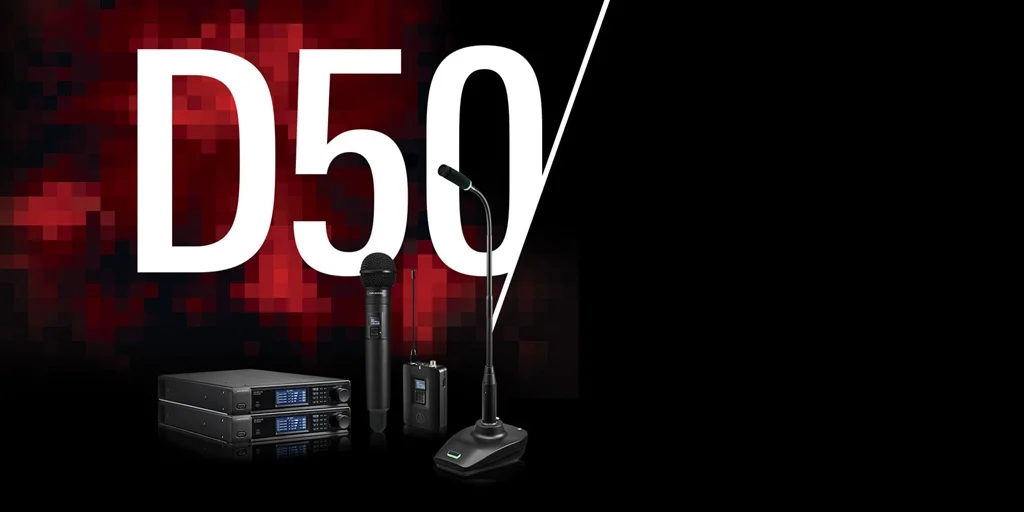
The landscape of wireless audio technology is undergoing a transformative shift as the available radio frequency (RF) spectrum becomes increasingly crowded and regulated. In response to these mounting challenges, Audio-Technica has announced the launch of the D50 Digital UHF Wireless System. This new series is engineered specifically to provide high-tier performance in the most demanding RF environments, catering to a diverse range of professional sectors including corporate AV, higher education, government institutions, houses of worship, and the high-stakes world of theater and live sound production.
The D50 system represents the culmination of Audio-Technica’s decades of research and development in digital wireless transmission. By prioritizing spectral efficiency, audio fidelity, and hardware reliability, the company aims to set a new benchmark for what integrators and end-users can expect from a mid-to-high-range digital wireless solution. As urban centers become saturated with signals from mobile devices, Wi-Fi networks, and other digital broadcasts, the D50 arrives as a robust tool designed to carve out clear, uninterrupted audio paths where traditional systems might falter.
Engineering for Spectral Efficiency and Stability
At the core of the D50 Digital UHF Wireless System is its remarkable agility within the frequency spectrum. Depending on the specific geographic region and local regulations, the system offers a switching bandwidth of up to 224 MHz. This wide range is a critical feature for touring professionals and multi-site corporate campuses, as it allows for flexible channel planning across a broad swath of the UHF band. In an era where "white space" is rapidly disappearing, the ability to shift frequencies across such a wide window ensures that users can find clean airwaves even in the most congested metropolitan areas.
To further bolster signal integrity, Audio-Technica has implemented advanced diversity techniques. The D50 features umschaltbare (switchable) Antenna-Combining-Diversity and Maximum-Ratio-Combining (MRC) True-Diversity modes. MRC is particularly significant in digital wireless systems; it works by analyzing the signals from two independent receiver sections and combining them at the bit level to maximize the signal-to-noise ratio. This process virtually eliminates dropouts caused by multipath interference, a common issue in indoor environments with many reflective surfaces like gymnasiums or modern glass-walled corporate offices.
Perhaps the most impactful technical achievement within the D50 series is its High-Density (HD) mode. In standard operating modes, wireless channels require a certain amount of "breathing room" or guard bands to prevent intermodulation distortion. However, the D50’s HD mode allows for the simultaneous operation of up to 63 channels within a single 8-MHz TV channel. This represents a massive leap in efficiency, enabling large-scale installations—such as university lecture hall complexes or massive theater productions—to operate dozens of microphones simultaneously without exhausting the available spectrum.
Versatile Receiver Architecture and Network Integration
The physical design of the D50 receivers reflects a deep understanding of modern rack-space constraints and the shift toward networked audio. The system utilizes a compact half-rack (19-inch) form factor, which is available in two primary configurations to suit different infrastructure needs.
The first variant is a two-channel receiver equipped with Audio-Technica Link. This proprietary protocol is designed for high-speed, low-latency audio transmission and control, making it an ideal choice for standalone setups or smaller integrated systems. The second, more advanced variant is a four-channel receiver that features full Dante networking support. In a remarkable feat of engineering density, the D50 allows for up to eight reception channels to be housed within a single rack unit (1U) when using the Dante-enabled receivers. This high-density rack utilization is a significant advantage for mobile production racks and crowded server rooms where space is at a premium.
Both receiver models are built for the rigors of professional use, featuring 96 kHz sampling rates to ensure that the digital conversion maintains the highest possible audio transparency. Furthermore, the receivers support redundant signal routing and can be powered via Power over Ethernet (PoE+). The inclusion of PoE+ simplifies installation significantly, as a single Category cable can provide both the data connection to the network and the electrical power required for operation, reducing the need for localized power outlets and bulky external power supplies.
Transmitter Innovation and Ergonomic Excellence
A wireless system is only as good as its transmitters, and the D50 series offers a comprehensive suite of options including handheld, bodypack, and tabletop (boundary) transmitters. Each unit is constructed with a focus on durability and long-term reliability, utilizing high-quality materials capable of withstanding the daily wear and tear of the education and corporate sectors.
The handheld transmitters are particularly noteworthy for their integration of Audio-Technica’s proven interchangeable capsule system. This allows engineers to swap out microphone heads based on the specific vocal characteristics of a performer or the acoustic requirements of a venue. The system is compatible with the acclaimed Artist Elite series of capsules, providing users with a wide palette of sonic textures, from the crisp detail of a condenser to the rugged warmth of a dynamic microphone.
In addition to sonic performance, the D50 transmitters are designed for extended operation. Long battery life is a hallmark of the series, ensuring that a full day of graduation ceremonies or a multi-act theatrical performance can proceed without the anxiety of mid-show power failures. The transmitters also feature user-friendly interfaces and robust locking mechanisms to prevent accidental setting changes during a performance.
Advanced Security and System Management
In the modern era, audio data is sensitive data. Whether it is a government hearing, a corporate board meeting discussing proprietary secrets, or a private legal proceeding, the need for secure transmission is paramount. To address this, the D50 series incorporates AES256-bit encryption. This industry-standard encryption protocol ensures that the wireless signal cannot be intercepted or eavesdropped upon by unauthorized parties, providing peace of mind for high-security applications.
Managing a complex multi-channel wireless system can be a daunting task for even the most experienced frequency coordinators. To streamline this process, the D50 includes integrated spectrum analysis tools within the receiver hardware. This allows users to visualize the RF environment in real-time directly from the front panel or via software.
Furthermore, the D50 is fully compatible with the Audio-Technica Wireless Manager software. This powerful software suite provides a centralized platform for frequency coordination, equipment configuration, and real-time monitoring of all networked D50 components. From a single computer, a technician can monitor battery levels, RF signal strength, and audio peaks across dozens of channels, making it possible to manage large-scale deployments with minimal staff.
Market Context and Professional Reception
The introduction of the D50 Digital UHF Wireless System comes at a time when the Pro-AV industry is demanding more "intelligence" from its hardware. Christian Bethin-Kittel, Audio-Technica’s Product Manager for the EMEA region, emphasized that the development process was deeply collaborative. "We spent a significant amount of time speaking with integrators, sound engineers, and other users who regularly work in challenging RF environments," Bethin-Kittel noted. "The result is a great-sounding wireless solution that is powerful, compact, and suitable for very flexible channel planning."

Industry analysts view the D50 as a strategic move to bridge the gap between entry-level digital systems and the ultra-high-end flagship series used in stadium tours. By offering professional-grade features like 96 kHz audio, Dante redundancy, and high-density channel counts at a competitive price point, Audio-Technica is positioning itself to capture a larger share of the institutional and corporate markets.
The D50 also addresses the "green" initiatives of many modern organizations. By optimizing power consumption and offering rechargeable battery options with precise telemetry, the system reduces the environmental impact and recurring costs associated with disposable alkaline batteries.
Chronology of Development and Availability
The development of the D50 followed a multi-year roadmap focused on refining digital modulation schemes to handle the increased interference of the 5G era. After extensive field testing in high-interference zones across Europe and North America, the system was finalized in early 2026.
The official European debut of the D50 Digital UHF Wireless System is scheduled for the LEAT Con 26 (Live Entertainment and Technology Convention), held from October 6 to 8 at the Hamburg Exhibition Center. Audio-Technica will be showcasing the full range of D50 hardware at Stand C11 in Hall A1. Attendees will have the opportunity to experience the system’s low latency and high-fidelity audio firsthand, as well as explore the Wireless Manager software integration.
Following the convention, the D50 is expected to begin shipping to authorized pro-audio dealers and integrators globally. The rollout will include localized support and training sessions for AV professionals to ensure they can maximize the potential of the system’s high-density and networking capabilities.
Broad Implications for the Pro-AV Industry
The launch of the D50 is more than just a product release; it is an indicator of the direction the entire audio industry is heading. As spectrum becomes a scarcer resource, the "brute force" approach of high-power analog transmission is being replaced by the "surgical precision" of digital UHF.
For the education sector, the D50 means that a university can now run dozens of wireless mics across a single campus without fear of one classroom’s lecture bleeding into another. For theaters, it means more performers can be mic’ed with higher fidelity and fewer rack units. For corporate entities, it means secure, reliable communication that integrates seamlessly into existing IT and Dante networks.
By combining high-end features like MRC True-Diversity and AES256 encryption with the practical benefits of PoE+ and high-density channel counts, Audio-Technica has crafted a system that respects both the art of sound and the science of RF management. As the industry gathers in Hamburg for LEAT Con 26, the D50 stands ready to prove that even in a crowded wireless world, there is still plenty of room for clear, professional audio.
