


The modern event production landscape has undergone a radical transformation over the last decade, shifting from specialized, point-to-point analog connections to complex, converged Internet Protocol (IP) networks. As lighting, audio, and video departments increasingly rely on shared infrastructure to transport protocols such as Art-Net, sACN, Dante, NDI, and SMPTE ST 2110, the industry has reached a critical bottleneck in interoperability. In response to this growing operational friction, Bodo Felusch, a veteran IT trainer and founder of the "IT For AVs" brand, has announced the release of BF-C.O.R.E. (Base Framework for Converged Operations & Reliable Event-IT). This new framework provides an open, free, and manufacturer-neutral set of rules for Virtual Local Area Network (VLAN) IDs and IP address assignments specifically designed for the mobile event industry.
The core objective of BF-C.O.R.E. is to eliminate the "digital islands" created when different production companies utilize proprietary or ad-hoc networking schemes. Currently, when multiple vendors collaborate on a large-scale production—such as a music festival, a corporate trade show, or a televised sporting event—each company arrives with its own internal logic for network configuration. One company might assign VLAN 10 to lighting, while another uses VLAN 500. One might use the 10.x.x.x IP range, while another uses 192.168.x.x. While these systems function perfectly in isolation, they create significant configuration overhead and potential for conflict when integrated into a unified production network.
The Technical Challenge of Converged Event Networks
In the traditional workflow, a network engineer or system technician must spend hours, or sometimes days, documenting the network architecture of various departments to ensure that control signals and media streams do not collide. The primary issue is not technical capability—modern switches and routers are more than capable of handling these loads—but rather a lack of convention. As Bodo Felusch noted during the launch, the technical decisions regarding which VLAN ID is assigned to which department are often arbitrary. Whether lighting sits on VLAN 500 or VLAN 141 is technically equivalent; however, the lack of a universal standard forces every production to "reinvent the wheel" during the setup phase.
This lack of standardization carries a heavy financial and operational price. Freelancers, who often work for four or five different major production houses, are forced to memorize or consult different documentation for every gig. Similarly, equipment rented via "dry hire" (equipment only, without personnel) often arrives with the previous user’s configuration, requiring a full factory reset and logical reconfiguration before it can be deployed. This "transfer time"—the period spent moving from documentation to device configuration—represents a significant portion of labor costs in modern event production.
The BF-C.O.R.E. Framework: Logic and Scalability
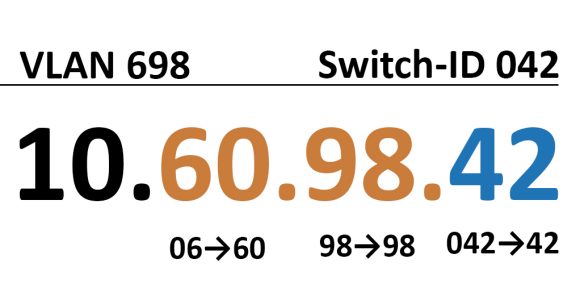
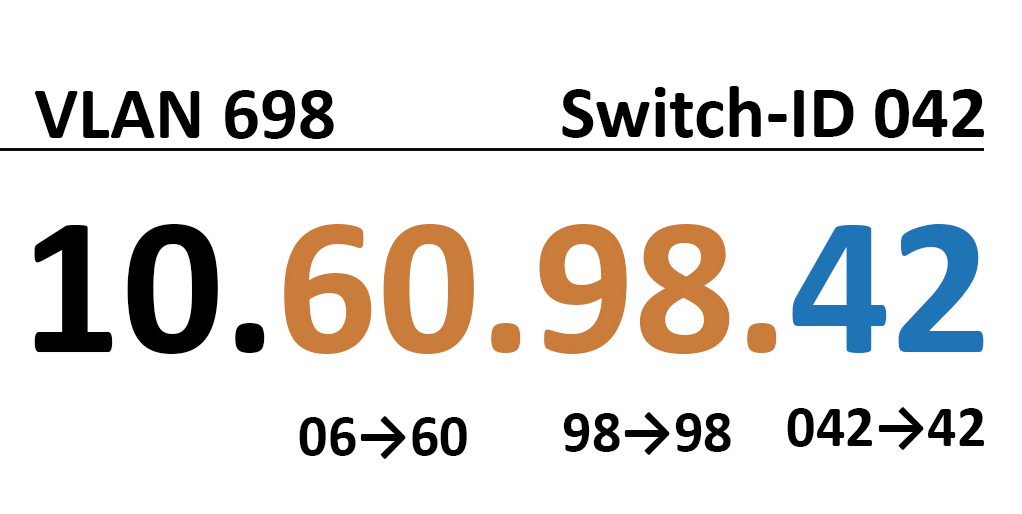
BF-C.O.R.E. addresses these inefficiencies by establishing a predictable, mathematical relationship between VLAN IDs, Switch IDs, and IP addresses. The framework is built on the principle that if a technician knows the VLAN ID and the Switch ID, they should be able to calculate any IP address in the system mentally, without needing to consult a manual or a "cheat sheet" taped to a flight case.
The framework organizes VLAN blocks according to specific production departments (lighting, audio, video, rigging, etc.). It then derives subnets and switch addresses directly from these IDs. Key technical specifications of the BF-C.O.R.E. system include:
- Scalability: The standard is designed to scale from small setups with as few as three switches to massive deployments involving up to 100 switches per production.
- Asset Management: For large rental houses, the system can accommodate asset pools of up to 9,999 switches without IP collisions.
- Capacity: Each department or "trade" is allocated 510 client addresses per VLAN, including specific recommendations for address assignment (e.g., static IPs for primary controllers versus DHCP ranges for guest devices).
- Neutrality: The framework remains strictly manufacturer-neutral. It does not dictate specific hardware choices, nor does it interfere with vendor-specific implementations of Quality of Service (QoS), routing protocols, or physical topologies.
By focusing purely on the logical layer—VLANs and IP addressing—BF-C.O.R.E. acts as a "Base Framework" that sits beneath the specialized configurations required for high-performance protocols like SMPTE ST 2110 or Dante.
Historical Context and the Evolution of "IT For AVs"
The release of BF-C.O.R.E. is the culmination of over 15 years of industry-specific education led by Bodo Felusch. Since 2009, under the "IT For AVs" banner, Felusch has trained thousands of event technicians in the nuances of network engineering. His curriculum was born out of the necessity to bridge the gap between traditional "AV guys" and "IT guys."
Historically, IT professionals from the corporate world often struggled with the real-time, low-latency requirements of live entertainment, while AV technicians often lacked the deep networking knowledge required to manage managed switches and complex subnets. As protocols like CobraNet and EtherSound gave way to Dante, and as DMX transitioned into Art-Net and sACN, the "network" became the most critical single point of failure in a show. Felusch’s work has consistently pushed for a more professionalized, standardized approach to this "Event IT" niche.

Industry Implications and Economic Impact
The introduction of an open standard like BF-C.O.R.E. has the potential to significantly reduce "Time-to-Show." In the event industry, where load-in schedules are increasingly compressed, any framework that reduces the time spent on troubleshooting IP conflicts is highly valuable.
For rental companies, adopting BF-C.O.R.E. means that their gear can be integrated into larger systems more seamlessly. For freelancers, it reduces the cognitive load of switching between different employers’ systems. For production managers, it provides a benchmark for reliability. If a system is "BF-C.O.R.E. compliant," there is an underlying assumption of logical clarity and ease of access for troubleshooting.
Furthermore, by keeping the standard open and free, Felusch is encouraging a community-driven evolution. Unlike proprietary management software offered by switch manufacturers, BF-C.O.R.E. does not lock a user into a specific ecosystem. This is particularly important in an era where global supply chain issues have forced many production houses to mix and match hardware from different brands (e.g., using Netgear, Luminex, and Cisco switches in the same network).
Technical Boundaries and Exclusions
It is important to note what BF-C.O.R.E. is not. The documentation explicitly states that it does not cover physical topologies (such as star vs. ring vs. mesh), specific QoS (Quality of Service) settings, or advanced routing protocols like OSPF or BGP. These elements are often dependent on the specific hardware being used and the specific requirements of the media protocols (for instance, the strict PTP timing requirements of AES67).
By excluding these variables, BF-C.O.R.E. remains a "lightweight" standard. It solves the most common point of human error—addressing and logical segregation—without overstepping into the complex engineering tasks that require specialized certification. Felusch emphasizes that a common standard must be "so good that one’s own reflection becomes unnecessary," meaning the logic should be so intuitive that it becomes the default path for any technician.
Chronology of Development and Public Release
The development of BF-C.O.R.E. has been an iterative process, informed by years of feedback from the "IT For AVs" community. The formal release on September 30, 2026, marks the transition from a training concept to a public-facing specification.
The timeline for the framework’s rollout includes several key phases:
- Phase 1 (Internal Development): Refinement of the VLAN-to-IP mathematical formula to ensure no overlaps occur across 9,999 possible assets.
- Phase 2 (Beta Testing): Implementation of the logic in select high-end touring productions to verify the "mental math" capability under high-stress environments.
- Phase 3 (Public Launch): The release of the specification as a free download on the IT For AVs website.
- Phase 4 (Community Feedback): Open discussion and refinement through industry forums and direct engagement.
Looking Ahead: LEAT Con 26 and Beyond
The next major milestone for BF-C.O.R.E. is the upcoming LEAT Con 26 (Live Entertainment and Technology Convention) in Hamburg. Scheduled for October 6 and 7, the convention will serve as the first major public forum for the framework. Bodo Felusch will be present to discuss the specification with system integrators, rental house owners, and touring technicians.
The success of BF-C.O.R.E. will ultimately depend on its adoption rate. In the world of technology, "standards" only become such when they are used by the majority. Given Felusch’s standing in the European event technology community, the framework starts with a significant degree of trust. If major rental players in the DACH region (Germany, Austria, Switzerland) begin to align their internal "house standards" with BF-C.O.R.E., it could quickly become the de facto language for event networking across the continent.
As production technology continues to advance toward fully software-defined workflows and cloud-integrated live events, the need for a stable, logical foundation at the local network level has never been greater. BF-C.O.R.E. represents a significant step toward that stability, moving the industry away from "creative" networking and toward professionalized, predictable IT infrastructure.
