

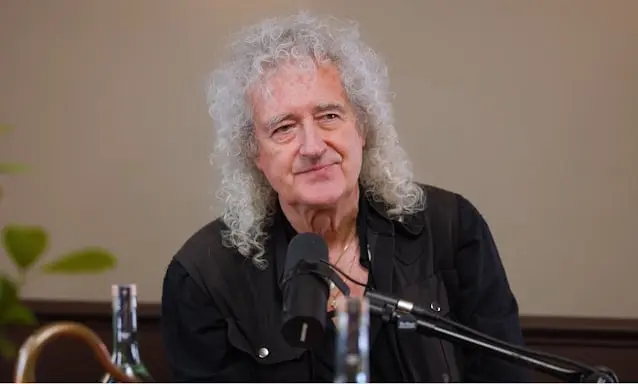
In a candid conversation with Samuel Goldsmith for the U.K.’s Good Food Podcast, legendary QUEEN guitarist Brian May has offered a profound glimpse into his personal journey towards veganism and his enduring, multi-faceted advocacy for animal welfare. While May has long been a vocal champion for wildlife conservation, his transition to a vegan lifestyle was a more recent development, initiated as an experiment in January 2020 through Veganuary. The global shift in perspective brought about by the coronavirus pandemic has, according to May, amplified his conviction that veganism represents a crucial pathway for humanity to coexist in greater harmony with the planet and its intricate ecosystems.
The interview, as transcribed by BLABBERMOUTH.NET, reveals the depth of May’s empathy for all sentient beings. "I’m definitely committed to trying to decrease the suffering of animals, ’cause I think every animal matters – not just species, not just numbers, but every single creature matters," he stated, underscoring a philosophy that transcends mere conservation. This deeply ingrained belief is vividly illustrated by his and his team’s ongoing efforts through the Save Me Trust, a wildlife rescue organization he co-founded. May shared a recent, heartwarming success: the rescue of two toads from a perilous drainage system. "We just rescued a couple of toads from the drains who couldn’t get out, and that gives me great pleasure," he remarked.
He lauded the tireless work of Anne Brummer, who manages the Save Me Trust, noting that "Anne Brummer, who runs my Save Me wildlife rescue, has rescued literally thousands of animals over the years we’ve been involved together, and that makes me very happy." The scope of their rescue operations is extensive, encompassing a wide array of wild animals including foxes, badgers, deer, numerous bird species, and hedgehogs. Beyond direct intervention, the Save Me Trust engages in crucial outreach, aiming to educate the public about the needs of wild animals and the detrimental impact of human activities on their habitats. At a higher level, the organization actively participates in lobbying efforts with the U.K. government and Parliament, striving to enact legislative changes that offer stronger protections against the exploitation and abuse of wild animals.
A Defining Childhood Moment
When questioned about the specific catalyst for his vegan leanings, May attributed it not to a single event, but rather to a lifelong affinity for animals, punctuated by formative experiences. "I’ve always been an animal lover, yeah," he confirmed. "There are certain moments in your life – aren’t there? – which change your feelings." He recounted a poignant childhood memory, dating back to when he was approximately eight or nine years old. At the time, he harbored a fear of buzzing insects like bees and wasps. His mother possessed a "FLIT gun," a primitive insecticide dispenser likely containing DDT, which he used out of fear against a large insect, possibly a wasp, that had entered their home.
"And I watched it buzz and buzz and fall to the ground and buzz and buzz and buzz and buzz and buzz and buzz," May described, his voice conveying the lasting impact of the scene. "And I watched it in what seemed like agony, and it absolutely killed me. I thought, ‘I’ve done this. Why have I destroyed this animal?’ Because I was afraid of it. That stuck with me for a long time, and I wouldn’t touch any of those sprays ever again." This visceral experience served as an early, powerful realization that animals, even those perceived as pests, are sentient beings capable of suffering, a sentiment that has profoundly shaped his worldview. He believes this, along with "a number of incidents," solidified his understanding that "animals are just like us."
Challenging Anthropocentric Views
May’s perspective aligns with the growing discourse around speciesism and human exceptionalism, a theme he frequently explores in his advocacy. He referenced a recent quote from renowned broadcaster and naturalist Sir David Attenborough, which encapsulates this challenge: "’Why is it we have the arrogance to think that the human race, that humans are the only significant animal on the planet? Why do we think we’re more important than all the other animals?’" May emphatically agrees, stating, "There’s no basis for that."
He elaborated on this point, suggesting that an objective, external observer might not necessarily prioritize humanity. "I mean, I’ve said very often, if an alien came to Earth and looked at all the different animals, creatures on Earth, they wouldn’t necessarily come to the conclusion that humans were the best and the most worthy of preserving," he argued. "We’ve done a lot of damage, and we still do a lot of damage, and I’m not convinced that we do a very good job as a species." This self-critical assessment leads him to question the prevailing assumption that other species exist solely for human exploitation. "So why do we assume all the other species are there for our exploitation? It’s not a logical assumption. To me, it’s self-evident that every animal matters."
Reconnecting with Nature
May’s advocacy extends beyond animal rights to a broader call for environmental stewardship and a reevaluation of humanity’s place within the natural world. He believes a disconnect from our primal roots has contributed to our current ecological crises. "We’re not aware enough yet of how much we need to look after not just the planet, but the wild animals that live on it, all the animals that live on it," he stated. He posits that humans, fundamentally, are also wild animals, and that our modern, urbanized lifestyles have alienated us from this essential truth. "And we are all wild animals, basically. I mean, how do you feel when you go out in the country, in the trees or the grass and everything? You think, ‘Oh, my God, this is where I belong.’ And you do belong. We don’t belong in this concrete stuff that we’ve manufactured for ourselves. We are wild animals." This sentiment suggests a need for a more intuitive and respectful integration of human society with the natural environment.
A Legacy of Conservation and Education
Brian May’s commitment to animal welfare is not a recent dalliance but a deeply ingrained aspect of his public and private life. As a co-founder of the Save Me Trust, he has been at the forefront of significant campaigns, most notably challenging the U.K. government’s controversial badger culls. This ongoing battle highlights the complex and often contentious nature of wildlife management and conservation policy.
Beyond direct activism, May has made tangible investments in creating havens for wildlife. In 2013, he acquired 157 acres of former farmland in Dorset, England, with the explicit goal of transforming it into a sanctuary. Over a decade later, this endeavor, known as May’s Wood, has flourished, now hosting an impressive array of over 101,000 trees and shrubs. This rewilding project has successfully attracted a diverse range of wildlife, with new species of insects, birds, and mammals now calling the land home, demonstrating the profound positive impact that dedicated conservation efforts can have.
His multifaceted approach to life and advocacy is further underscored by his significant academic achievement. In 2017, Brian May earned a PhD in astrophysics from Imperial College, a testament to his intellectual curiosity and his ability to excel in disparate fields. This academic pursuit, while seemingly distant from his animal advocacy, can be viewed through a similar lens of seeking understanding and appreciating the intricate complexities of the universe, whether it be the cosmos or the delicate balance of terrestrial ecosystems.
The interview with the Good Food Podcast serves as a powerful platform for Brian May to articulate his evolving perspectives on veganism and his unwavering dedication to the welfare of all creatures. His personal narrative, from a childhood incident with a FLIT gun to his current role as a prominent advocate and conservationist, offers a compelling testament to the power of empathy and the urgent need for a more compassionate and sustainable relationship between humanity and the natural world. His continued efforts through the Save Me Trust and initiatives like May’s Wood provide concrete examples of how individuals can translate conviction into meaningful action, inspiring others to consider their own impact and to embrace a more harmonious existence with the planet and its diverse inhabitants.
