

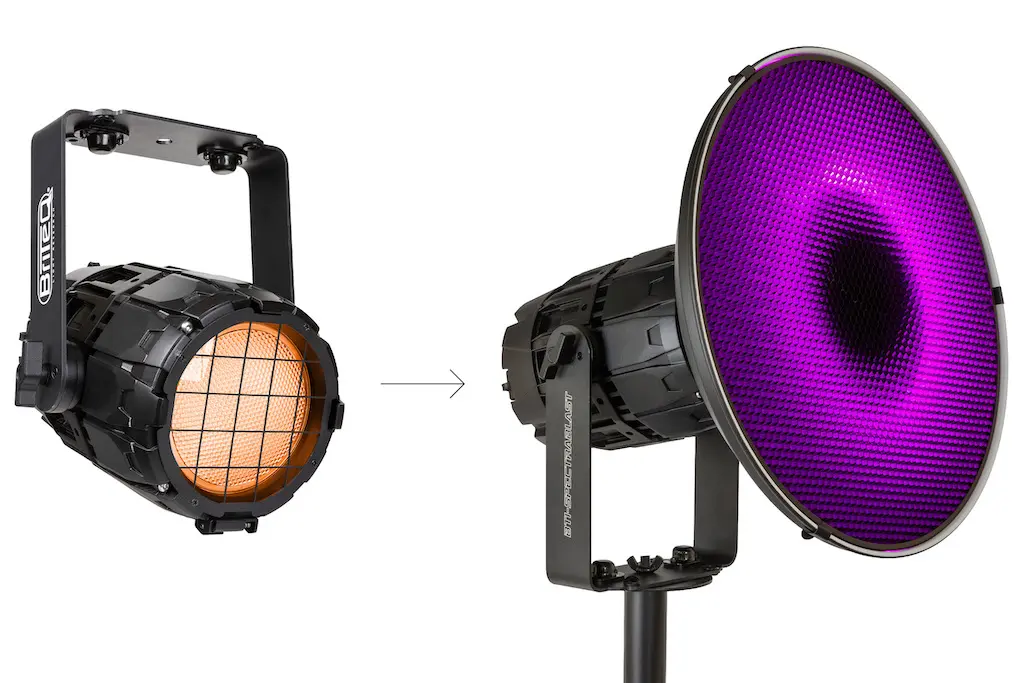
The professional lighting industry has witnessed a significant shift toward high-efficiency LED alternatives to traditional tungsten fixtures, and the introduction of the Briteq BTI-Spectrablast marks a pivotal moment in this technological transition. Distributed in Germany by MR Products Ton- und Lichttechnik GmbH, the BTI-Spectrablast is not merely a replacement for the classic audience blinder but a multifaceted lighting tool that integrates advanced color mixing, modular hardware design, and rugged environmental protection. At the core of the BTI-Spectrablast is a potent 380-watt RGBALC LED engine. This configuration, which includes Red, Green, Blue, Amber, Lime, and Cyan emitters, allows for a level of color precision and white-light quality that far exceeds the capabilities of standard RGB or RGBW fixtures. By incorporating lime and cyan, Briteq has addressed common gaps in the visible spectrum, ensuring that the BTI-Spectrablast can produce vivid, saturated colors while maintaining a high Color Rendering Index (CRI) across its variable color temperature range of 1,500 K to 8,500 K.
The Evolution of the Blinder: From Tungsten to RGBALC
For decades, the "audience blinder" was defined by the DWE lamp—a high-wattage tungsten source that provided a warm, intense glow and a characteristic "amber drift" when dimmed. As the light intensity decreased, the filament cooled, shifting the color temperature toward a deep orange. The BTI-Spectrablast replicates this behavior through sophisticated software algorithms. This "Amber Drift" effect allows lighting designers to maintain the nostalgic aesthetic of traditional rock-and-roll lighting while benefiting from the energy efficiency and longevity of LED technology.
The transition to the RGBALC engine represents a strategic move for Briteq. While traditional blinders were limited to a single color temperature, the BTI-Spectrablast serves as a hybrid fixture. In its 1,500 K setting, it mimics the dim glow of a cooling filament; at 8,500 K, it provides a crisp, daylight-white punch suitable for modern high-energy stroboscopic effects. This versatility is essential for rental houses and production companies that require fixtures capable of performing multiple roles within a single rig, thereby maximizing the return on investment.
Modular Engineering and the Bowens Mount Innovation
One of the most distinctive features of the BTI-Spectrablast is its mechanical flexibility. The fixture is designed with an optional Bowens-mount adapter, a standard widely recognized in the photography and cinematography industries. By adopting this mount, Briteq has opened the BTI-Spectrablast to a vast ecosystem of third-party modifiers, including softboxes, beauty dishes, snoots, and various reflectors. This feature transforms the unit from a simple stage blinder into a sophisticated key light or soft wash light, making it equally suitable for television studios, film sets, and corporate events where controlled light spill and soft shadows are required.
Beyond the optical modifiers, the physical housing of the BTI-Spectrablast is built for the rigors of the touring industry. Constructed from high-grade die-cast aluminum, the chassis provides both durability and efficient heat dissipation. The fixture is rated IP65, signifying that it is "dust-tight" and protected against water jets from any angle. This rating is critical for contemporary festival production, where equipment must remain operational despite exposure to rain, dust, and humidity.
The modularity extends to the way multiple units interact. Through the use of optional "Splice" and "Clamp" connectors, technicians can link several BTI-Spectrablast units together to create complex geometric arrays. These connectors allow for the formation of linear bars, circular clusters, or large-scale square matrices. This "building block" approach enables lighting designers to move away from the traditional 2-lite or 4-lite blinder configurations and create custom light sculptures that can be mapped via DMX or Art-Net to act as low-resolution video surfaces or dynamic backdrops.
Technical Specifications and Performance Data
The BTI-Spectrablast’s 380W LED source is managed by a high-frequency pulse-width modulation (PWM) system, ensuring flicker-free operation even when captured by high-speed cameras used in modern broadcasting and 4K cinematography. The performance data released by the manufacturer highlights several key metrics:
- Light Source: 380W RGBALC LED Engine.
- Color Temperature Range: 1,500 K to 8,500 K (Adjustable).
- Protection Rating: IP65 (Weatherproof).
- Housing: Die-cast aluminum with a rugged finish.
- Cooling: Advanced passive and active cooling systems designed for silent operation in noise-sensitive environments.
- Control Protocols: DMX512, RDM compatibility for remote addressing and monitoring.
- Connectivity: Weatherproof PowerCON True1 in/out and 5-pin XLR connectors.
The inclusion of the "Lime" and "Cyan" chips is particularly noteworthy for technical directors. In traditional RGB systems, achieving a high-quality white or a realistic mint green is difficult, often resulting in a "muddy" or "split" spectrum. The RGBALC array fills these spectral gaps, allowing the BTI-Spectrablast to achieve a CRI that rivals dedicated studio fixtures. This makes the unit a viable option for lighting skin tones on stage, a task where traditional LED blinders often fail due to poor color rendering in the red and yellow frequencies.
Market Context and Distribution Strategy
The German market, known for its stringent safety standards and high expectations for build quality, is a primary focus for Briteq. The partnership with MR Products Ton- und Lichttechnik GmbH ensures that the BTI-Spectrablast is supported by a robust distribution and service network. MR Products has a history of bringing versatile, high-value lighting solutions to the DACH region (Germany, Austria, Switzerland), focusing on products that balance performance with cost-effectiveness.
Industry analysts note that the release of the BTI-Spectrablast comes at a time when the European Union’s Ecodesign directives are placing increasing pressure on the event industry to phase out high-energy-consumption lamps. A traditional 4-lite blinder consumes approximately 2,600 watts of power and generates immense heat. In contrast, a cluster of BTI-Spectrablast units provides comparable lumen output at a fraction of the power consumption, significantly reducing the carbon footprint of large-scale tours and decreasing the load on portable power generators at outdoor festivals.
Industry Implications and User Reactions
Early feedback from lighting designers who have engaged with the BTI-Spectrablast prototypes suggests that the fixture’s primary appeal lies in its "hybridity." In a recent statement regarding the modular trends in stage lighting, industry veterans pointed out that the ability to transition from a blinding strobe to a soft-box-mounted key light within minutes is a logistical advantage that cannot be overstated.

"The BTI-Spectrablast represents a shift in how we view ‘utility’ fixtures," noted a technical director familiar with the development of the BTI series. "In the past, a blinder did one thing: it blinded the audience. Now, with the RGBALC engine and the Bowens mount, that same piece of equipment can be used for theatrical washes, colored accents, and even high-quality video lighting. It reduces the number of spare parts we need to carry and simplifies the overall rig design."
Furthermore, the integration of RDM (Remote Device Management) allows technicians to monitor the internal temperature and status of each unit from the lighting console. In an outdoor environment where fixtures may be rigged 20 meters in the air on a festival stage, the ability to troubleshoot and reconfigure settings remotely is a vital safety and efficiency feature.
Chronology of Development and Future Outlook
The development of the BTI-Spectrablast is the culmination of Briteq’s multi-year initiative to modernize its "Pro" lighting line. Following the success of their previous IP-rated wash lights, the company identified a gap in the market for a high-output, color-mixing blinder that did not sacrifice the "warmth" of traditional sources.
- Q1 2025: Research and development began on the RGBALC light engine, focusing on spectral consistency across high-wattage outputs.
- Q4 2025: Prototypes were tested at several European outdoor festivals to verify the IP65 integrity and heat management under direct sunlight.
- Q2 2026: Finalization of the "Splice and Clamp" system and the Bowens adapter design.
- October 2026: Official launch and distribution through MR Products in Germany.
Looking ahead, the BTI-Spectrablast is expected to become a staple in the inventory of medium-to-large-scale rental companies. Its arrival signals a broader trend where the boundaries between "stage lighting," "studio lighting," and "architectural lighting" are increasingly blurred. As LED technology continues to mature, the focus is shifting from raw brightness to the quality of light and the flexibility of the hardware.
The BTI-Spectrablast stands as a testament to this evolution. By combining the raw power required for stadium-level blinding effects with the finesse of a studio-grade color engine and the versatility of a modular mounting system, Briteq has provided the industry with a tool that is prepared for the demands of 2026 and beyond. For production companies looking to future-proof their inventory against changing regulations and evolving designer demands, the BTI-Spectrablast offers a compelling, multi-functional solution that honors the past while embracing the technological possibilities of the future.
