

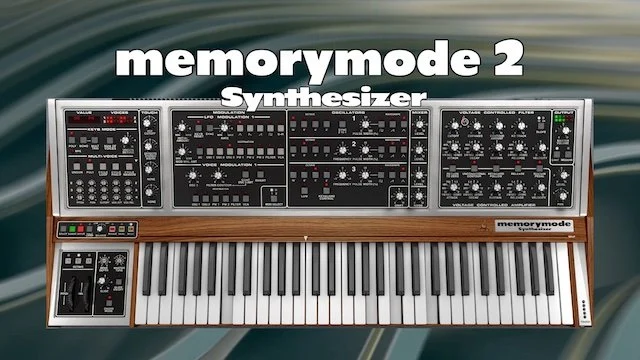
Cherry Audio has officially announced the release of Memorymode 2, a significant evolution of its acclaimed software emulation of the legendary Memorymoog synthesizer. Positioned as a "bigger, bolder, and better reimagining," this second iteration arrives five years after the original 2021 plugin, representing a substantial leap in both sonic fidelity and functional versatility. By leveraging advanced analysis and design techniques, Cherry Audio aims to set a new benchmark for analog modeling accuracy, providing musicians and producers with the raw power of a vintage polyphonic powerhouse without the prohibitive costs or mechanical instabilities associated with hardware from the early 1980s.
The launch of Memorymode 2 is not merely a cosmetic update but a complete architectural overhaul. At the heart of the new instrument is a CPU-optimized dual-layer engine, allowing users to stack two independent 16-voice polyphonic synthesizers or create complex keyboard splits. This architecture supports a massive potential of up to 48 voices per layer when utilizing unison stacking, a feat that would have been physically and thermally impossible for the original hardware. The release marks a pivotal moment for Cherry Audio as it continues to solidify its reputation for delivering high-end boutique synthesis at an accessible price point.
Historical Context: From the Memorymoog to the Digital Realm
To understand the significance of Memorymode 2, one must look back at the instrument that inspired it. The original Memorymoog, released in 1982, was the final synthesizer produced by Moog Music Inc. before its initial bankruptcy. It was a monumental achievement in engineering, often described as "six Minimoogs in one." Each of its six voices featured three oscillators and the famous 24 dB/octave ladder filter, providing a richness of tone that few instruments have matched since. However, the hardware was notoriously temperamental; its internal heat generation often led to tuning instability, and its complex voice-assignment circuitry was prone to failure.
In 2021, Cherry Audio addressed these historical pain points with the first version of Memorymode. It captured the essence of the "Moog sound"—the massive low end and the searing lead capabilities—while introducing modern stability. The transition to Memorymode 2 in 2026 represents a half-decade of research into component-level modeling. This new version focuses on the nuances of analog drift, envelope behavior, and filter non-linearities that define the "organic" feel of vintage electronics.
Architectural Enhancements and Dual-Layer Capability
The most striking technical advancement in Memorymode 2 is its dual-layer architecture. While the original Memorymoog was a single-timbral instrument, Memorymode 2 allows for two distinct patches to be loaded simultaneously. This dual-layer approach facilitates the creation of massive, evolving textures that were previously unattainable. Users can toggle between layers or view them side-by-side, providing a streamlined workflow for sound design.
The polyphony has also seen a dramatic increase. With up to 16 voices per layer as standard, and the ability to expand that for unison modes, the software can handle complex orchestral-style arrangements and dense jazz harmonies without voice stealing. This is particularly relevant for modern film scoring and electronic music production, where high voice counts are often required for long-release ambient pads.
Advanced Filter Modeling and Sonic Refinement
Cherry Audio’s engineering team has completely redesigned the filter and envelope sections. The centerpiece of the instrument remains the classic 24dB/octave ladder filter, but it is now joined by a 12dB/octave option for more subtle, Oberheim-esque filtering. A significant addition is the "emphasis compensation" feature. In traditional ladder filters, increasing the resonance (emphasis) often leads to a perceived loss of low-frequency weight. Memorymode 2’s compensation circuit maintains the fundamental’s power even at high resonance settings, ensuring that the bass remains "beefy" regardless of the filter’s position.
Furthermore, the "Modern" setting introduces a refined frequency response that provides "crystalline highs" and a tighter bottom end, catering to contemporary production standards. Conversely, users seeking the grit of the 1980s can utilize the analog drift control, which introduces subtle, randomized fluctuations in pitch and filter cutoff to mimic the behavior of aging capacitors and resistors.
Performance, Modulation, and Expression
In an era where MIDI Polyphonic Expression (MPE) is becoming a standard for professional controllers, Memorymode 2 enters the market fully equipped. It supports MPE and polyphonic aftertouch, allowing for per-note modulation of parameters such as vibrato, filter brightness, and volume. This level of expressiveness bridges the gap between the static nature of some software instruments and the tactile response of acoustic instruments.
The modulation matrix has been expanded to include four lanes of touch-oriented modulation with 52 potential routing destinations. This is complemented by the "Touch Animator," a performance-based automation tool that allows for rhythmic and evolving parameter changes that respond to the player’s input. Additionally, each layer features its own 16×4 programmable polyphonic step sequencer and arpeggiator, enabling complex rhythmic patterns and generative melodies.
Integrated Effects and Studio Processing
Memorymode 2 includes a comprehensive suite of 22 studio-quality effects, distributed across three independent effect chains. This allows for dedicated processing for each layer plus a master bus effect chain. Notable new additions include the "Wide Phaser," which provides a lush, stereophonic sweep, and a "Rotary Speaker" emulation that pays homage to the classic organ-and-synth pairings of the 1970s and 80s. These effects are integrated directly into the modulation matrix, meaning users can modulate the speed of a phaser or the depth of a delay using the LFOs or envelopes of the synth engine itself.
Philanthropy and the Bob Moog Foundation
Coinciding with the release of the synthesizer is the "Foundation Preset Pack," a collection of 275 presets designed to showcase the new features of Memorymode 2. These patches range from classic 80s pop leads to modern cinematic soundscapes. In a move that has garnered praise from the music community, Cherry Audio has announced that all proceeds from the sales of this pack during August 2026 will be donated to the Bob Moog Foundation.
This partnership celebrates the 20th anniversary of the Foundation, which works to preserve the legacy of Dr. Bob Moog and provide hands-on synthesis education through its "Dr. Bob’s SoundSchool" program. Michelle Moog-Koussa, Executive Director of the Bob Moog Foundation, noted that such collaborations are vital for inspiring the next generation of innovators and ensuring that the history of electronic music remains accessible to all.
Market Impact and Industry Reception
The pricing strategy for Memorymode 2 remains aggressive, consistent with Cherry Audio’s historical approach. At a retail price of $69, with a $39 upgrade path for existing users, the software provides a cost-effective alternative to hardware clones and high-priced competitor plugins. Industry analysts suggest that this pricing model is designed to capture a broad segment of the market, from hobbyists to professional studio engineers who require a reliable "workhorse" poly-synth.
Initial reactions from sound designers have highlighted the "weight" of the sound. Early testers have noted that the dual-layer functionality effectively doubles the value of the instrument, allowing for complex "bi-timbral" performances that were a hallmark of high-end synths like the Roland Jupiter-8 or the Sequential Prophet-10, but with the distinct Moog character.
Chronology of Development
The development of Memorymode 2 followed a rigorous three-year cycle after the initial feedback from version 1 was processed.
- 2021: Launch of Memorymode 1, focusing on core emulation and reliability.
- 2023: Initiation of the "Advanced Modeling Project," aimed at component-level analysis of the original Moog ladder filter and envelope generators.
- 2024-2025: Beta testing of the dual-layer architecture and MPE integration.
- August 2026: Official global release and launch of the Bob Moog Foundation charity drive.
Conclusion and Implications
Memorymode 2 represents more than just a software update; it is a testament to the enduring appeal of the analog sound in a digital world. By combining the legendary "six Minimoogs" concept with 21st-century features like MPE, dual-layering, and advanced modulation, Cherry Audio has created a tool that respects the past while looking firmly toward the future.
The inclusion of the Foundation Preset Pack and the support for the Bob Moog Foundation further cements the instrument’s place within the culture of synthesis. As digital audio workstations continue to evolve, the demand for high-quality, characterful instruments remains high. Memorymode 2 appears poised to meet that demand, offering a versatile, powerful, and historically significant sound palette to creators worldwide. With its blend of technical sophistication and philanthropic commitment, Cherry Audio’s latest release sets a high bar for the industry, proving that the spirit of analog innovation is alive and well in the software domain.
