

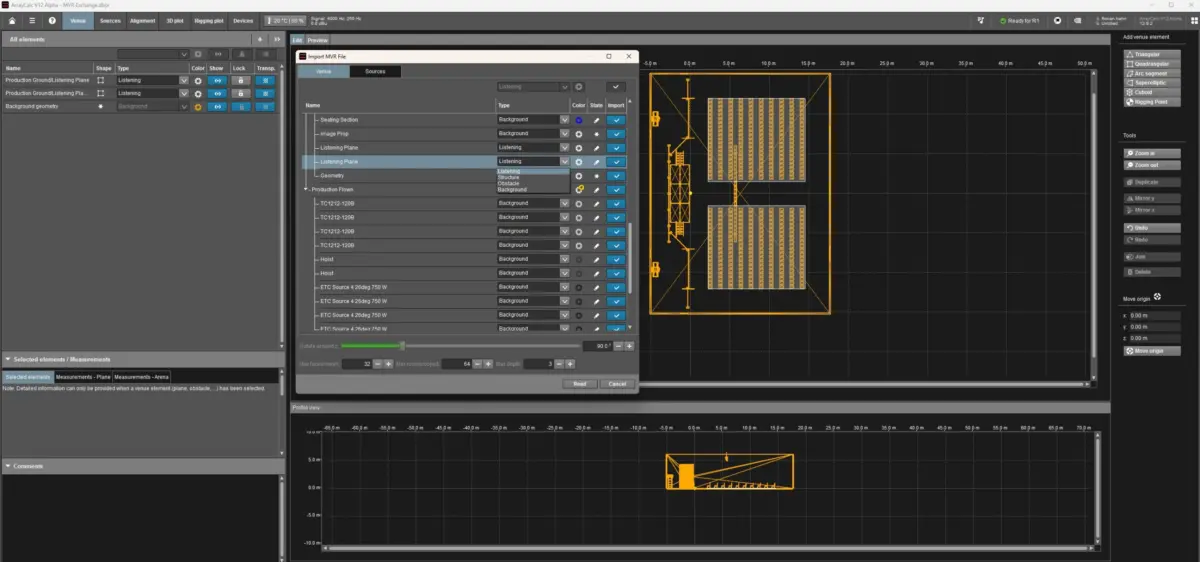
The introduction of MVR Exchange by d&b audiotechnik marks a significant milestone in the evolution of live sound reinforcement design, offering a seamless bridge between disparate production disciplines through the My Virtual Rig (MVR) open standard. By integrating this feature into the latest beta version of its industry-standard ArrayCalc simulation software, the German pro-audio manufacturer is addressing one of the most persistent bottlenecks in event production: the manual transfer of venue and equipment data between lighting, rigging, and audio departments. This development allows for the bidirectional exchange of venue models and loudspeaker system designs, ensuring that all stakeholders in a production are working from a synchronized, high-fidelity digital twin of the performance space.
The Evolution of Interdisciplinary Standards in Live Production
To understand the impact of MVR Exchange, it is essential to examine the origins of the MVR standard itself. Developed as a collaborative effort between Vectorworks, Inc., MA Lighting International, and Robe Lighting, MVR was designed to provide a unified file format that could carry data across various CAD, lighting console, and visualizer platforms. It was eventually formalized as DIN SPEC 15800, a recognized industry standard that facilitates the exchange of a "scene" or "rig" between different software tools. While the lighting and scenic industries were quick to adopt MVR for sharing geometry and fixture data, the audio sector remained largely siloed, relying on proprietary file formats or manual data entry to translate venue dimensions into acoustic simulation software.
The integration of MVR into d&b audiotechnik’s ArrayCalc changes this dynamic. Traditionally, an audio engineer would receive a PDF or a 2D DWG file of a venue and then spend hours—if not days—manually recreating the 3D geometry within ArrayCalc to perform accurate acoustic mapping. With MVR Exchange, the engineer can now import a complex 3D model directly from a lighting designer’s Vectorworks file or a rigger’s plan. This not only saves time but also eliminates the potential for human error in translating coordinates, ensuring that the acoustic simulation reflects the physical reality of the venue with surgical precision.
Technical Capabilities of MVR Exchange in ArrayCalc
The MVR Exchange feature in the ArrayCalc Beta provides a robust set of tools for data management. On the import side, users can bring in venue geometry, including walls, balconies, and stage structures, which serve as the foundation for acoustic calculations. On the export side, the software allows users to push their loudspeaker system designs—including array positions, tilt angles, and mounting heights—back into the master production file.
This bidirectional flow is critical for several technical assessments during the pre-production phase:
- Sightline Analysis: By exporting d&b loudspeaker arrays into a comprehensive CAD environment, production managers can immediately see if a PA hang obstructs the view of a video wall or a lighting effect.
- Collision Detection: In modern arena tours, where rigging points are at a premium, the ability to see exactly where a loudspeaker array sits in relation to lighting trusses and automated scenic elements is vital for preventing physical interference.
- Weight and Rigging Documentation: The inclusion of loudspeaker data in the master MVR file assists riggers in calculating point loads and ensuring the structural integrity of the roof or support system.
The synchronization feature is perhaps the most innovative aspect of the MVR Exchange. Rather than being a one-time import/export process, the system allows for continuous updates. If a lighting designer moves a truss in Vectorworks, the change can be reflected in ArrayCalc with minimal effort, allowing the audio engineer to adjust the sound system design accordingly.
A Strategic Shift Toward Open Standards
The decision by d&b audiotechnik to embrace an open standard rather than developing a proprietary plugin is a strategic move that reflects a broader trend in the professional AV industry. Florian Hahn, Product Manager Software at d&b audiotechnik, emphasized this philosophy during the announcement, noting that the goal was to provide users with more time to focus on the creative and technical aspects of sound design rather than the logistics of data transfer.
By opting for MVR, d&b ensures compatibility with a vast ecosystem of software. While Vectorworks is the primary CAD tool for many in the entertainment industry, MVR is also supported by platforms like Cinema 4D, Unreal Engine, and various lighting consoles and visualizers. This interoperability prevents "vendor lock-in" and fosters a more collaborative environment where different software packages can "speak" to one another without the need for expensive third-party middleware.
Historical Context and the Timeline of Development
The journey toward a unified data exchange format in the event industry has been a decade-long process. In the early 2010s, the industry struggled with the lack of a common language for fixture data. This led to the creation of the General Device Type Format (GDTF), which defined how a device (like a moving light or a loudspeaker) behaves. MVR was the logical next step, defining where those devices sit in a 3D space.
- 2018: The GDTF and MVR standards are first announced at Prolight + Sound in Frankfurt.
- 2020: DIN SPEC 15800 is officially published, providing a formal framework for MVR.
- 2022-2023: Major CAD and lighting manufacturers complete full integration of MVR into their core products.
- November 2024: d&b audiotechnik announces the MVR Exchange for ArrayCalc, marking one of the first major audio-specific integrations of the standard.
This timeline highlights the audio industry’s cautious but necessary move toward the "Digital Twin" philosophy that has already transformed the architecture and construction industries through Building Information Modeling (BIM).
Implications for the Live Sound Industry
The implications of MVR Exchange extend beyond mere convenience. For large-scale touring productions, the ability to maintain a single, updated source of truth for the entire rig can significantly reduce the "load-in" time. When the virtual plan perfectly matches the physical venue, there are fewer surprises on-site. For the audio engineer, this means that the "as-built" system is more likely to perform exactly as the "as-designed" simulation predicted.
Furthermore, this integration allows for more sophisticated acoustic modeling. If a venue model imported via MVR includes detailed material properties or complex architectural features, ArrayCalc can potentially provide even more accurate predictions of how sound will behave in that space. While current versions of ArrayCalc focus on coverage and SPL, the path is now open for deeper data integration involving acoustic treatment and environmental factors.
From a business perspective, d&b’s adoption of MVR reinforces its position as a leader in system integration. By making their software more accessible and compatible with the tools used by production managers and lighting designers, they increase the value proposition of their entire ecosystem—from the d&b Soundscape spatial audio platform to their flagship SL-Series line arrays.

Statements and Industry Reaction
The response from the professional community has been overwhelmingly positive. Early adopters of the beta version have noted that the reduction in manual modeling allows for more iterative design cycles. Instead of settling for a "good enough" speaker placement because of the time required to re-model the venue, engineers can now test multiple configurations in the time it previously took to set up one.
Industry analysts suggest that d&b’s move will likely pressure other major loudspeaker manufacturers to follow suit. As production workflows become more integrated, the "siloed" approach to software will become an increasingly difficult sell for rental houses and touring companies who demand efficiency and cross-platform compatibility.
The Future of ArrayCalc and MVR
As the MVR Exchange moves from beta to a full release, d&b audiotechnik is expected to continue refining the interface and expanding the types of data that can be exchanged. Future updates may include more granular control over how specific loudspeaker components are represented in CAD environments, as well as enhanced support for the GDTF standard to provide even deeper technical specifications within the MVR container.
The introduction of MVR Exchange is not just a software update; it is a fundamental shift in how audio is positioned within the broader context of show design. It acknowledges that sound does not exist in a vacuum but is part of a complex, moving, and highly engineered environment. By breaking down the walls between audio and other disciplines, d&b audiotechnik is ensuring that the "art" of sound design remains supported by the highest standards of "science" and engineering efficiency.
In conclusion, d&b audiotechnik’s MVR Exchange represents a vital step toward a more unified, efficient, and error-free production environment. By leveraging open standards and focusing on interdisciplinary collaboration, the company is providing a blueprint for the future of professional audio software. As the industry continues to push the boundaries of what is possible in live performance, tools that facilitate better communication and data integrity will remain the cornerstone of successful, high-impact productions. The ArrayCalc Beta with MVR Exchange is currently available for download, inviting users to experience the next generation of integrated system design.
