

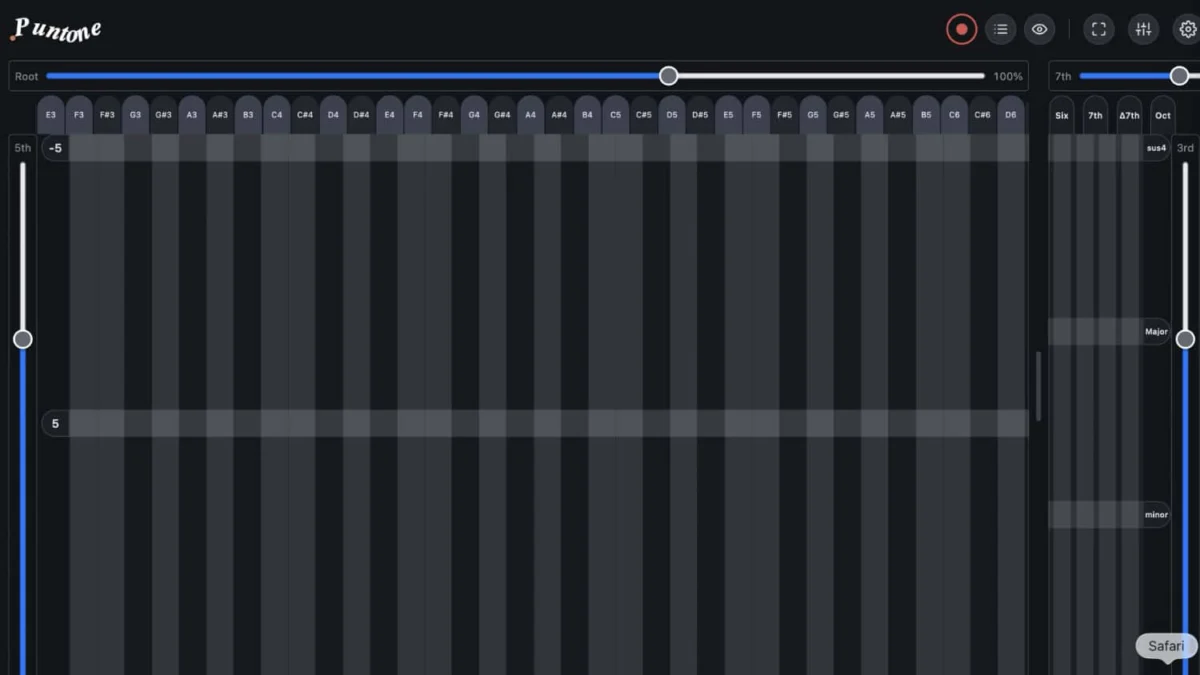
The landscape of digital synthesis has expanded with the release of Puntone, a free, browser-based musical instrument developed by Kota Kato that reimagines the traditional boundaries of polyphonic performance. By merging the fluid, continuous pitch control of a theremin with the structural complexity of harmonic chords, Puntone offers a unique interface for musicians, sound designers, and experimentalists. The instrument is accessible directly through modern web browsers, requiring no installation, account creation, or external plugins, signaling a continued shift toward high-performance, low-barrier-to-entry creative tools powered by the Web Audio API.
Technical Foundation and the Power of Web Audio
Puntone is built entirely on the Web Audio API, a high-level system for processing and synthesizing audio in web applications. Unlike many browser-based instruments that rely on pre-recorded samples or simplified MIDI triggers, Puntone utilizes raw oscillators. The developer has implemented continuous frequency ramps, which allow the pitch to move smoothly between frequencies without the "stepping" or "zipper noise" often associated with digital controls.
This architectural choice is significant for the instrument’s primary function: chord morphing. In a standard synthesizer, transitioning from a C Major triad to an F Major triad typically involves a discrete jump where one set of notes stops and another begins. Puntone, however, treats the transition as a physical movement. By dragging one chord voicing into another, every individual note within the cluster undergoes a portamento-style slide, maintaining its harmonic relationship throughout the travel. This creates a "smearing" effect that is difficult to achieve on traditional keyboards without complex modulation routing or MPE (MIDI Polyphonic Expression) controllers.
Interface Design and User Experience
The instrument is optimized for the modern tactile environment, specifically targeting tablet users on platforms like the iPad. The interface is centered around a dual-pad system designed to decouple the fundamental components of a musical performance: the root note and the harmonic structure.
In the dual-pad mode, the left side of the screen generally controls the root note of the sound. As the user slides their finger across this axis, the entire harmonic structure shifts in pitch, much like moving a finger along a stringed instrument or a theremin’s pitch antenna. The right side of the interface is dedicated to chord voicing and morphing. Here, users can define the intervals of the chord and transition between different "shapes." This separation allows for a high degree of expressive control; a performer can maintain a steady bass note while morphing the upper structures of a chord from a tight cluster to a wide, open voicing.
For those without a touchscreen, Kato has included a simplified single-note mode. This mode features full-time portamento, allowing users to play the instrument using a standard PC keyboard or mouse. While the dual-pad morphing is the flagship feature, the single-note mode provides a high-quality, monophonic gliding synth that captures the classic "etheric" quality of early electronic instruments.
The Evolution of the Theremin Concept
The naming and marketing of Puntone as "theremin-style" pay homage to Leon Theremin’s 1920 invention. The original Theremin was revolutionary because it was played without physical contact, relying on the proximity of the performer’s hands to two antennas to control pitch and volume. It provided a continuous, glissando-heavy sound that became a staple of avant-garde music and science fiction soundtracks.
Puntone evolves this concept by applying that same continuous frequency logic to polyphony. Historically, polyphonic glissando has been a challenge for electronic instruments. On an analog synthesizer, this would require a dedicated voltage-controlled oscillator (VCO) for every note, with all oscillators being modulated by a single, perfectly synced control voltage (CV) ramp. In the digital realm, Kato achieves this through precise mathematical frequency mapping. By treating a chord not as a static set of notes but as a dynamic group of frequencies, Puntone allows for a level of "liquid" harmony that feels more organic and less rigid than traditional digital synthesis.
Integrated Workflow: Recording and Layering
Beyond its synthesis capabilities, Puntone includes a built-in recording functionality. This feature is particularly useful given the instrument’s browser-based nature, where routing audio to a Digital Audio Workstation (DAW) can sometimes be cumbersome for casual users. The recording tool allows users to capture their performances in real-time and layer multiple takes.
This layering capability transforms Puntone from a simple performance tool into a compositional environment. A user can record a low-frequency drone with a slow, sweeping root note and then overdub complex, morphing chord structures on top of it. Because the instrument is monophonic in its "pathway" but polyphonic in its "voicing," layering is the primary method for building dense, orchestral-scale textures.

Chronology of Web-Based Music Tools
The release of Puntone follows a decade of rapid advancement in web-based music technology. In the early 2010s, browser-based audio was largely limited to simple beep-and-boop generators or Flash-based samplers with significant latency. The introduction of the Web Audio API by the W3C changed the landscape, allowing developers to access the computer’s sound card directly with low-latency processing.
- 2011-2013: Initial standardization of the Web Audio API. Early experiments focused on recreating classic drum machines (like the 808) in the browser.
- 2015-2018: The emergence of "in-browser DAWs" and more complex synthesis. Tools like Google’s Chrome Music Lab brought these concepts to a mainstream educational audience.
- 2020-Present: High-fidelity instruments like Puntone begin to emerge. These tools focus less on mimicking hardware and more on creating new interfaces that are only possible through a combination of touchscreens and modern web processing.
Kota Kato’s contribution with Puntone sits at the forefront of this current era, where the "app" is replaced by a URL, making professional-grade experimental synthesis available to anyone with a web connection.
Implications for the Music Industry and Education
The accessibility of Puntone has several implications for the broader music community. For professional composers, particularly those working in film and game scoring, Puntone offers a specialized palette for creating tension and atmosphere. The ability to "slide" into a chord provides a sense of unease or transition that is highly effective for cinematic "risers" and ambient textures.
For music educators, Puntone serves as a practical demonstration of harmonic theory and frequency physics. Students can visually and aurally see how intervals change as they morph from a major triad to a diminished chord, all while hearing the microtonal frequencies in between. Because it is free and requires no installation, it can be deployed instantly in a classroom setting on school-issued tablets or laptops.
Furthermore, Puntone challenges the traditional "pay-to-play" model of the music software industry. While high-end VSTs (Virtual Studio Technology) can cost hundreds of dollars and require gigabytes of storage, Puntone provides a sophisticated sound engine for free. This democratizes the tools of experimental music, allowing creators from all socioeconomic backgrounds to explore complex synthesis.
Market Context and Future Prospects
The synthesizer market has seen a resurgence in "boutique" and "experimental" instruments over the last five years. Instruments like the Teenage Engineering OP-1 or the Moog Animoog have paved the way for touch-based, unconventional interfaces. Puntone fits into this niche but distinguishes itself by its delivery method.
By choosing a browser-based delivery, Kota Kato avoids the hurdles of the Apple App Store or Google Play Store, such as commission fees and strict update approvals. This "open web" approach ensures that the instrument remains lightweight and universally compatible.
As the Web Audio API continues to evolve—with future updates expected to improve MIDI integration and multi-core processing—the potential for instruments like Puntone will only grow. We may soon see browser-based instruments that can rival the complexity of standalone software, with Puntone serving as an early benchmark for what is possible when innovative UI design meets powerful web standards.
Conclusion and Availability
Puntone represents a significant achievement in the realm of accessible music technology. By focusing on the specific niche of "chord morphing" and "theremin-style" control, Kota Kato has created an instrument that is both a nostalgic nod to the history of electronic music and a forward-looking exploration of digital interfaces. Its reliance on the Web Audio API makes it a testament to the power of the modern browser as a creative platform.
Puntone is currently available for free. Users can access the instrument by visiting the developer’s hosted page at puntone-synth.pages.dev. As the project is hosted via modern web infrastructure, it is expected to remain a stable and accessible resource for the global music community for the foreseeable future. Whether used for a professional score, an educational exercise, or a casual experiment in sound, Puntone offers a "liquid" harmonic experience that is as technically impressive as it is musically evocative.
