

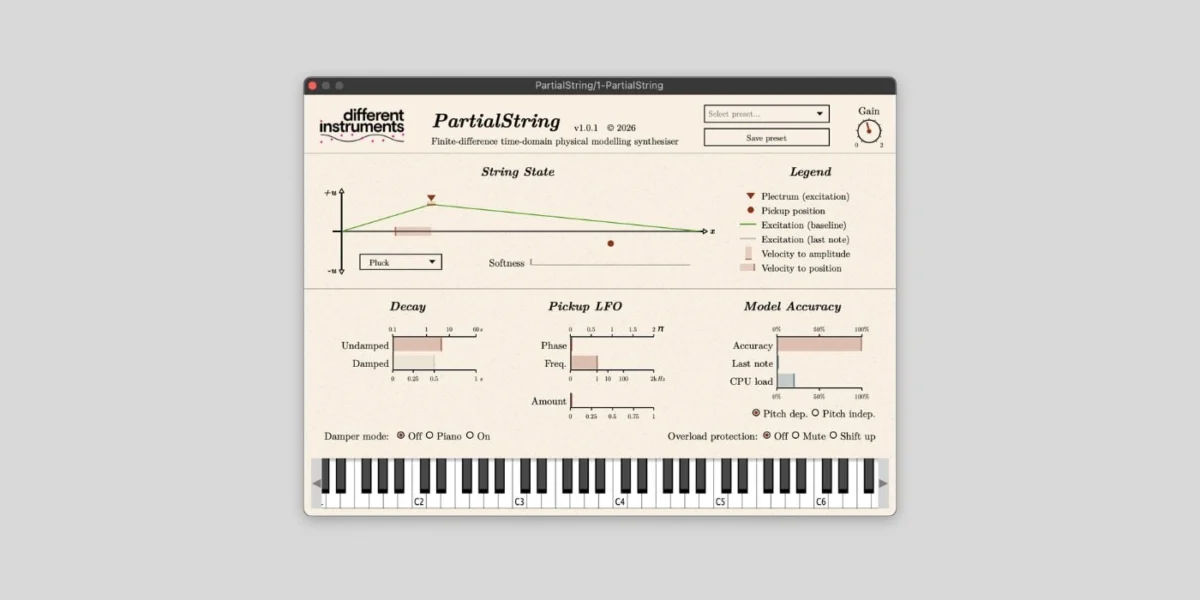
Different Instruments, led by developer Christian Baker, has officially released PartialString, a new virtual synthesizer that offers a distinctive approach to physical modeling. Available as a free, cross-platform instrument, PartialString leverages the finite-difference time-domain (FDTD) method to simulate the intricate vibrations of a plucked string, presenting a compelling alternative to more conventional synthesis techniques. The synth is compatible with macOS (10.13 or later), Windows (10 or later), and Linux, and is offered in both AU and VST3 plugin formats, making it accessible to a broad spectrum of music producers and sound designers. This release, designated as v1.0.1, marks the culmination of an extensive development period that began as a passion project following Baker’s earlier work on GoStringSynth in 2022.
The Genesis of PartialString: From GoStringSynth to FDTD Innovation
The journey leading to PartialString began in the wake of Christian Baker’s previous venture, GoStringSynth. Released in 2022 and made available through GitHub, GoStringSynth demonstrated Baker’s early interest in string synthesis and the exploration of unique sonic textures. While GoStringSynth provided a foundational understanding of the complexities involved in digitally recreating string behaviors, it laid the groundwork for a more ambitious undertaking. Recognizing the potential for deeper exploration into physical modeling, Baker embarked on PartialString as a side project. This initiative quickly evolved, transforming into a four-year development cycle dedicated to refining an unconventional synthesis methodology. The dedication to this project underscores Baker’s commitment to pushing the boundaries of what is traditionally expected from software instruments, particularly in the realm of physical modeling. The choice to release PartialString as a free plugin further aligns with a philosophy of democratizing access to innovative sound design tools, a trend increasingly observed within the independent developer community.
A Deep Dive into Finite-Difference Time-Domain (FDTD) Modeling
The core innovation of PartialString lies in its utilization of the finite-difference time-domain (FDTD) method for string vibration simulation. This technique stands in contrast to more widely adopted algorithms, such as Karplus-Strong, which have historically dominated the digital emulation of plucked or struck string sounds. Understanding the FDTD method requires a brief foray into the principles of physical modeling synthesis.
Physical modeling aims to recreate the sound of an instrument by simulating its physical properties and the interactions between its components. Instead of relying on samples or subtractive synthesis, it mathematically models the instrument’s physics. The FDTD method achieves this by discretizing both space and time into a computational grid. In the context of a one-dimensional string, this means the string is divided into numerous small segments, and the wave equation governing its vibration is solved numerically at each point and at each discrete time step. This iterative process allows the software to track the propagation and reflection of waves along the string, as well as the energy dissipation and interaction with boundary conditions (like fixed ends).
This granular, real-time calculation of physical phenomena provides a high degree of accuracy in reproducing the complex overtone structures and decay characteristics inherent in real strings. The result is a richer, more nuanced sound that captures subtle physical behaviors often missed by simpler algorithms. The computational intensity, however, is a direct consequence of this detailed simulation. Solving complex differential equations across numerous grid points and time steps in real-time demands significant processing power, which has historically been a barrier to widespread adoption of FDTD in musical instruments. However, advancements in computing power and optimization techniques have made such methods increasingly viable for real-time applications.
FDTD vs. Karplus-Strong: A Comparative Analysis
To fully appreciate PartialString’s approach, it is crucial to compare the FDTD method with the more prevalent Karplus-Strong algorithm. Developed by Kevin Karplus and Alex Strong at Stanford University in the early 1980s, the Karplus-Strong algorithm revolutionized digital string synthesis due to its simplicity and computational efficiency. It works by feeding a short, exciting waveform (often a burst of noise or an impulse) into a filtered delay line. The output of the delay line is then fed back into its input, creating a loop. The filter within the loop shapes the harmonics and simulates the energy decay, mimicking the natural damping of a vibrating string.
Key Differences and Implications:
- Accuracy vs. Efficiency: Karplus-Strong is celebrated for its low CPU footprint, making it highly efficient for polyphonic applications and embedded systems. Its simplicity, however, means it can be less accurate in modeling the complex nuances of a string’s vibration, especially regarding dynamic changes in timbre and overtone decay. The FDTD method, by contrast, offers superior accuracy because it directly models the underlying physics, capturing a wider range of physical phenomena. This translates into more realistic and dynamically responsive timbres, but at the cost of higher CPU utilization.
- Physical Fidelity: FDTD can model nonlinearities, dispersion, and boundary conditions with greater precision, leading to more authentic decay envelopes and harmonic evolution. Karplus-Strong, while effective, often produces a more idealized or "synthesized" string sound, though it can be highly musical.
- Sound Design Potential: While Karplus-Strong is excellent for its specific sonic character (often associated with plucked strings, bass, and some percussive sounds), FDTD’s detailed physical modeling opens doors for more intricate and experimental sound design, allowing for the exploration of non-traditional string behaviors that might emerge from unusual excitation or measurement points.
- Historical Context: Karplus-Strong quickly became a cornerstone of digital synthesis, appearing in various forms in software and hardware instruments. Renowned companies like Applied Acoustic Systems (AAS) have built their entire product lines on advanced physical modeling, often utilizing refined Karplus-Strong principles or modal synthesis, demonstrating that the core concept can be incredibly versatile and powerful when expertly implemented. The FDTD method, while present in academic research for decades, has seen less widespread commercial adoption in musical instruments due to its computational demands, making PartialString’s implementation a notable development.
User Interface and Experimental Sound Design
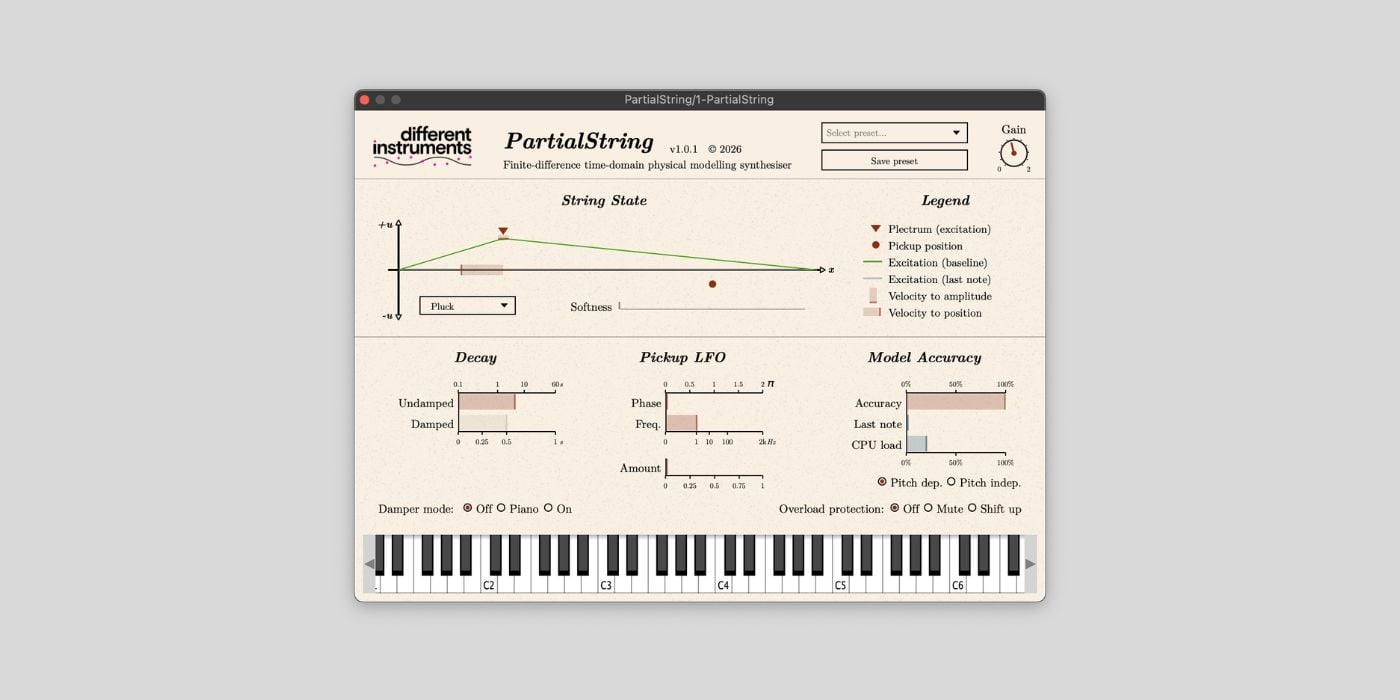
PartialString’s graphical user interface (GUI) reflects its technical underpinnings, presenting an aesthetic reminiscent of a scientific or mathematical diagram. This design choice is fitting for a plugin that delves into the physics of sound generation. Despite its complex internal workings, the interface is well-organized and intuitive, focusing on a handful of key sections that allow users to sculpt the sound effectively.
The primary control sections include:
- String State: This section is critical for defining how the virtual string is excited and how its displacement is measured.
- Plectrum (Exciter): Controls the position and characteristics of the "pluck." By adjusting the plectrum’s location along the string, users can influence the initial harmonic content and attack transient, mimicking the varied sounds produced by plucking a string at different points (e.g., near the bridge for a bright sound, near the neck for a softer tone).
- Pickup: Determines where the string’s vibration is "read" to generate the audio output. Similar to a physical guitar pickup, its position significantly alters the resulting timbre by emphasizing or de-emphasizing certain harmonics.
- Decay: This section allows for fine-tuning the rate at which the string’s energy dissipates. While physical modeling naturally handles decay, these controls provide artistic license to extend, shorten, or shape the decay envelope, moving beyond strict physical realism towards more expressive and synthetic textures.
- Pickup LFO: Introducing modulation to the pickup position via an LFO (Low-Frequency Oscillator) opens up a vast array of evolving timbres. This dynamic movement of the "pickup" along the vibrating string can create anything from subtle tremolo-like effects to sweeping filter-like movements, transforming a static pluck into a rich, modulating pad or atmospheric texture.
- Model Accuracy: This parameter likely allows users to adjust the resolution or complexity of the FDTD simulation. A higher accuracy setting would result in a more detailed and physically precise sound but would demand more CPU resources. Conversely, a lower accuracy setting would reduce CPU load, potentially leading to a slightly less detailed sound but allowing for higher polyphony or use on less powerful systems. This control offers a crucial trade-off, empowering users to balance sonic fidelity with system performance.
One of PartialString’s explicit design goals, despite its foundation in accurate physical modeling, is to encourage experimental sound design. The interplay between the String State, Decay, Pickup LFO, and Model Accuracy settings enables users to transcend traditional string sounds. The provided demo video illustrates this capability, showcasing transitions from dull, muted plucks to bright, harsh tones, and even the creation of modulating, pad-like textures. The inclusion of a brief excerpt from Radiohead’s "Everything in Its Right Place" within the demo subtly highlights the synth’s potential for evocative and complex soundscapes, demonstrating its versatility beyond mere emulation.
Polyphony and Performance Considerations
Given the inherent computational demands of the FDTD method, PartialString incorporates a dynamic polyphony system. The synth supports up to 10 voices, but this number is dynamically adjusted based on the host computer’s capabilities. This intelligent resource management is critical for a high-fidelity physical modeling instrument, ensuring that users can achieve the best possible performance without overwhelming their CPU. On powerful systems, users can enjoy the full 10-voice polyphony, enabling complex chords and layered textures. On systems with more modest specifications, the polyphony will scale down gracefully, preventing audio dropouts and maintaining stability. This pragmatic approach addresses one of the primary challenges associated with advanced physical modeling techniques, making the instrument practical for a wider range of users and studio setups.
Broader Implications for the Synthesis Community
The release of PartialString carries several significant implications for the music technology landscape:
- Democratization of Advanced Synthesis: By offering a sophisticated FDTD-based physical modeling synthesizer for free, Different Instruments is making cutting-edge sound design techniques accessible to a broader audience. This aligns with a growing trend of high-quality, free software instruments that empower independent producers and hobbyists without financial barriers.
- Stimulating Innovation: The explicit focus on experimental sound design encourages users to explore new sonic territories. This can foster creativity and potentially inspire further innovations in synthesis and sound design, pushing artists to think beyond conventional instrument emulations.
- Validation of Independent Development: Christian Baker’s journey from a GitHub project (GoStringSynth) to a polished, free commercial-grade plugin like PartialString underscores the vital role of independent developers in driving innovation within the music technology industry. These individual efforts often lead to unique perspectives and novel implementations that larger companies might overlook.
- Advancing Physical Modeling: PartialString’s successful implementation of FDTD in a real-time, polyphonic context for a virtual instrument demonstrates the continuing evolution of physical modeling synthesis. As computing power increases, more sophisticated and accurate physical models become viable, blurring the lines between digital emulation and acoustic reality, while also opening new avenues for entirely new sound palettes.
- Educational Value: The plugin can serve as an excellent educational tool for those interested in the underlying physics of sound and advanced synthesis techniques. Its "math textbook" GUI and distinct approach provide a tangible example of theoretical concepts put into practice.
The Future of Physical Modeling and Different Instruments
PartialString represents a significant step forward in the realm of physical modeling synthesis, particularly for its innovative use of the FDTD method in a user-friendly and accessible package. Its release reaffirms the potential for digital instruments to offer both high fidelity and extensive creative freedom. As computing power continues its exponential growth, the boundaries of what is possible with physical modeling will undoubtedly expand further, leading to even more realistic, expressive, and imaginative sound design tools.
Different Instruments, under Christian Baker’s direction, has clearly demonstrated a commitment to exploring less trodden paths in synthesis. The evolution from GoStringSynth to PartialString showcases a dedication to research, development, and the provision of high-quality, innovative tools to the music production community. The success and reception of PartialString will likely inform the future direction of Different Instruments, potentially inspiring further exploration into other complex physical models or novel synthesis paradigms. This focus on pushing technical boundaries while remaining accessible bodes well for the future contributions of this developer to the evolving landscape of music technology.
Last Updated on July 20, 2026 by Tomislav Zlatic.
