

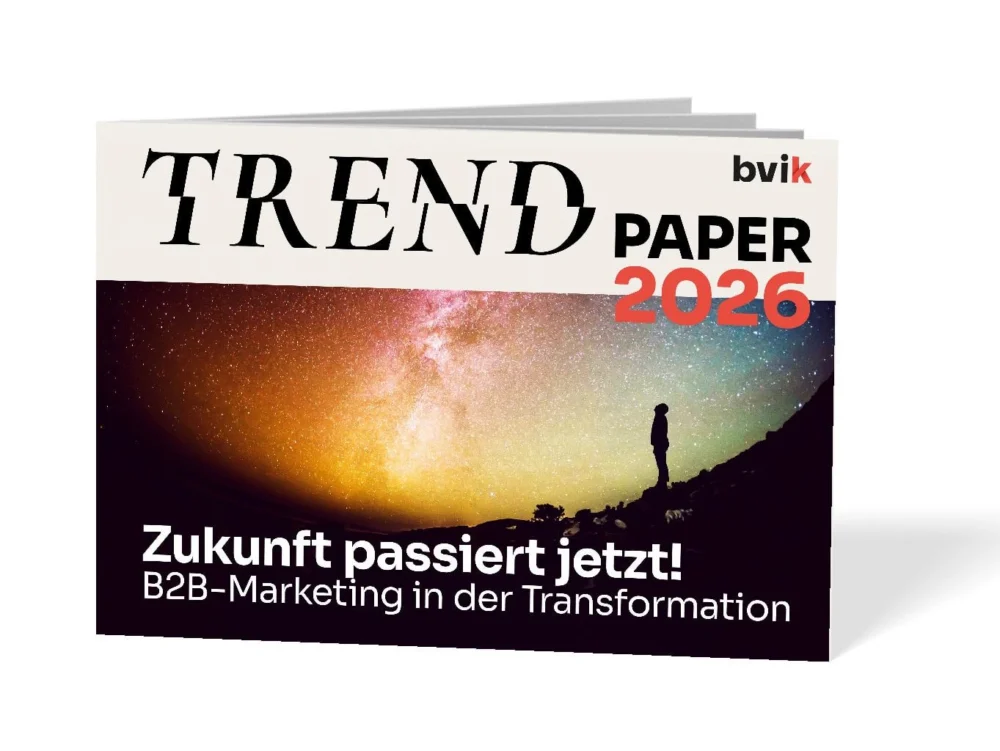
The Federal Association of Industrial Communication (bvik) has officially unveiled its comprehensive Trendpaper 2026, titled "Future is Happening Now! B2B Marketing in Transformation." This 50-page strategic document serves as a roadmap for medium-sized industrial enterprises, commonly referred to as the "Mittelstand," providing actionable insights on how to navigate a landscape defined by economic volatility, technological disruption, and shifting geopolitical realities. By focusing on five core pillars—marketing, brand, mindset, knowledge, and digitalization—the publication asserts that the current era of uncertainty should be viewed not as a barrier, but as a catalyst for organizational evolution and market share protection.
Ramona Kaden, CEO of bvik, emphasizes that the speed of organizational learning has become the primary competitive advantage in the modern industrial sector. According to Kaden, the fundamental question facing German industry is no longer whether adaptation is necessary, but how rapidly organizations can evolve their marketing functions and broader corporate cultures to meet the demands of a digitized global economy.
The Context of Permanent Crisis and Industrial Resilience
The release of the Trendpaper 2026 comes at a critical juncture for European industry. For several years, industrial players have operated in a state of "polycrisis"—a convergence of budget constraints, a chronic shortage of skilled labor, geopolitical instability, and an accelerating pace of technological change driven by artificial intelligence (AI) and automation. The bvik report acknowledges these pressures but offers a counter-narrative of optimism. It suggests that the current transformation phase is exactly when the "wheat is separated from the chaff," as forward-thinking companies leverage data and human-centric strategies to outpace competitors who remain in a reactive posture.
Historically, industrial marketing in the B2B sector was often relegated to a support role—frequently described as an "extended workbench" for the sales department. The Trendpaper 2026 argues that this model is obsolete. In a world where 70% to 80% of the B2B buyer’s journey occurs digitally before a customer ever speaks to a sales representative, the marketing function must take a lead role in strategic growth and brand positioning.
Five Central Theses for the Future of B2B Marketing
The core of the Trendpaper is built upon five interconnected theses derived from extensive industry research. These theses provide a framework for companies to assess their current maturity and plan their strategic investments through 2026 and beyond.
1. Adaptability as the New Organizational Standard
The report posits that rigid five-year plans are a relic of the past. Future-proof organizations are those that build "agile resilience." This involves creating modular team structures that can pivot in response to supply chain shifts or sudden technological breakthroughs. The bvik suggests that the ability to "unlearn" old processes is just as vital as the acquisition of new skills.
2. Strategic Elevation of Marketing and Brand
In times of economic downturn, many firms instinctively cut marketing budgets. The Trendpaper 2026 warns against this, providing data that suggests brands that maintain or increase their visibility during crises capture significantly more market share during the subsequent recovery. The brand is no longer just a logo; it is a promise of reliability in an unstable world, serving as a critical differentiator in commoditized industrial markets.
3. Data-Driven Management and Precision Targeting
The transition from gut-feeling decision-making to data-backed strategy is a central theme. The report highlights the necessity of integrated CRM systems, marketing automation, and AI-driven analytics. By leveraging data, industrial firms can move toward "predictive marketing," identifying customer needs before the customer even articulates them. This shift requires a significant investment in digital infrastructure and data literacy across the workforce.
4. Expansion of Digital Sales and Omnichannel Presence
The traditional reliance on trade fairs and direct sales visits is being supplemented—and in some cases replaced—by sophisticated digital sales channels. The bvik analysis shows a growing trend toward B2B e-commerce and digital twins, allowing customers to configure complex industrial machinery in virtual environments. Companies that fail to provide a seamless digital purchasing experience risk losing the next generation of "digital native" procurement officers.
5. The Synthesis of Human Creativity and Technology
While AI and automation are transformative, the Trendpaper underscores that human creativity remains the ultimate "X-factor." The ability to tell compelling stories, build deep-rooted trust, and solve complex problems requires a human touch. The most successful firms in 2026 will be those that achieve a "centaur" model—combining the processing power of AI with the emotional intelligence and strategic vision of human experts.
Methodology: A Multi-Dimensional Analysis
The findings within the Trendpaper are not merely theoretical; they are grounded in a robust multi-stage research process conducted throughout late 2025 and early 2026. The foundation of the report is the "bvik Trendbarometer Industriekommunikation 2026," a quantitative study that surveyed hundreds of marketing and communication decision-makers across the DACH region (Germany, Austria, and Switzerland).
To provide qualitative depth, bvik organized a high-level "Future Workshop" involving heads of marketing from leading industrial firms and specialized B2B agencies. This was followed by six in-depth expert interviews with C-level executives and thought leaders from globally recognized brands, including Festo, Bosch Rexroth, and MANN+HUMMEL. These interviews provide a "behind-the-scenes" look at how industry leaders are restructuring their departments to handle the pressures of digitalization and ESG (Environmental, Social, and Governance) reporting requirements.
Expert Insights from the Industrial Frontline
The inclusion of voices from companies like Festo and Bosch Rexroth provides practical credibility to the report’s claims. For instance, representatives from Bosch Rexroth discuss the "Move" transformation, which focuses on shifting the organization toward a more customer-centric and agile mindset. Meanwhile, experts from MANN+HUMMEL highlight the importance of sustainability as a brand pillar, noting that "green marketing" in the industrial sector must be backed by verifiable data to avoid "greenwashing" and to meet the stringent requirements of the EU’s Corporate Sustainability Reporting Directive (CSRD).

A recurring sentiment among the interviewed experts is that the "human factor" is the most significant bottleneck—and the greatest opportunity. The "War for Talent" in 2026 is no longer just about hiring engineers; it is about attracting digital marketers, data scientists, and transformation managers who understand the nuances of the industrial sector.
Marketing as a Strategic Growth Lever
One of the most provocative conclusions of the Trendpaper 2026 is the "Empowerment Gap." The bvik observes that while marketing is being asked to do more—manage social media, oversee lead generation, implement AI, and handle internal communications—it is often doing so with stagnant or shrinking resources.
To bridge this gap, the report advocates for marketing to be represented at the board level or within key decision-making circles. Ramona Kaden argues that marketing should function as the "eye and ear" of the company, acting as the primary link between market trends, technological possibilities, and corporate strategy. When marketing is viewed as a value-driver rather than a cost center, it enables the "Mittelstand" to defend its global leadership position against emerging competitors from Asia and North America.
Implications for the Future of the Industry
The broader implications of the bvik Trendpaper 2026 suggest a fundamental reordering of the industrial hierarchy. The "Hidden Champions" of the past—companies that succeeded through engineering excellence alone—must now become "Connected Champions." This involves a holistic transformation where the product, the service, and the digital experience are inseparable.
Furthermore, the report touches upon the role of "Co-opetition"—collaboration between competitors to solve industry-wide challenges, such as data standardization and carbon footprint tracking. In the 2026 landscape, the ability to participate in digital ecosystems and platforms is projected to be a major determinant of long-term viability.
Accessing the Report
The "Zukunft passiert jetzt! B2B-Marketing in der Transformation" Trendpaper is currently available for distribution. In line with bvik’s mission to foster knowledge sharing within the industry, the whitepaper is provided free of charge to all association members via their digital download portal. For non-members, the association has made the document available for a nominal fee of €195, reflecting the high value of the proprietary research and expert analysis contained within.
As the industrial sector continues to navigate the complexities of the mid-2020s, the bvik Trendpaper 2026 stands as a vital resource for leaders looking to transform uncertainty into a structured path for growth. It serves as a reminder that in the world of B2B communication, the future is not something that happens to a company—it is something a company creates through deliberate, data-driven, and human-centric action.
