

The professional lighting industry has witnessed a significant shift in the landscape of large-scale aerial effects throughout the summer and autumn seasons of late 2025 and early 2026, driven largely by the market entry of GLP’s Mad Maxx. As the world’s first "Super-Fatbeam" of its kind, the Mad Maxx was engineered with a specific and ambitious goal: to provide a viable, high-efficiency LED alternative to the traditional 3-kW and 7-kW Xenon searchlights that have dominated stadium and festival skylines for decades. By combining massive output with the versatility of modern LED pixel control, the fixture has moved beyond being a mere novelty to becoming a staple in the toolkits of international production designers and rental houses.
The Technical Evolution of the FatBeam Concept
At the core of the Mad Maxx’s appeal is its unprecedented physical presence. Featuring a beam diameter of 750 millimeters, the fixture produces a column of light that possesses a structural quality rarely seen in LED-based luminaires. This "FatBeam" characteristic allows designers to create architectural shapes in the air that do not wash out over long distances, a common limitation of smaller-aperture LED fixtures.
The light engine is comprised of 19 individually controllable 90-watt LEDs, culminating in a staggering total output of up to 68,000 lumens. Beyond raw power, the fixture offers a sophisticated level of control. The pixels are arranged to allow for granular manipulation, either as individual units or grouped into three distinct segments: the Center, the Inner Ring, and the Outer Ring. This segmentation enables complex pixel mapping and dynamic internal effects, allowing the "face" of the light to become a scenic element in itself, rather than just a source of illumination. For lighting programmers, the inclusion of an Extended Mode provides nearly limitless creative options, bridging the gap between a high-intensity searchlight and a multi-functional effect light.
Early Adoption and Strategic Investment: Gateway Productions
The rapid ascent of the Mad Maxx in the North American market can be traced back to early strategic investments by regional production firms. Gateway Productions, based in Newburyport, Massachusetts, was among the first in the United States to recognize the potential of the fixture. Owner Alex Sommerfeld, a long-time partner of GLP (German Light Products), initially encountered the Mad Maxx through digital previews before conducting hands-on testing at the InfoComm trade show.
Sommerfeld’s decision to add ten units to his inventory was driven by a desire to offer a unique value proposition in a competitive market. In the professional rental sector, regional providers often face the challenge of distinguishing themselves from larger national conglomerates. Sommerfeld noted that the Mad Maxx provided an "edge" that standard bright moving lights could not match. By offering a fixture that occupies its own category, Gateway Productions was able to provide touring clients with a high-impact visual "topper"—or, as Sommerfeld colloquially described it, "the sprinkles on the ice cream"—that elevates a standard lighting rig into a world-class production.
Case Study: T-Pain’s TP20 Anniversary Tour
One of the most high-profile deployments of the Mad Maxx occurred during T-Pain’s "TP20" 2025 Tour, which celebrated the 20th anniversary of his seminal debut album, Rappa Ternt Sanga. Lighting designer Noah "Nappy Boy" Lucas sought a fixture that could provide the scale required for large amphitheater shows while maintaining the speed and agility of modern moving heads.
For the tour’s landmark performance at New York City’s Radio City Music Hall in September, Lucas utilized six Mad Maxx units positioned upstage in a linear configuration behind four vehicles integrated into the stage design. The objective was to recreate the massive, sweeping searchlight effects synonymous with grand cinematic premieres and large-scale hip-hop spectacles. Lucas reported that the fixtures surpassed expectations not only in terms of output—matching the throw and intensity of on-stage lasers—but also in their mechanical performance. Despite their massive 750mm lenses, the units demonstrated surprising movement speed, allowing for synchronized ballyhoos and rapid position changes.
A standout moment in the programming involved the use of the fixture’s pixel-mapping capabilities. During the performance of the hit "Got Money," Lucas programmed the beam structures to resemble casino dice, utilizing the segmented LED rings to create thematic visual cues that resonated with the song’s lyrics. This level of thematic integration demonstrated that the Mad Maxx is as much a graphical tool as it is a beam light.
Resilience and Atmosphere at the Valley of the Seven Stars Festival
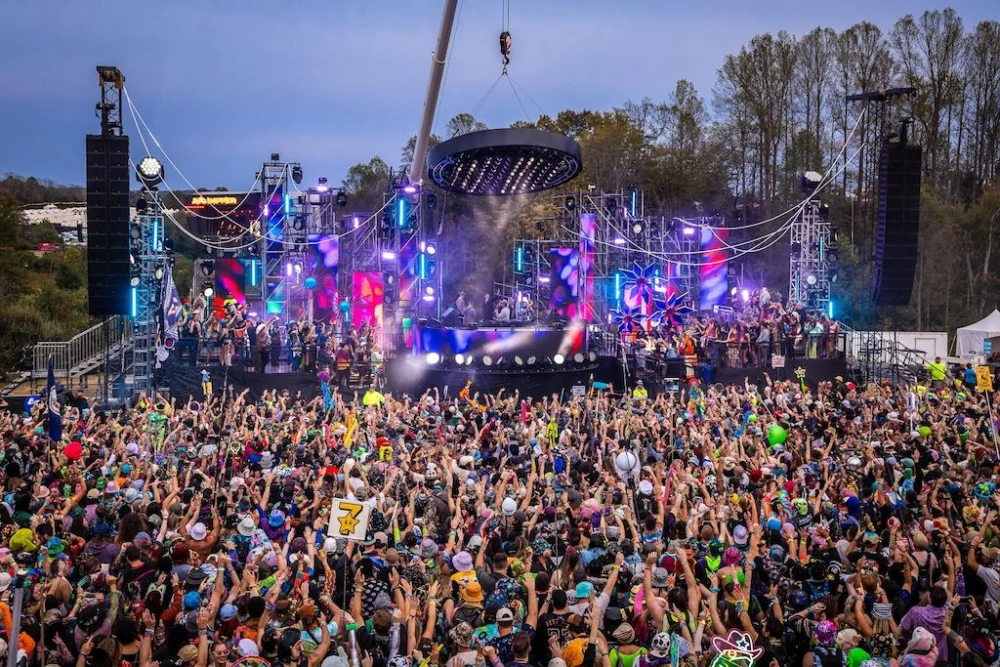
The outdoor festival circuit presents the ultimate litmus test for new lighting technology, requiring fixtures to withstand environmental stressors while competing with ambient light and vast open spaces. At the Valley of the Seven Stars Festival in Arrington, Virginia, PHNTM Productions utilized the Mad Maxx to anchor the visual identity of the Zodiac Stage.
Designers Chris Ruppel and Michael Smalley selected the fixtures specifically for their geometric form and lens surface area, which complemented the stage’s scenographic elements. Supplied by Volt Lites via primary contractor Christie Lites, two Mad Maxx units were mounted atop 7.5-meter towers flanking the PA system. Operating in "Mode 3 Multi Beam" (utilizing 170 DMX channels), the fixtures served as visual anchors that mirrored the shapes of the stage architecture.
The festival also highlighted the fixture’s performance in adverse weather. During a period of heavy rain on the event’s third day, the Mad Maxx’s "FatBeam" interacted with the precipitation and low-hanging clouds to create a spectacular atmospheric effect. The density of the beam caused light to refract through the raindrops, effectively turning the entire atmosphere into a canvas and providing a bonus visual layer that would have been impossible with traditional, thinner beams.

Shifting the Industry Standard: From Xenon to LED
The broader implications of the Mad Maxx’s success lie in the ongoing transition from discharge-based lamps to LED technology. For decades, the 3-kW and 7-kW Xenon searchlights were the only options for designers requiring "sky-tracking" capabilities. However, Xenon technology carries significant drawbacks, including massive power consumption, short lamp life, the need for specialized high-voltage power strikes, and substantial heat dissipation requirements.
The Mad Maxx addresses these issues by providing a solid-state alternative that reduces power draw while offering a wider color gamut and instantaneous dimming/strobing capabilities. Furthermore, the longevity of the LED source significantly reduces the "total cost of ownership" for rental houses, as the need for frequent and expensive lamp replacements is eliminated. As sustainability becomes a core requirement for global tours—pioneered by acts like Coldplay and Billie Eilish—the shift toward high-output LED searchlights like the Mad Maxx is expected to accelerate.
Future Outlook and Global Expansion
The momentum for the Mad Maxx shows no signs of waning as the 2026 touring season approaches. Lighting designer Marcus Jessup has already integrated the Gateway Productions fleet into Playboi Carti’s "Antagonist" tour and has indicated plans to specify a significantly larger quantity for Bad Bunny’s upcoming world tour. The fixture’s ability to "fill the frame" makes it particularly attractive for televised events and tours that rely heavily on social media visibility, as the 750mm lens creates a massive "eye" that translates exceptionally well to camera.
Other major productions currently utilizing the fixture include Falling In Reverse and Ice Cube’s "Truth To Power 40th Anniversary Tour." The latter is reportedly the subject of an upcoming technical case study by GLP, focusing on how the Mad Maxx was used to bridge the gap between old-school West Coast lighting aesthetics and modern digital precision.
In conclusion, the GLP Mad Maxx has successfully carved out a new niche in the professional lighting market. By delivering a "Super-Fatbeam" that combines the raw power of legacy searchlights with the sophisticated control of modern LEDs, it has provided designers with a new vocabulary for large-scale visual storytelling. As more rental houses invest in the platform and more designers explore its 170-channel potential, the Mad Maxx is poised to remain a dominant force in the evolution of the global concert and festival experience.
