

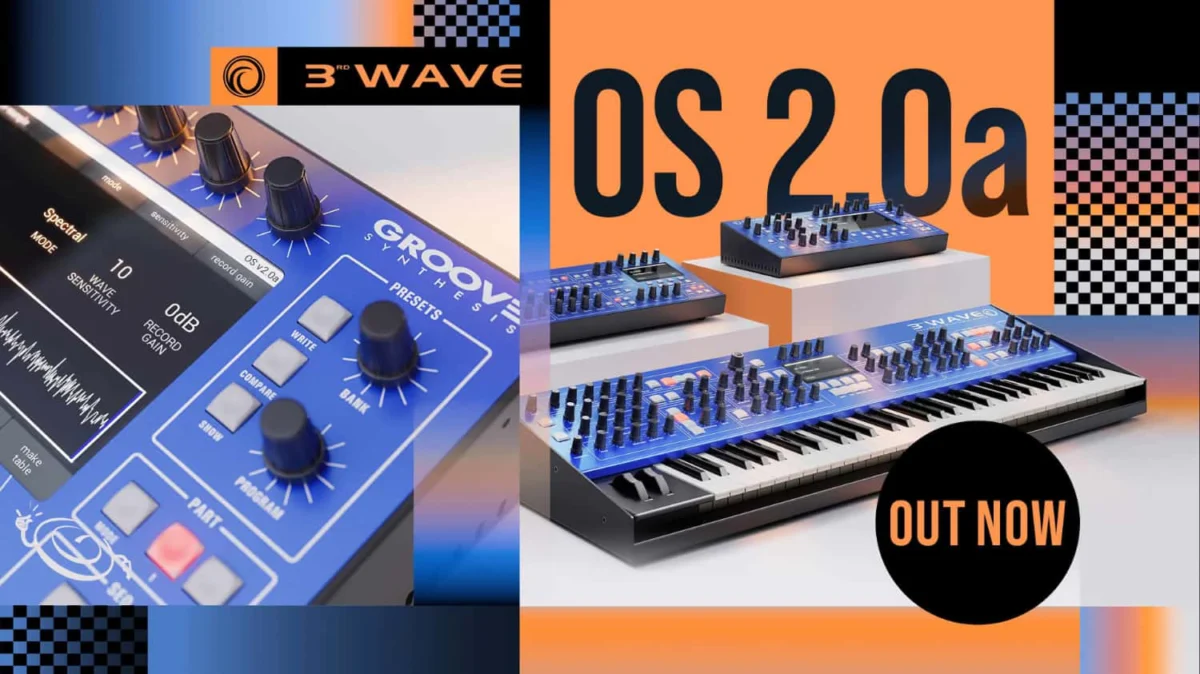
Groove Synthesis has officially announced the release of OS Version 2.0a for the 3rd Wave synthesizer, a significant firmware update that introduces sophisticated signal processing capabilities and refined wavetable generation tools. Available as a free download for owners of the 3rd Wave 24-voice keyboard, as well as the 24M and 8M desktop modules, this update represents a major milestone in the instrument’s lifecycle. By integrating a high-fidelity Shimmer Reverb and a groundbreaking "Spectral" mode for its internal wavetable creator, Groove Synthesis has expanded the sonic palette of an instrument already regarded as the spiritual successor to the legendary PPG Wave series. This update reflects the company’s commitment to iterative development, ensuring that the 3rd Wave remains at the forefront of modern hybrid synthesis.
The Evolution of the 3rd Wave Synthesizer
To understand the impact of OS 2.0a, it is necessary to examine the context in which the 3rd Wave was developed. Groove Synthesis was founded by a team of industry veterans, including Andrew Silverman and Bob Coover, many of whom held pivotal roles at Sequential. When the 3rd Wave was launched, it was positioned as a "powerhouse" wavetable synthesizer, capable of recreating the classic 8-bit grit of the 1980s while offering the high-fidelity precision of modern digital oscillators and the warmth of Dave Rossum-designed analog filters.
The 3rd Wave is a 24-voice, 4-part multi-timbral synthesizer that utilizes three oscillators per voice. It famously includes a "Circuit Correct" emulation of the PPG Wave 2.2 and 2.3, allowing users to access the historical wavetables that defined the sound of New Wave and early electronic film scores. However, the instrument’s true strength lies in its ability to generate new wavetables from external audio, a feature known as "Make Waves." Since its debut, the 3rd Wave has seen several incremental updates, but OS 2.0a is widely considered the most substantial enhancement to its core synthesis engine and effects processor to date.
Technical Analysis of the Shimmer Verb
One of the most requested features by the 3rd Wave community was a dedicated Shimmer Reverb. While the synthesizer already possessed a robust effects section, the addition of "Shimmer Verb" in the second effect slot (located immediately after the Super Plate algorithm) provides a new dimension of atmospheric sound design.
Technically, Shimmer Reverb is a pitch-shifted delay-reverb hybrid that feeds the output of a reverb tail back into a pitch shifter. In OS 2.0a, Groove Synthesis has implemented a version that allows for extreme precision. Unlike many shimmer effects that are limited to fixed octave intervals, the 3rd Wave’s implementation allows users to shift the pitch in fractions of a semitone across a full two-octave range. This allows for the creation of haunting, dissonant textures or perfectly tuned harmonic overtones that evolve over time.
Bob Coover, the lead DSP engineer at Groove Synthesis, noted that the effect was designed to provide an "immense" sense of space even with minimal input. The Shimmer Verb includes a dedicated Filter Cutoff parameter, which is essential for managing the high-frequency buildup often associated with pitch-shifted feedback loops. By adjusting the Low Pass (LP) and High Pass (HP) cutoffs, users can transition from dark, cavernous swells to bright, ethereal shimmers. Furthermore, the integration of Rev Time, Pitch Amount, and Cutoff frequencies into the modulation matrix allows for dynamic control via LFOs, envelopes, or the instrument’s pressure-sensitive keyboard.
Advancements in Wavetable Creation: The Spectral Mode
The "Make Waves" feature has been a cornerstone of the 3rd Wave’s appeal, allowing users to plug in a microphone or line-level source and convert audio into a playable wavetable. Prior to OS 2.0a, this system relied on two primary algorithms: Pitch On and Pitch Off.
- Pitch On: This mode was designed for harmonic, monophonic sources with a stable fundamental frequency. It attempts to detect the pitch and lock the waveform cycles to that frequency, ensuring a clean, musical result.
- Pitch Off: This mode ignores pitch detection and instead searches for optimal splice points in the raw audio. It is ideal for non-tonal sounds, such as percussion hits or industrial noise.
With the introduction of OS 2.0a, Groove Synthesis has added a third mode: Spectral Mode. This mode represents a paradigm shift in how the 3rd Wave processes audio. Rather than analyzing the waveform in the time domain (looking at the "shape" of the wave), Spectral Mode analyzes the audio in the frequency domain. It uses complex mathematical transforms to identify the harmonic content of the audio and then reconstructs that content into a series of wavetable frames.
Spectral Mode is specifically engineered for "difficult" audio sources that previously resulted in glitchy or unusable wavetables. This includes ambient field recordings, sounds with heavy chorus or phasing, and audio with wandering pitches. Because it focuses on the frequency spectrum rather than the zero-crossing points of a waveform, it can find the "essence" of a sound that is too complex for traditional pitch-tracking. This addition effectively removes the limitations of the built-in wavetable creator, making it one of the most powerful tools for custom sound design available in a hardware synthesizer.

Expanded MIDI Capabilities and Workflow Improvements
Beyond the headline synthesis and effects features, OS 2.0a addresses several logistical and workflow-oriented needs, particularly for users of the 8M and 24M desktop modules. These modules, which pack the full power of the 3rd Wave into a more compact form factor, require robust MIDI implementation to compensate for the lack of a full keyboard and dedicated slider array.
The update introduces expanded MIDI CC (Continuous Controller) mappings, ensuring that every critical parameter can be automated or controlled via external hardware sequencers or Digital Audio Workstations (DAWs). This is a vital improvement for professional studio environments where the 3rd Wave is integrated into a larger MIDI ecosystem.
Additionally, the update enhances the MIDI System Exclusive (SysEx) functionality. Users can now import and export wavetables and samples via SysEx, facilitating easier backup and sharing of custom sounds. This level of data portability is essential for the growing community of 3rd Wave "sound designers" who trade and sell custom patches. The update also includes a new envelope retrigger option with a "quick reset" function, which improves the responsiveness of the envelopes during fast, polyphonic playing or when triggered by external gate signals.
Chronology of the OS 2.0a Development
The development of OS 2.0a followed a period of intense feedback from the 3rd Wave user base. Since the release of the 8M module in late 2023, Groove Synthesis has focused on bridging the gap between the hardware’s massive internal potential and the user’s ability to manipulate that power.
- June 2022: The 3rd Wave 24-voice keyboard is launched, reviving interest in high-end wavetable synthesis.
- Early 2023: OS 1.5 is released, introducing initial refinements to the "Make Waves" algorithm and bug fixes.
- Late 2023: The 8M and 24M desktop modules are released, expanding the user base.
- Mid-2024: Groove Synthesis begins beta testing for OS 2.0, focusing on the Spectral mode and new reverb algorithms.
- Present: OS 2.0a is released to the public, incorporating final bug fixes and optimized MIDI mappings.
Official Statements and Industry Impact
The release of OS 2.0a has been met with significant praise from synthesis enthusiasts and professional musicians alike. Andrew Silverman, co-founder of Groove Synthesis, emphasized that the instrument has evolved far beyond its original design specifications. “The 3rd Wave has come a long way since it first came out, capable of things we never dreamed of at launch,” Silverman stated.
Industry analysts suggest that the 3rd Wave’s continued development is a strategic move to maintain its position against competitors like the Waldorf Quantum and the Korg Modwave. By offering high-value features like Spectral synthesis and a premium Shimmer reverb as free updates, Groove Synthesis is fostering a loyal customer base and increasing the "resale value" and longevity of the hardware.
The inclusion of Spectral synthesis is particularly noteworthy. In the current market, most spectral processing is confined to software plugins (such as iZotope Iris or Spectrasonics Omnisphere). Bringing this level of frequency-domain analysis to a hardware instrument with an analog signal path is a rare feat of engineering that distinguishes the 3rd Wave from other digital-analog hybrids.
Conclusion and Future Implications
Groove Synthesis 3rd Wave OS Version 2.0a is more than a simple patch; it is a fundamental expansion of the instrument’s capabilities. By refining the wavetable creation process and adding high-end spatial effects, Groove Synthesis has ensured that the 3rd Wave remains a relevant and powerful tool for composers, sound designers, and performers.
The "Spectral" mode, in particular, opens up a new world of "organic digital" sounds, allowing users to transform any recording into a playable, multi-dimensional instrument. As the synthesizer market continues to lean toward "lifetime" instruments—hardware that receives significant updates long after purchase—Groove Synthesis is demonstrating that they are a premier player in the industry. For owners of the 3rd Wave, OS 2.0a is a testament to the instrument’s untapped potential, promising years of further sonic exploration.
