

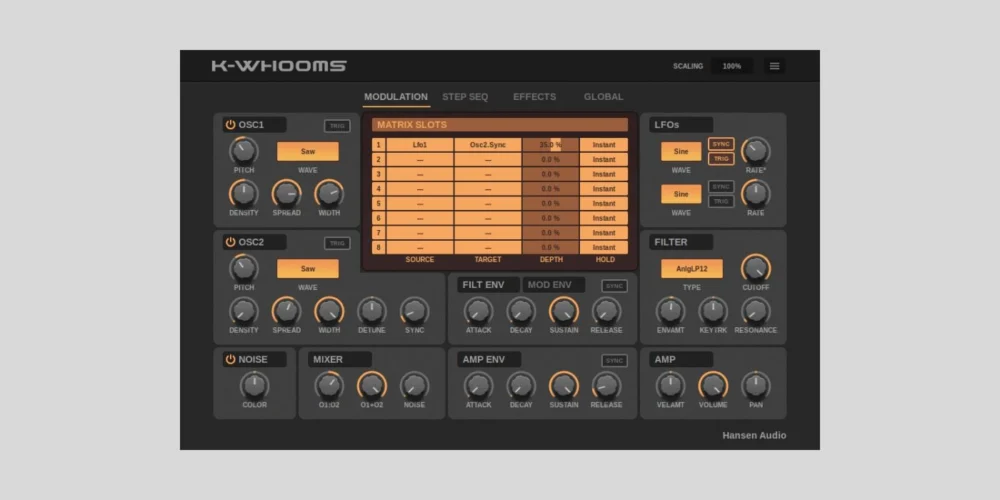
The digital audio workstation (DAW) landscape has recently been enriched by the emergence of K-Whooms, a sophisticated yet entirely free virtual analog synthesizer developed by Hansen Audio. Initially launched in 2024 and subsequently refined with an update in 2025, K-Whooms has garnered attention for its comprehensive feature set, intuitive interface, and crucial compatibility with both Windows and Linux operating systems. Its recent spotlight on prominent music production platforms underscores a growing industry trend towards accessible, high-quality freeware instruments, particularly those addressing the specific needs of the Linux audio community.
Background: The Evolving Landscape of Software Synthesis
The proliferation of virtual instruments has revolutionized music production over the past few decades, democratizing access to studio-grade sounds and complex synthesis architectures. Virtual analog synthesizers, in particular, aim to emulate the warmth, character, and often unpredictable nuances of classic hardware synthesizers using digital algorithms. This category of software has become a cornerstone for producers across genres, offering a vast palette of sounds from foundational basslines and soaring leads to intricate pads and atmospheric textures.
Within this expansive ecosystem, the segment of free virtual instruments plays a vital role. Developers like Hansen Audio contribute significantly by offering powerful tools without a financial barrier, enabling aspiring musicians, educators, and budget-conscious professionals to explore advanced sound design concepts. The release of K-Whooms aligns with a broader movement towards making sophisticated music production more accessible, fostering creativity among a wider audience.
A Timely Discovery: Addressing Community Demand
Despite its initial release in 2024 and a significant update in 2025, K-Whooms remained somewhat under the radar of some major music technology outlets until recently. Its discovery and subsequent feature highlight by Bedroom Producers Blog (BPB), a widely respected resource for freeware and affordable music production tools, illustrates the power of community engagement in the digital age. The blog noted an increasing number of requests from its readership for coverage of Linux-compatible software, reflecting a discernible shift in the user base and a growing demand for professional audio tools on open-source platforms.
The mention of K-Whooms within BPB’s community section, specifically attributed to a user identified as "Numanoid," served as a catalyst for its wider recognition. This organic discovery process underscores the importance of user-generated content and community forums in identifying valuable, often overlooked, software innovations. For independent developers like Hansen Audio, community advocacy can be a crucial factor in achieving broader visibility and adoption.
Core Architecture: A Robust Subtractive Synthesizer
K-Whooms is fundamentally a subtractive synthesizer, a classic and highly versatile synthesis method that begins with harmonically rich waveforms and then "subtracts" frequencies using filters to shape the final sound. This approach, pioneered by legendary instruments such as the Moog Minimoog and Sequential Circuits Prophet-5, forms the basis of countless iconic sounds in music history. K-Whooms embraces this established paradigm, focusing on delivering a comprehensive and well-executed interpretation rather than attempting to radically redefine it. This design philosophy ensures a familiar and approachable experience for users acquainted with traditional synthesis principles, while still offering enough depth for advanced sound design.
Detailed Feature Set: Unleashing Sonic Potential
The synthesizer’s architecture is thoughtfully organized, presenting its various modules in a clear and intuitive interface that belies its underlying power. This design choice is particularly beneficial for those new to synthesis, offering a structured environment to learn the interconnections between different sound-generating and sound-shaping components.
-
Multi-Oscillators: At the heart of K-Whooms’ sound generation are two multi-oscillators. Each oscillator is capable of generating up to nine individual phases, which can be dialed in steplessly. This multi-phase capability is a significant feature, allowing for the creation of incredibly thick, rich, and complex waveforms from a single oscillator. By spreading these phases, users can introduce subtle detuning and phase shifts, leading to lush, evolving textures that would typically require multiple stacked oscillators. The ability to widen the stereo panorama for each multi-oscillator further enhances this effect, creating expansive, three-dimensional sounds that can fill a mix. This level of control over the fundamental sound source provides a strong foundation for diverse sonic exploration, from subtle chorusing effects to massive, super-saw-like sounds.
-
Noise Generator: Complementing the harmonic richness of the multi-oscillators is a dedicated noise generator. Noise is an essential component in many synthesis patches, used for percussive elements, atmospheric textures, or to add grit and realism to synthesized sounds. K-Whooms offers an adjustable characteristic for its noise, ranging from blue through white to pink noise. This nuanced control allows users to dial in the specific spectral balance of noise required for their sound design, from bright, high-frequency white noise suitable for cymbal-like sounds, to warmer, bass-heavy pink noise often favored for environmental textures or low-frequency rumble.
-
Filter Section: The filter section is arguably the most crucial component in a subtractive synthesizer, responsible for shaping the tonal character of the sound by selectively attenuating frequencies. K-Whooms boasts an impressive array of 12 distinct filter types, offering a wide spectrum of sonic possibilities. Among these is a "ladder filter," a highly sought-after emulation of the classic Moog filter design, renowned for its distinct warmth, resonance, and organic saturation characteristics. The inclusion of various filter types, likely encompassing low-pass, high-pass, band-pass, and perhaps notch filters with different slopes (e.g., 12dB, 24dB per octave), allows for immense flexibility in carving out the desired timbre. The quality and variety of filters significantly contribute to the synth’s overall sound design potential, enabling users to craft everything from biting leads to smooth, evolving pads.
-
Modulation Matrix: For dynamic and expressive sound design, a robust modulation system is indispensable. K-Whooms features an eight-assignable-slot modulation matrix, a powerful routing hub that allows users to connect various modulation sources to a multitude of synthesis parameters. The flexibility of this matrix is a standout feature, enabling complex and interconnected modulations that bring sounds to life. Modulation sources include a dedicated envelope generator and two Low-Frequency Oscillators (LFOs). Envelopes are crucial for shaping a sound’s amplitude over time (attack, decay, sustain, release), but in a modulation matrix, they can also control parameters like filter cutoff, oscillator pitch, or even LFO rate, adding dynamic movement. LFOs, which generate periodic waveforms (e.g., sine, triangle, square), are ideal for creating rhythmic pulsations, vibrato, tremolo, or slowly evolving textures.
A particularly advanced feature within the modulation matrix is the ability to route Steinberg Note Expression parameters. This allows for per-note modulation of volume, pan, pitch, and custom parameters, offering an unparalleled level of polyphonic expression. This functionality, often found in high-end synthesizers, enables musicians to imbue individual notes within a chord or melodic phrase with distinct expressive characteristics, moving beyond global modulation applied to an entire voice. Furthermore, the modulation matrix’s target updates can synchronize to the host tempo, ensuring that modulated parameters remain perfectly in time with the user’s project, a critical feature for rhythmic and groove-oriented music production. The intuitive design of the modulation matrix has been specifically highlighted by early adopters as a particularly enjoyable and powerful aspect of K-Whooms.
-
Integrated Effects: To further refine and polish the synthesized sounds, K-Whooms includes a selection of built-in effects. A simple distortion unit allows users to add grit, saturation, or aggressive drive to their patches, significantly altering the timbre and harmonic content. This effect is invaluable for creating edgy basslines, searing leads, or simply adding character. A stereo delay effect provides spatialization and rhythmic echoes, capable of transforming dry sounds into expansive, ambient textures or rhythmic pulses. The inclusion of these fundamental effects directly within the synthesizer streamlines the sound design workflow, reducing the need to rely solely on external plugins for basic processing.
-
Synchronization and Interface Scalability: Practical considerations for integration into a modern DAW environment have also been addressed. Time and rate parameters throughout K-Whooms can sync to the host tempo, ensuring seamless integration with existing projects and accurate rhythmic execution of LFOs, delays, and other time-based effects. The graphical user interface (GUI) offers scalability from 100% to 200% in four distinct steps. This feature is increasingly important in contemporary production setups, accommodating various monitor sizes, resolutions, and user preferences, improving ergonomics and accessibility for producers working in diverse environments.
User Experience and Learning Curve
One of K-Whooms’ most compelling attributes is its well-organized interface. The clear layout of controls makes it an ideal tool for individuals embarking on their journey into synthesis. Complex concepts, such as the modulation matrix or step sequencing, become more approachable when presented in an uncluttered and logical manner. For instance, a beginner seeking to understand how a modulation matrix functions can visually trace the signal flow from source to destination, gaining practical insight into sound design principles. Similarly, the integrated step sequencer provides a hands-on opportunity to experiment with rhythmic patterns and arpeggiations directly within the synth, fostering an intuitive learning experience.
For experienced producers, K-Whooms offers a streamlined workflow for rapid sound design and experimentation. The immediate accessibility of its core features means less time navigating menus and more time creating. Its robust set of features, particularly the multi-oscillators and sophisticated modulation matrix, provides ample depth for crafting unique and complex sounds that can stand out in a professional mix.
Implications for the Music Production Community
The release and growing recognition of K-Whooms carry several significant implications for the music production community:
- Democratization of Tools: As a free VST3 plugin, K-Whooms lowers the barrier to entry for high-quality sound synthesis. This empowers aspiring musicians and producers who may not have the financial resources for expensive hardware or premium software synthesizers, allowing them to access powerful creative tools.
- Support for Linux Audio: The explicit compatibility with Linux is a crucial development. While the Windows and macOS platforms dominate the professional audio market, the Linux audio community has been steadily growing, fueled by open-source DAWs like Ardour and LMMS, and a strong user base advocating for native support. K-Whooms helps fill a persistent gap in high-quality, free native Linux VSTs, validating the platform as a viable environment for serious music production. This could encourage other developers to consider Linux compatibility in their future releases.
- Educational Value: The intuitive interface and clear layout make K-Whooms an excellent educational tool. Music technology educators and self-learners can leverage its design to teach and understand the fundamental principles of subtractive synthesis without being overwhelmed by overly complex or obscure interfaces.
- Innovation in Freeware: K-Whooms demonstrates that "free" does not equate to "basic" or "limited." Its advanced features, such as the multi-phase oscillators, comprehensive modulation matrix with Note Expression support, and multiple filter types, position it as a serious contender alongside commercial offerings. This raises the bar for freeware instruments, encouraging a higher standard of quality and functionality across the board.
- Community-Driven Discovery: The story of K-Whooms gaining wider traction through community recommendation highlights the evolving landscape of software discovery. In an era of abundant plugins, user testimonials and organic mentions within active communities are increasingly powerful tools for highlighting valuable, niche products that might otherwise remain undiscovered by mainstream channels.
Concluding Analysis
Hansen Audio’s K-Whooms is more than just another free synthesizer; it represents a thoughtful contribution to the digital music production ecosystem. By combining a robust subtractive synthesis engine with a user-friendly interface, comprehensive modulation capabilities, and essential cross-platform compatibility, it addresses key needs across the spectrum of music producers. Its embrace of Linux, in particular, signals a positive trend towards greater inclusivity in software development for audio. As the demand for versatile, accessible, and high-performance virtual instruments continues to grow, K-Whooms stands out as a compelling example of how independent developers can deliver exceptional value, further enriching the creative possibilities available to musicians worldwide. Its continued evolution and adoption will undoubtedly be watched with keen interest by the global music production community.
