

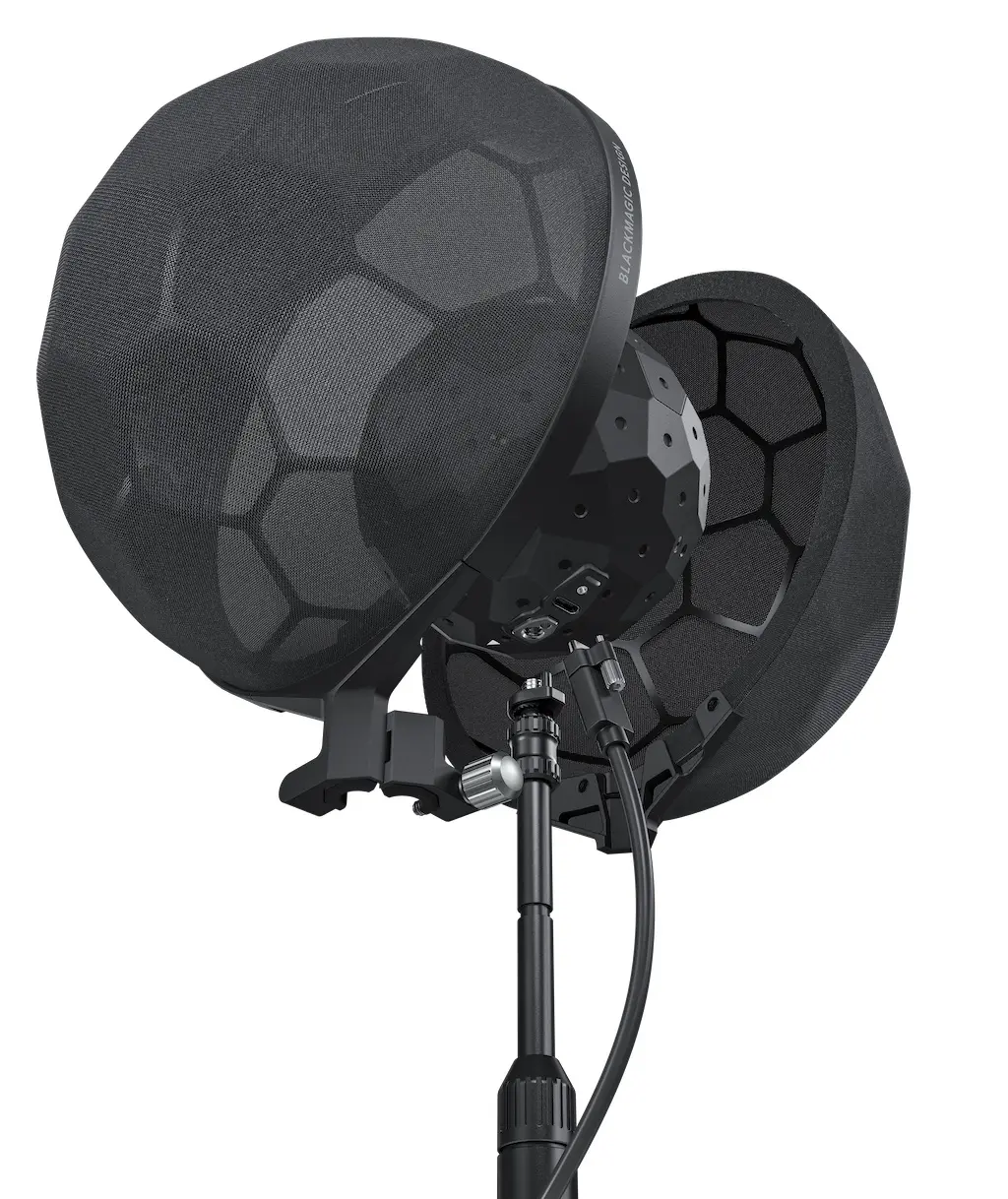
Blackmagic Design has officially announced the Blackmagic Ambisonic Microphone, a high-fidelity 7th order Ambisonic recording device featuring an unprecedented array of 108 digital MEMS microphones. This hardware represents a significant leap in spatial audio technology, designed to provide a comprehensive and immersive soundstage for high-end cinematic productions, virtual reality (VR) environments, and advanced broadcast applications. Priced at $1,695 USD (excluding local taxes and duties), the microphone is scheduled for global availability starting in December 2026. By integrating high-order Ambisonic (HOA) processing directly within the microphone housing, Blackmagic Design aims to eliminate the traditional complexities associated with spatial audio capture, such as external encoding software, bulky breakout boxes, and multi-cable configurations.
A New Benchmark in Spatial Resolution and MEMS Technology
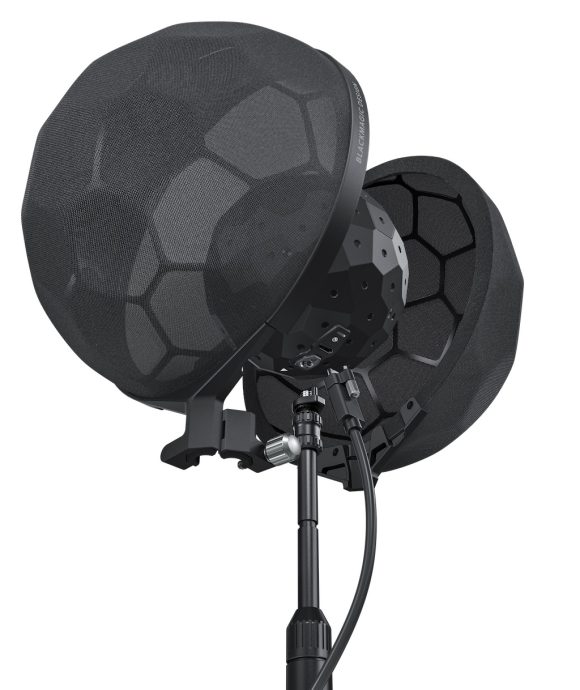
The cornerstone of the Blackmagic Ambisonic Microphone is its dense array of 108 digital Micro-Electro-Mechanical Systems (MEMS) microphones. These sensors are flush-mounted into a precision-engineered, faceted metal housing. Unlike traditional condenser microphones, MEMS technology offers exceptional consistency between units, which is a critical requirement for the mathematical accuracy needed in high-order Ambisonic processing. The faceted geometry of the housing is not merely aesthetic; it is designed to optimize the phase relationship and frequency response of each individual capsule, ensuring that the 360-degree sound field is captured with surgical precision.
Ambisonics is a multichannel surround sound format that covers a full sphere of sound. While 1st order Ambisonics—the industry standard for many years—utilizes four channels to represent the sound field, it often lacks the spatial "sharpness" required for modern immersive formats like Dolby Atmos or the specialized audio required for the Apple Vision Pro. By moving to 7th order Ambisonics, the Blackmagic microphone captures significantly more spatial information, resulting in 64 channels of discrete audio data. This allows for a much higher degree of localization, enabling sound designers to pinpoint audio sources in a three-dimensional space with far greater accuracy and clarity during post-production.
The Strategic Partnership with Apple and Integrated Processing
One of the most notable aspects of the Blackmagic Ambisonic Microphone is the collaboration between Blackmagic Design and Apple Inc. The device utilizes Apple’s proprietary spatial audio geometry and licensed Ambisonic encoding filters. This integration allows the microphone’s internal processor to handle the complex task of converting raw microphone signals into 7th order Ambisonic B-format in real-time.
Grant Petty, CEO of Blackmagic Design, emphasized the importance of this collaboration, stating that Apple provided the underlying geometry and filtering logic, while Blackmagic handled the hardware engineering and technical implementation. This "plug-and-play" capability is a major departure from existing high-order solutions, which typically require the user to record raw "A-format" audio and then use a computer-based plugin to convert it to "B-format" before it can be used in a mix. By performing this conversion on-board, the Blackmagic Ambisonic Microphone delivers a ready-to-use spatial stream via a single USB-C connection.
Seamless Integration Across the Blackmagic Ecosystem
The Blackmagic Ambisonic Microphone is designed to function as a core component of a larger immersive production workflow. It is specifically optimized for use with the Blackmagic URSA Cine Immersive camera. When mounted to the top of the URSA Cine, the microphone feeds spatial audio data directly into the camera’s immersive file formats. This synchronization ensures that the audio and video metadata are perfectly aligned, simplifying the ingest process for editors working in DaVinci Resolve.
Beyond the cinema camera range, the microphone’s versatility extends to mobile and studio environments:
- Mobile Production: The microphone can be connected directly to an iPhone running the Blackmagic Camera App. This allows independent creators to capture professional-grade spatial audio for immersive video projects intended for platforms like YouTube VR or Apple Vision Pro, using only a smartphone and a single cable.
- Live Sound and Post-Production: For studio professionals, the microphone acts as a USB-class compliant device, meaning it requires no specialized drivers or plugins to function with macOS or Windows. It integrates directly with Fairlight Live, allowing sound engineers to record and mix 3D audio in real-time. This is particularly useful for live theater, concerts, and sporting events where a sense of "being there" is paramount.
- Broadcast Workflows: To cater to the rigorous demands of the broadcast industry, Blackmagic Design will also release a dedicated USB-to-SMPTE-2110 converter. This allows the 7th order Ambisonic stream to be integrated into IP-based broadcast infrastructures, ensuring compatibility with modern television and streaming standards.
Technical Specifications and Design Durability
The physical construction of the microphone reflects Blackmagic’s commitment to the professional market. The housing is crafted from high-grade metal, designed to withstand the rigors of on-location filming and external environments. Despite the complexity of its internal 108-mic array, the unit remains compact and portable, making it suitable for handheld rigs, gimbal mounts, and drone-based cinematography.
Key technical highlights include:
- Connection Type: Single USB-C (handles both 64-channel audio data and bus power).
- Audio Format: Real-time 7th Order Ambisonic B-format.
- Compatibility: USB Class Compliant (Works with Fairlight, DaVinci Resolve, and third-party DAWs).
- Mounting: Specialized mounting points for URSA Cine Immersive and standard tripod/cold-shoe adapters.
- Signal Processing: On-board DSP for Apple-licensed encoding filters.
Chronology of the Immersive Audio Movement
The announcement of the Blackmagic Ambisonic Microphone follows a clear timeline of industry shifts toward spatial computing and immersive media. In early 2024, the launch of the Apple Vision Pro catalyzed a demand for high-quality "Spatial Video" and "Spatial Audio" content. Shortly thereafter, Blackmagic Design announced its intent to support these formats through the URSA Cine Immersive and updates to DaVinci Resolve.
Historically, capturing high-order Ambisonics was a niche endeavor reserved for acoustic researchers or high-budget Hollywood productions using custom-built arrays. Previous market solutions, such as those from Zylia or Sennheiser, paved the way for consumer and prosumer spatial audio, but they often stopped at 1st or 3rd order resolution or required extensive post-processing. The December 2026 release of this microphone marks the first time a 7th order solution has been offered in a streamlined, consumer-accessible package under the $2,000 price point.

Industry Implications and Market Analysis
The introduction of a $1,695 7th order Ambisonic microphone is expected to disrupt the spatial audio market significantly. Comparable high-order arrays often cost upwards of $5,000 to $10,000 and require complex multi-cable "snakes" to connect to high-end audio interfaces. By consolidating the preamp, A/D converter, and DSP into the microphone itself, Blackmagic has lowered the barrier to entry for high-fidelity 3D audio.
Industry analysts suggest that this move will accelerate the adoption of immersive audio in mid-market productions, such as independent documentaries, corporate training VR, and high-end podcasting. Furthermore, the inclusion of a SMPTE-2110 pathway indicates that Blackmagic is positioning itself to capture the growing "spatial broadcast" market, where live sports are increasingly being delivered in immersive formats to viewers using headsets or advanced home theater systems.
The choice of MEMS microphones is also a strategic move for long-term reliability. Unlike traditional large-diaphragm capsules which are sensitive to humidity and temperature fluctuations—factors that can alter the phase response and ruin an Ambisonic image—MEMS sensors are incredibly stable. This ensures that the microphone maintains its calibration over years of use in varied climates, a vital feature for news gathering and nature cinematography.
Conclusion and Future Outlook
As the industry moves toward the "December 2026" launch date, the Blackmagic Ambisonic Microphone stands as a testament to the convergence of hardware and software. By bridging the gap between Apple’s spatial audio ecosystem and Blackmagic’s renowned hardware engineering, the device provides a comprehensive solution for the next generation of storytellers.
The ability to capture 7th order Ambisonics with a single cable represents more than just a convenience; it represents a democratization of sound. As audiences increasingly expect audio that moves with them and surrounds them, tools like this will become essential in the toolkit of every modern filmmaker and sound designer. With the upcoming release, Blackmagic Design continues its tradition of taking complex, high-end technology and making it accessible to the broader creative community.
