

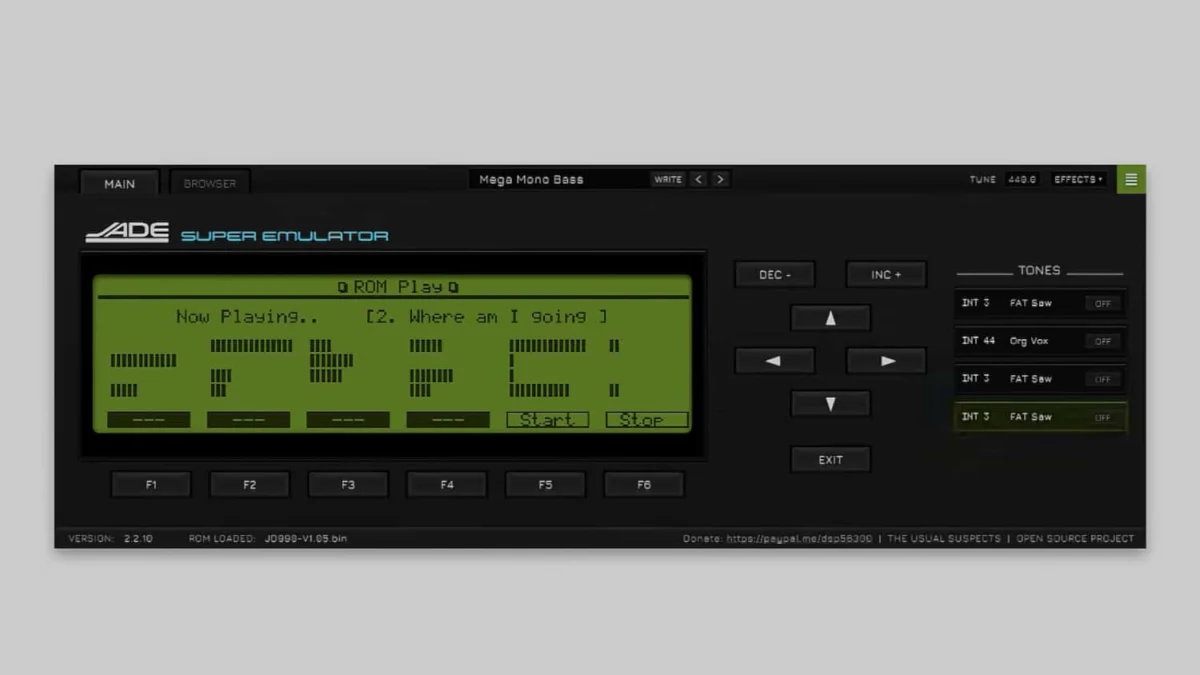
The landscape of digital synthesis emulation has reached a significant milestone with the unveiling of JADE, a highly anticipated software emulator of the legendary Roland JD-990 Super JD synthesizer module. Developed by the collective known as The Usual Suspects—the technical team behind the acclaimed DSP56300 emulation project—JADE represents a sophisticated attempt to recreate the complex architecture and high-fidelity sound of one of the most revered rackmount synthesizers of the 1990s. The project was recently highlighted through a comprehensive first-look video published by Autodafe, a prominent voice in the synthesizer community, showcasing the current alpha state of the software and its remarkably accurate sonic reproduction.
As an alpha-stage project, JADE is currently undergoing rigorous testing and development. The Usual Suspects have established a reputation for "bit-accurate" emulation, previously gaining international recognition for their work on the Osirus and Ostirus plugins, which emulated the Access Virus and Waldorf Q series, respectively. This latest endeavor shifts the focus toward Roland’s classic PCM-based (Pulse Code Modulation) synthesis, specifically targeting the JD-990, a unit often cited by sound designers and film composers as the pinnacle of Roland’s 1990s engineering.
The Historical Context of the Roland JD-990 Super JD
To understand the significance of JADE, one must examine the legacy of the hardware it seeks to replicate. Released in 1993, the Roland JD-990 was the rackmount successor to the JD-800. While the JD-800 gained fame for its slider-heavy interface that invited tactile sound design, the JD-990 "Super JD" was the more powerful sibling under the hood. It featured a vastly expanded feature set, including more waveforms, sophisticated modulation routings, and an improved effects processor.
The JD-990 was notable for its use of 44.1 kHz samples, which was a high standard for the era, providing a crystalline clarity that distinguished it from the darker, more compressed sounds of the earlier D-series synthesizers. It became a staple in professional studios worldwide, favored for its "lush" pads, "glassy" textures, and "industrial" leads. For many purists, the JD-990 remains the greatest digital synthesizer Roland ever produced, surpassing even later JV and XV models in terms of raw filter character and sonic presence. By emulating this specific unit, The Usual Suspects are addressing a long-standing demand for a modern, software-based solution that captures the specific nuances of the original hardware’s digital-to-analog converters and internal processing logic.
Technical Architecture and Development Methodology
The Usual Suspects have adopted a unique approach to software synthesis. Unlike many commercial plugins that utilize standard C++ coding to approximate the behavior of a synthesizer, JADE operates on the principle of hardware emulation. The developers essentially create a software environment that mimics the behavior of the original Motorola DSP56300 series chips (or similar proprietary architectures) found in vintage digital hardware.
This methodology allows the software to run the original firmware code of the synthesizer. By doing so, JADE can theoretically achieve 100% accuracy in terms of envelope shapes, filter curves, and modulation timing—elements that are often "lost in translation" when a synthesizer is recreated using traditional modeling techniques. The JADE project follows the success of the team’s previous emulators, which utilized this "DSP-in-a-box" approach to bring discontinued hardware back to life within modern Digital Audio Workstations (DAWs) like Ableton Live, Logic Pro, and FL Studio.
In the first-look video provided by Autodafe, the interface of JADE is shown to be a faithful recreation of the JD-990’s aesthetics, though optimized for mouse and keyboard interaction. The alpha version includes the ability to load original sysex data, meaning users who own original patches for the JD-990 can import them directly into the software, ensuring continuity for long-time users of the hardware.
Chronology of the JADE Development Cycle
The development of JADE has been a subject of speculation within synthesis forums for several months. The timeline of the project reflects the meticulous nature of reverse-engineering complex 90s hardware:
- Initial Research Phase: Following the completion of the Access Virus emulation, the development team began exploring other hardware platforms that utilized similar digital signal processing philosophies.
- Alpha Announcement: In early 2024, whispers of a Roland-focused project began to surface on the DSP56300 Discord server.
- Public Demonstration: The release of the Autodafe "First Look" video in late May 2024 marked the first time the broader public heard the emulator in action.
- Current Status: JADE is currently in a closed or semi-public alpha. Access is typically granted to community members who support the project’s infrastructure costs, allowing for a feedback loop that helps the developers squash bugs and refine the user interface.
- Future Milestones: The team is expected to move toward a beta release once the core engine stability is confirmed across various operating systems, including Windows, macOS, and potentially Linux.
Sound Preview and Performance Capabilities
A critical component of the JADE reveal was a series of demo songs played back through the emulator without additional external processing. These demos highlight the JD-990’s signature multi-timbral capabilities. The sound palette demonstrated includes complex, evolving pads that utilize the JD-990’s unique "Structures"—a feature that allows different oscillators to interact through ring modulation or booster circuits before hitting the filters.
The JD-990’s filter, often described as "liquid" and "resonant," appears to be replicated with high fidelity in JADE. In the demo recordings, the resonance behaves predictably without the digital "zipper noise" often found in lesser emulations. Furthermore, the emulator handles the unit’s specialized effects section, which includes high-quality reverbs and delays that were integral to the "expensive" sound of 90s television and film scores.
Supporting data from community testers suggests that the CPU overhead of JADE, while higher than a standard subtractive VST, is manageable on modern multi-core processors. This is a significant achievement, as the overhead of emulating an entire DSP chip in real-time can be computationally taxing.
Market Implications and Official Responses
While Roland has its own "Roland Cloud" service, which offers a JD-800 plugin and various Zen-Core based models, JADE occupies a different niche. The Roland Cloud version of the JD-800 is a modern reconstruction, whereas JADE is a low-level emulation of the JD-990. For professionals who rely on the specific artifacts and quirks of the 1993 hardware, JADE represents a more "authentic" alternative.
Official responses from Roland Corporation regarding third-party emulations of their legacy hardware have historically been guarded. However, projects like JADE often exist in a legal gray area where the software itself is original code (the emulator), but the "ROM" or firmware required to run it must be provided by the user. This "Bring Your Own ROM" (BYOR) model has allowed The Usual Suspects to operate within the enthusiast community while providing a tool that arguably increases the value and longevity of the original intellectual property by keeping it relevant in a modern production context.
Industry analysts suggest that the rise of high-quality emulators like JADE may impact the second-hand market for vintage hardware. Currently, a functional Roland JD-990 in good condition can command prices upwards of $1,000 on platforms like Reverb or eBay. If JADE can provide a sonically indistinguishable experience, the demand for the physical rack units may shift toward collectors rather than active producers, potentially stabilizing or lowering the "vintage tax" on such equipment.
Broader Impact on the Music Production Industry
The release of JADE is more than just the arrival of another plugin; it is a testament to the power of community-driven development in the music technology sector. The Usual Suspects have demonstrated that a dedicated group of engineers can achieve levels of accuracy that sometimes elude the original manufacturers.
For the modern music producer, JADE offers several distinct advantages:
- Space and Reliability: It replaces a heavy 2U rack unit that is prone to screen failure and internal battery leaks.
- Total Recall: Unlike the hardware, every parameter of JADE is saved within the DAW project, allowing for instantaneous session loading.
- Automation: Every aspect of the JD-990’s synthesis engine can now be automated with sample-accurate precision, a task that was difficult via MIDI CC on the original 1993 hardware due to bandwidth limitations.
As JADE moves toward a more stable release, it is expected to become a staple for composers looking to capture the "nostalgic-futurism" of the 90s. From ambient techno to cinematic soundscapes, the JD-990’s DNA is woven into the fabric of modern electronic music. With JADE, that DNA is being preserved and updated for a new generation of creators.
The Usual Suspects have not yet announced a definitive release date for the final version of JADE, as the project remains a labor of love funded and supported by its user base. However, the progress shown in the Autodafe preview suggests that the project is well-advanced. As the digital synthesis community watches closely, JADE stands as a bridge between the golden age of digital hardware and the limitless potential of modern software.
