

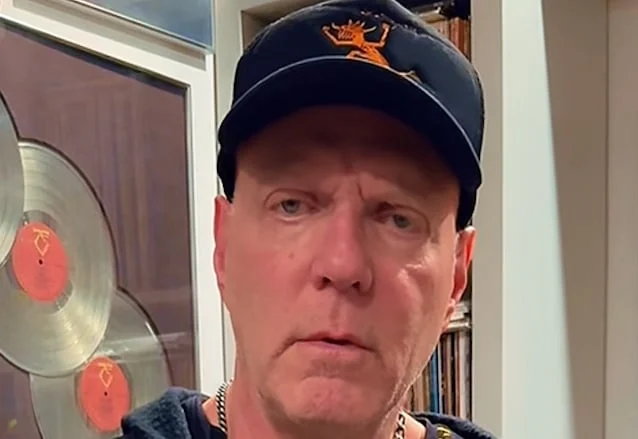
In a candid recent interview on The Mistress Carrie Podcast, hosted by "Mistress Carrie" Sarao, Jay Jay French, the veteran guitarist of the iconic heavy metal band TWISTED SISTER, articulated his long-held frustrations regarding the band’s conspicuous absence from the prestigious Rock And Roll Hall Of Fame. French, a pivotal figure in the band’s enduring legacy, challenged the Hall’s stated criteria, particularly its emphasis on musical influence, innovation, and career impact over sheer record sales, by highlighting TWISTED SISTER’s substantial global commercial success.
"The thing that’s ironic about that statement is that our record sales are up there," French stated during the podcast conversation. "So if you’re using record sales internationally, we’re at the 30-million mark, and I’ve got, like, 37 gold and platinum albums from around the world, and we’ve played in 40 countries as a headliner around the world."
French then drew a parallel to a band often cited as an example of influence over sales: "But you take a band like THE VELVET UNDERGROUND—there’s a perfect example of what you say. There’s a cliché about THE VELVET UNDERGROUND: ‘THE VELVET UNDERGROUND only sold 3,000 albums, but everybody who bought one started a band.’ And I love that. I love that cliché, ’cause we’re also big VELVET UNDERGROUND fans. And so that’s exactly to your point. That’s exactly to your point. Now, THE VELVET UNDERGROUND is in the Rock And Roll Hall Of Fame, I believe. So is Lou Reed. And they are justifiably in it."
This stark contrast, French implied, underscores a perceived inconsistency in the Hall’s selection process. He further elaborated on his belief that the institution is not immune to the political machinations inherent in the music industry. "There are some artists, I don’t believe, are justifiably in it, but that’s a political game, ’cause I think you know as well as I do there’s politics involved in every Hall Of Fame."
The Politics of Recognition and Long Island’s Musical Identity
French attributed the lack of recognition not solely to musical merit but also to broader industry biases, including a perceived dismissal of artists from his home region. "It’s music ‘business’, and I know the politics of the business. And so it almost doesn’t surprise me that we don’t get the respect we should get, ’cause we’re from Long Island, and Long Island doesn’t get a lot of respect. It really doesn’t," he explained. "I mean, yes, Billy Joel’s from Long Island—I get that—but Long Island in general doesn’t get that much respect in the industry, even though we’re only a stone’s throw from Manhattan. We just don’t."
This sentiment was further contextualized by French’s recollection of TWISTED SISTER’s early career trajectory in the late 1970s, a period when the New York punk and new wave scenes were gaining significant traction. "The irony is that TWISTED SISTER was selling out these gigantic rooms in the New York area at the time the CBGBs was exploding. But those bands at CBGBs, which was BLONDIE, TELEVISION, the RAMONES, those guys couldn’t work in any of the places we were playing ’cause they couldn’t sell tickets. We, however, were selling out 5,000-seaters all around New York and never playing New York City."
He recounted a pivotal moment in 1979, prior to securing a record deal, when their manager proposed playing the Palladium Theater in New York City, a venue with a capacity of 3,500. French’s initial hesitation stemmed from the venue’s historical exclusivity. "I said, ‘No band without a deal has ever sold out the Palladium.’ And we did—twice. And that was a point we made to the music business, which is, ‘You guys don’t respect us, you don’t understand us, but our following is massive.’ And we had a massive following." This assertion highlights a disconnect between the industry’s perception and the band’s demonstrable fan base and commercial viability, even without major label backing.
Eligibility, Inconsistencies, and Past Criticisms
The Rock And Roll Hall Of Fame’s eligibility criteria stipulate that artists become eligible a quarter century after their first records were released. However, the Hall also considers "influence and significance of the artists’ contributions to the development and perpetuation of rock ‘n’ roll," a subjective measure that has often led to debate and controversy.
TWISTED SISTER became eligible for induction in 1999. The journey to recognition for some established acts has been notably long. For instance, KISS, also eligible since 1999, did not receive its first nomination until 2009 and was eventually inducted in 2014. Similarly, DEEP PURPLE was eligible in 1993 but was not inducted until 2016. The selection process involves voting by over 1,200 artists, historians, and music industry professionals, a system that French implicitly criticizes as susceptible to political maneuvering.
The list of metal or metal-adjacent acts inducted into the Hall remains relatively short, including BLACK SABBATH, LED ZEPPELIN, METALLICA, AC/DC, JUDAS PRIEST, KISS, VAN HALEN, RUSH, GUNS N’ ROSES, Ozzy Osbourne, and DEEP PURPLE. This limited representation, particularly for bands that achieved massive global success and influenced subsequent generations, fuels the ongoing discussion about the Hall’s curatorial direction.
French’s current remarks echo his previous strong criticisms of the Rock And Roll Hall Of Fame. In March 2021, he publicly denounced the institution as an "elitist" organization that has overlooked significant and influential artists from the 1980s. During an appearance on "The Cassius Morris Show," French did not mince words: "I’m not happy with it. I went to the Rock And Roll Hall Of Fame years ago and thought it was the worst-curated piece of shit I’d ever seen. I didn’t understand it."
He questioned the Hall’s geographical location in Cleveland and its perceived disconnect from other vital music scenes. "The fact of the matter is that the Rock And Roll Hall Of Fame is in Cleveland. Cleveland’s in the Midwest. How do you not have KANSAS, how do you not have REO SPEEDWAGON, how do you not have Bob Seger—how do you not have bands that kept fucking rock and roll alive in the ’80s?" French argued that these artists were instrumental in sustaining the music industry during a period that, in his view, was unfairly dismissed. "It was so hip for you to say we suck, it was so hip to go, ‘The ’80s sucked.’"
French vehemently refuted this notion: "I’ve got news for you all: the ’80s not only didn’t suck, but the ’80s, in terms of the kids around the world—South America, Europe, Japan, the Far East, India—they fill stadiums today because of the music that we created back then. And if that music is that damn important, then why the hell do we not have the respect of being acknowledged by the Rock And Roll Hall Of Fame? That’s what annoys me." He stressed that while acknowledging the rightful place of legendary acts like THE BEATLES, he believes a significant number of other artists, who were responsible for the "propagation and the continuation of the kind of music that we grew up [on], that I played and that inspired you," are unjustly overlooked. Until this is rectified, he stated, "I don’t respect that. I just think it’s completely misguided and totally elitist and really fucked up."
Bandmate’s Accord and the Enduring Power of "We’re Not Gonna Take It"
Jay Jay French’s sentiments are shared by his TWISTED SISTER bandmate, Dee Snider, who has also been a vocal critic of the Rock Hall. In February 2021, Snider described the Hall’s committee members as "arrogant elitist assholes who look down on metal and other bands that sell millions because we’re not their definition of cool." Responding to a fan’s suggestion that the Hall caters to the masses, Snider countered, "If they were catering to the masses they would have the biggest selling bands. Corporate rock bands that sell tens of millions are ignored because they aren’t ‘cool.’ The fact is the RnR Hall of Fame is struggling. Was it crowded when you were there? It wasn’t when I went." This exchange highlights a perceived disconnect between the Hall’s stated mission and its actual practices, with Snider suggesting that commercial success, rather than coolness, should be a primary indicator of mass appeal.
The enduring cultural impact of TWISTED SISTER is undeniable, particularly through their anthemic hit, "We’re Not Gonna Take It." The song, released in 1984 from the album "Stay Hungry," has transcended its original context to become a rallying cry for defiance and a ubiquitous cultural touchstone. Its lyrics, penned solely by Dee Snider, with influences ranging from the glam rock band SLADE and punk pioneers the SEX PISTOLS to the traditional Christmas carol "O Come, All Ye Faithful," resonate with themes of rebellion against condescension and an assertion of self-determination. The song’s message, "Oh you’re so condescending/Your gall is never ending/We don’t want nothin’/Not a thing from you," continues to find relevance in various contexts.
"We’re Not Gonna Take It" achieved significant commercial success, peaking at number 21 on the Billboard Hot 100 and ranking 47th on VH1’s "100 Greatest ’80s Songs." Its lasting appeal is further evidenced by its widespread use in commercials for brands such as Extended Stay America, Claritin, Walmart, Stanley Steamer, and Yaz birth control, demonstrating its broad cultural penetration and adaptability. The song’s continued relevance and the band’s substantial global record sales and touring history, as highlighted by French, underscore the ongoing debate surrounding the Rock And Roll Hall Of Fame’s selection process and its acknowledgment of artists who have undeniably shaped the landscape of popular music. The discussion initiated by Jay Jay French on The Mistress Carrie Podcast adds another layer to the complex narrative of legacy, influence, and recognition within the music industry.
