

The landscape of modern media production is undergoing a fundamental transformation, driven by the need for greater efficiency, decentralization, and the total integration of signal processing. In response to these shifting industry requirements, Lawo has introduced Edge One, a next-generation, network-native I/O platform designed to unify audio, video, and control functions within a singular, highly compact hardware unit. This release marks a significant milestone in Lawo’s multi-year strategy to dissolve the traditional boundaries between audio and video hardware silos, offering a versatile solution for broadcast, live events, and fixed installations such as theaters and stadiums.
A New Paradigm in Signal Processing and I/O
Edge One is not merely a replacement for the traditional stagebox; it represents a comprehensive reimagining of the interface between the analog and digital domains. Developed within the Chief Technology Office (CTO) at Lawo, the platform addresses the reality of modern production environments where budgets are tightening, physical space is at a premium, and the pool of available specialized personnel is shrinking. By combining audio I/O, video I/O, routing, and sophisticated signal processing into a 1RU, half-rack width chassis, Lawo is challenging the conventional necessity of maintaining separate hardware chains for different media types.
Lucas Zwicker, Product Manager at Lawo’s CTO Office, emphasizes that the development of Edge One was prompted by a simple but profound question: why must a production require separate devices for audio and video when the underlying transport mechanism—the IP network—treats both as data? Edge One is the answer to this question, serving as a converged "edge" device that processes signals at the point of origin or delivery, reducing the need for extensive cabling and intermediate conversion hardware.
Technical Specifications and Modular Flexibility
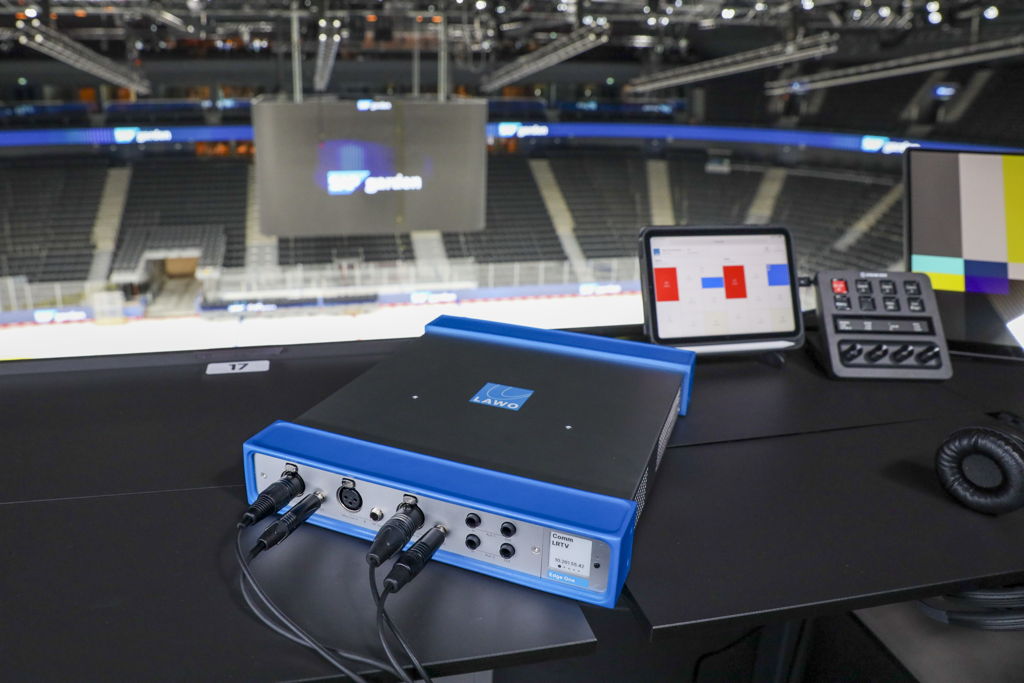
The physical design of Edge One is optimized for high-density environments. Its half-rack width allows two units to be mounted side-by-side in a standard 19-inch rack, or it can be used as a standalone device in cramped locations such as commentary booths or mobile production kits. To facilitate field use, the device comes equipped with protective rubberized sleeves on the front and back, allowing it to be placed directly on surfaces without the immediate need for a flight case. For permanent installations, optional rack ears and mounting brackets for under-desk or wall installation are available, catering to decentralized editing suites and voice-over booths.
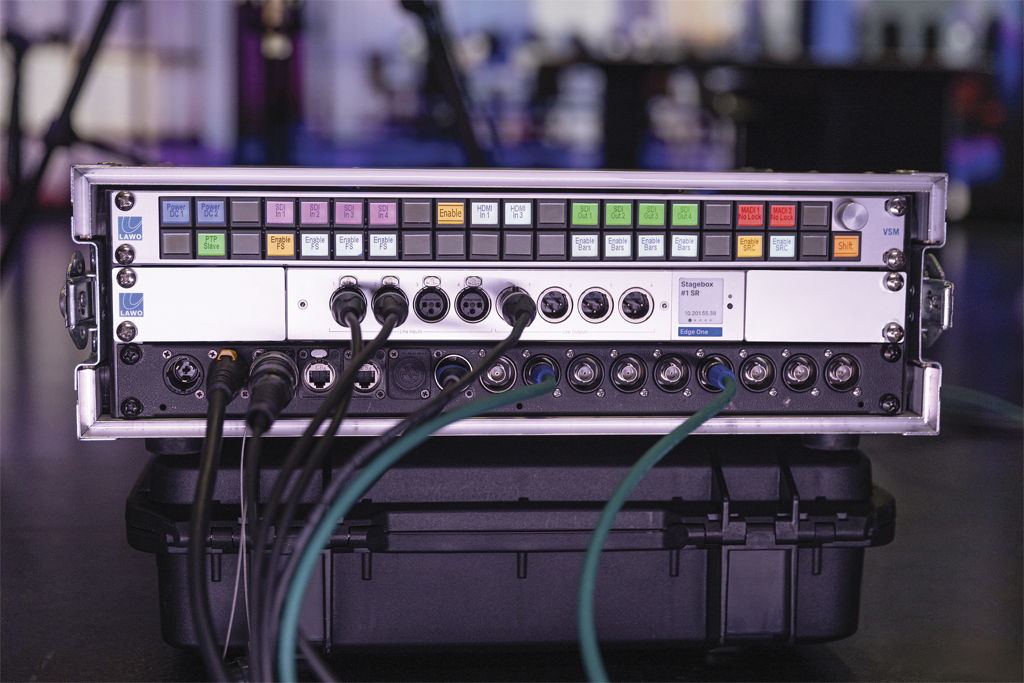
On the audio side, Edge One features a modular front-panel I/O system. Users can configure the device with various modules based on specific production needs:
- Mic Module: Eight high-quality microphone inputs.
- Combined Module: Four microphone/line inputs and four outputs.
- Commentary Module: Three microphone inputs, three headphone outputs, and two auxiliary inputs/outputs.
This modularity allows for rapid on-site reconfiguration. If a production shifts from a standard musical performance to a sports broadcast requiring specialized commentary positions, the hardware can be adapted in minutes. Furthermore, the audio section includes two 64-channel MADI ports, which can operate independently or in a redundant configuration. Both ports feature integrated Sample Rate Conversion (SRC), ensuring seamless integration with legacy digital audio equipment.
The video capabilities of Edge One are equally robust. The platform includes eight bidirectional SDI ports and four HDMI interfaces (inputs and outputs). A notable innovation is the flexible HDMI implementation: to conserve front-panel space, Lawo utilizes two electronically switchable HDMI ports that can be dynamically assigned as inputs or outputs. This allows for a maximum of four HDMI outputs or a balanced configuration of two inputs and two outputs. This inclusion of HDMI is a strategic move to accommodate the growing use of prosumer monitors and compact cameras in professional workflows, eliminating the need for external HDMI-to-SDI converters.
Integration of High-Performance DSP
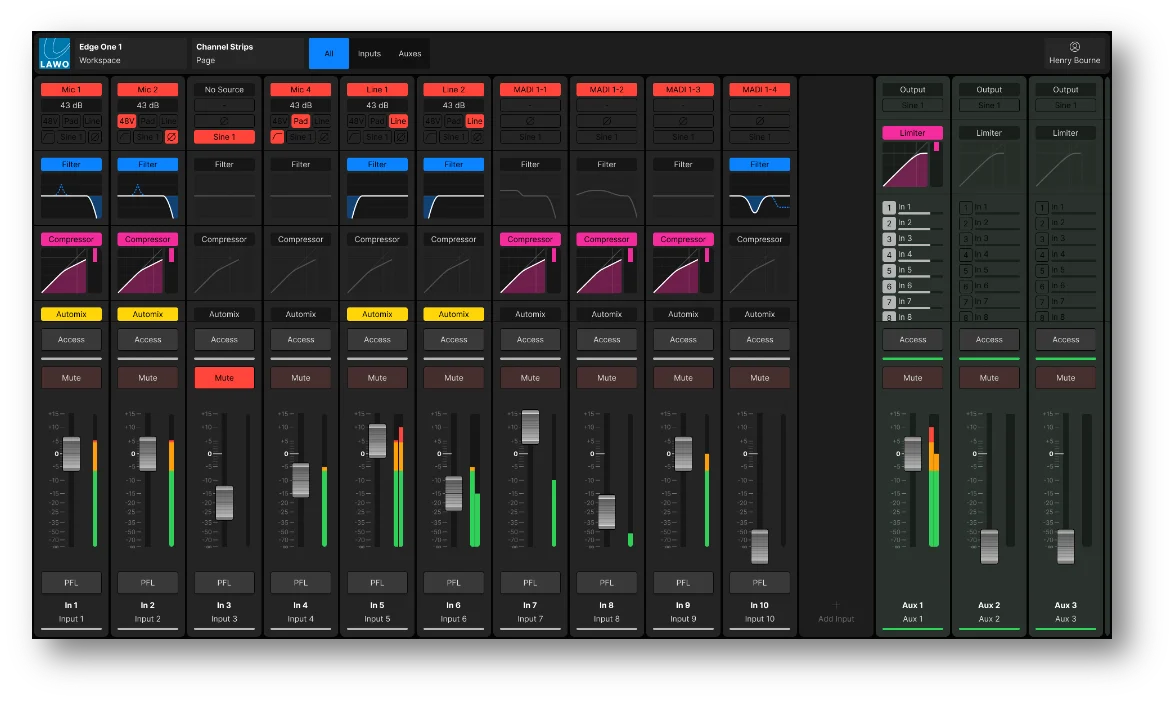
Beyond simple I/O, Edge One incorporates significant onboard Digital Signal Processing (DSP). This enables the device to handle low-latency monitoring and preliminary mixing directly at the edge of the network. The integrated DSP suite includes:
- Multi-band Equalizers (EQ)
- Compressors and Limiters
- An advanced Automixer
The inclusion of an automixer is particularly relevant for panel discussions and multi-person commentary setups, where it can manage gain levels automatically to prevent feedback and ensure vocal clarity. While Edge One is not intended to replace a full-scale mixing console like the Lawo mc² series, it provides the necessary tools for local "foldback" and monitoring mixes, which are critical for talent performance in remote production scenarios.
Native IP Standards and Connectivity
Edge One is built upon a foundation of open standards, ensuring it can operate within any modern IP-based infrastructure. It provides native support for SMPTE ST 2110 for professional media over IP, as well as NMOS (Networked Media Open Specifications) for discovery, registration, and connection management. This commitment to open standards means that Edge One is not locked into a proprietary ecosystem; it can be integrated into multi-vendor environments alongside equipment from other manufacturers.
For network connectivity, the device features:
- Two SFP slots for high-speed fiber or copper uplinks.
- Two Ethernet ports for control and management.
- Redundant power supply inputs for mission-critical reliability.
- Sub-D GPIO ports (2x GPI / 4x GPO) for triggering external events or tally lights.
- Comprehensive sync options including Wordclock Out and Sync In/Through/Out.
A forward-looking feature of Edge One is the planned expansion of its RJ45 ports to function as switch or tunnel ports. This will allow users to connect additional AES67 devices, intercom stations, or remote control surfaces—such as a Stream Deck—directly to the Edge One unit, which then tunnels the data back to the central production hub.
The Evolution of Commentary and Remote Production
One of the primary drivers for the development of Edge One is the radical shift in commentary workflows. In contemporary sports and event broadcasting, the "Commentator" role is evolving into a "Producer-Commentator" role, where the talent often manages their own monitoring levels and basic show control.
Edge One facilitates this by moving away from expensive, proprietary commentary hardware panels. Instead, it leverages a software-based control approach. By using Lawo’s software interfaces in conjunction with affordable, tactile controllers like the Elgato Stream Deck, production teams can build highly customized commentary positions that are smaller, lighter, and significantly more cost-effective. A dedicated Stream Deck plugin for Edge One will be provided by Lawo, allowing for seamless mapping of mic mutes, talkback triggers, and monitor source selection.
Business Model and Licensing: The Lawo Flex Approach
Lawo is also introducing a modernized approach to equipment procurement and utilization through its "Lawo Flex" licensing model. Recognizing that production requirements can vary wildly from one week to the next, Edge One users can choose between different functional licenses:
- Audio-only: Optimized for radio or pure audio capture.
- Video-only: For high-density SDI/HDMI to IP conversion.
- Combined: Unlocking the full potential of the converged platform.
In addition to traditional permanent licenses, Lawo offers a subscription-based model. This allows broadcasters and rental companies to scale their capabilities on demand. For example, a rental house might own 50 Edge One units with basic audio licenses but can "rent" additional video or commentary DSP licenses for a specific high-profile event. Once the event is over, the licenses can be returned to a central pool and reassigned to other hardware units as needed. This shift from Capital Expenditure (CAPEX) to Operational Expenditure (OPEX) provides the financial flexibility that modern media organizations require.
Chronology and Market Availability
The journey of Edge One from concept to market reflects Lawo’s long-term commitment to IP convergence. The internal development phase spanned several years, focusing on the miniaturization of processing components and the perfection of the software-defined hardware architecture.
- July 28, 2026: Official announcement of the Edge One platform.
- July 2026: Commencement of the ordering phase for early adopters and key accounts.
- September 6, 2026: Final technical specifications and feature sets updated following successful field trials.
- October 2026: Scheduled start of first customer shipments.
The base variant of Edge One is set to enter the market with a list price of approximately €8,500. This pricing strategy positions the device as a competitive alternative to purchasing multiple discrete converters and interfaces, particularly when the value of integrated DSP and remote management is factored in.
Industry Implications and Analysis
The introduction of Edge One is likely to accelerate the trend of "Edge Computing" within the broadcast sector. By moving processing power closer to the camera and microphone, broadcasters can reduce the bandwidth load on their core networks and decrease the latency associated with backhauling every raw signal to a central data center for processing.
Furthermore, Edge One addresses the sustainability goals of many modern corporations. Its compact size and reduced power consumption—compared to the multiple racks of equipment it can replace—contribute to a smaller carbon footprint for mobile production units and permanent studios alike.
As the industry moves toward the "October 2026" shipping window, the focus will shift to real-world performance. The success of Edge One will depend on its ability to maintain Lawo’s reputation for audio excellence while proving its mettle as a reliable video processor in high-pressure live environments. If the platform delivers on its promises of flexibility and convergence, it may well set the standard for the next decade of I/O technology.
In conclusion, Lawo Edge One represents a strategic pivot toward a software-defined, hardware-efficient future. By consolidating the essential components of the production chain into a single, network-native device, Lawo is providing the tools necessary for the next generation of decentralized, high-quality media creation. Further practical testing and reports on initial field applications are expected to follow the official market launch later this year.
