

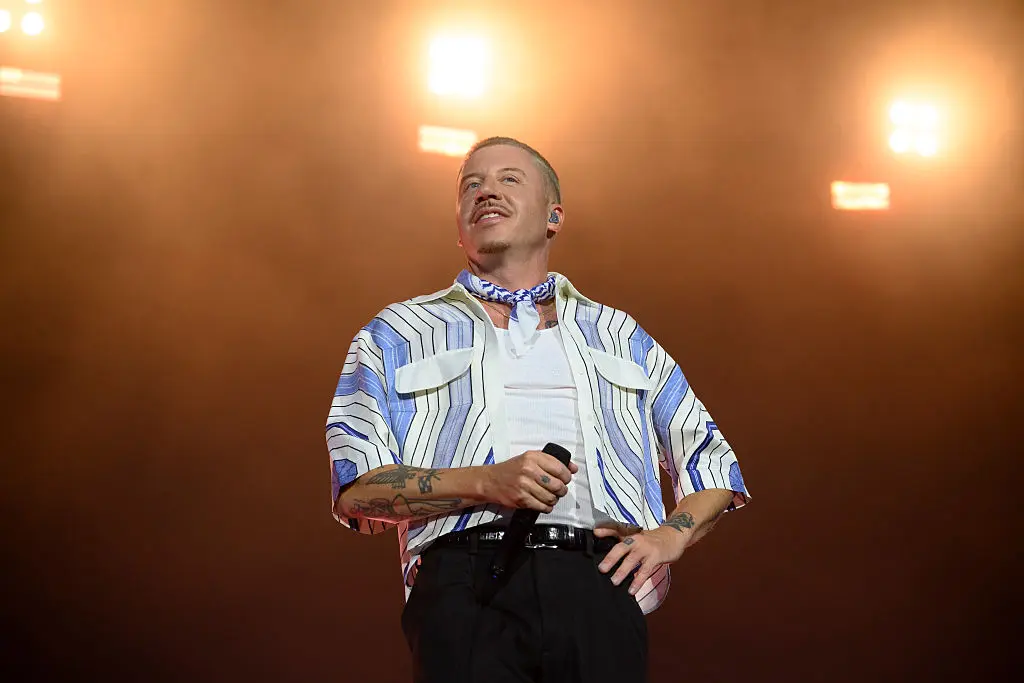
During a captivating 17-song set at Colorado’s iconic Red Rocks Amphitheatre on Thursday night (October 22), acclaimed rapper Macklemore paused the performance to deliver a powerful, unequivocal message to the assembled crowd. His address made it explicitly clear that he has no intention of retreating from the humanitarian stance that recently led to his removal from Ed Sheeran’s highly anticipated tour. The Seattle-born artist, whose real name is Benjamin Hammond Haggerty, leveraged the natural grandeur of the venue to amplify his urgent call for a "free Palestine," while also drawing attention to other pressing global humanitarian crises in Sudan, Congo, Lebanon, and Haiti, alongside the systemic issues affecting individuals under the purview of U.S. Immigration and Customs Enforcement (ICE).
The impassioned interlude underscored Macklemore’s commitment to using his platform for social justice, a commitment that has both garnered immense support and ignited significant controversy in recent weeks. "Being a human being in this moment is not complicated," Macklemore declared, his voice resonating through the open-air venue, according to footage captured by concertgoers. "It is not political. It is human to have a heart, to watch others suffering and to say, ‘Not anymore!’ So I say, free Palestine. I say, free Palestine!" He then broadened his appeal, stating, "I say, free Sudan. I say, free Congo, Lebanon, to Haiti, to all the people that are affected by ICE in America, who are afraid to leave their houses." He concluded his address with a unifying sentiment: "The message will always be love."
A Contentious Return: The Ed Sheeran Tour Background
This Red Rocks appearance marked Macklemore’s first major concert since a turbulent September run as an opening act for Ed Sheeran’s "Loop Tour" across North America. The controversy first erupted during two performances at MetLife Stadium in New Jersey, where Macklemore used his slot to vocally advocate for Palestinian freedom. Crucially, he performed his 2024 protest anthem, "Hind’s Hall," a track explicitly critical of U.S. policy regarding the conflict in Gaza and supportive of the Palestinian cause, accompanied by poignant imagery from the region displayed on the stage’s screens.
"Hind’s Hall" itself quickly became a focal point of the controversy. Released in May 2024, the song, named after Hind Rajab, a six-year-old Palestinian girl killed in Gaza, resonated deeply with activists and supporters of Palestine, rapidly gaining traction across social media platforms. Its raw lyrics and direct condemnation of perceived governmental complicity and media narratives positioned it as a powerful voice in the ongoing discourse. The song’s creation was inspired by the student protests at Columbia University, where activists renamed Hamilton Hall "Hind’s Hall" in solidarity with Palestinians, creating a powerful cultural moment that Macklemore quickly harnessed. The track’s performance, coupled with the visual backdrop at MetLife, was a clear and unambiguous statement from the artist, designed to provoke thought and rally support.
The performances at MetLife Stadium swiftly drew criticism from various organizations, most notably the Israeli-American Council, which expressed strong disapproval of the rapper’s rhetoric and the accompanying imagery. These criticisms, citing the divisive nature of the message and its potential to cause offense, ultimately set in motion a chain of events that led to Macklemore’s abrupt removal from the remainder of Sheeran’s tour.
The Removal and Industry Reactions
Following the MetLife incidents, tour promoter Messina Touring Group announced that Macklemore would no longer be performing on the upcoming U.S. dates. The promoter stated that venues on the remaining tour schedule had informed organizers they would not host concerts with Macklemore on the lineup. This effectively placed the onus of the decision on the venues themselves, highlighting the complex interplay between artist expression, promoter logistics, and venue policies.
Adding a specific dimension to the controversy, Robert Kraft, the billionaire owner of the Kraft Group, which notably owns Gillette Stadium in Foxborough, Massachusetts, publicly confirmed his direct intervention. Kraft stated that he had personally barred Macklemore from appearing at the Massachusetts venue. His reasoning was explicit: the rapper’s rhetoric and imagery, particularly those displayed during the "Hind’s Hall" performances, had been "offensive and hurtful to members of the Jewish community." Kraft’s statement underscored the significant financial and political pressures that can be brought to bear on artists and venues when political stances clash with corporate interests or perceived community sensitivities.
Ed Sheeran, the headliner of the tour, subsequently addressed the situation, emphasizing that the decision to remove Macklemore was not his own. In a public statement, Sheeran clarified that the choice had been made by the promoter and the various venues involved. While distancing himself from the decision, Sheeran also articulated his respect for Macklemore’s conviction. "I respect Macklemore’s strength of purpose to stand up and shout for what he believes," Sheeran stated, while adding that his personal approach was to "maintain diplomacy and keep conversations open, not closed." Sheeran’s carefully worded response reflected an attempt to navigate a highly sensitive situation, acknowledging his opening act’s integrity while protecting his own tour and brand from further controversy.
In a direct response to his removal and the ensuing public debate, Macklemore pledged the entirety of the $1 million he had earned from his stint on the Sheeran tour to organizations providing humanitarian aid to Palestinians. This financial commitment served as a tangible manifestation of his advocacy, turning earnings from a controversial tour into direct support for the cause he championed. In a parallel gesture, Robert Kraft later announced a $2 million contribution of his own, directed towards humanitarian aid in the region, a move that some interpreted as an attempt to balance the scales or demonstrate a broader commitment to humanitarian efforts amidst the contentious debate.
The fallout from Macklemore’s stance and subsequent removal extended beyond the primary figures. Several other artists scheduled to open for Sheeran’s tour also withdrew their participation. Finneas, Aaron Rowe, and Lukas Graham, as well as Sheeran’s backing band Beoga, all subsequently announced their withdrawal from scheduled appearances. While the exact reasons for each withdrawal were not always explicitly stated, the collective departure of multiple acts suggested a broader ripple effect, potentially influenced by solidarity with Macklemore, discomfort with the politically charged atmosphere, or simply a desire to avoid entanglement in the ongoing controversy. This mass withdrawal further reshaped the remainder of Sheeran’s tour, altering the lineup and potentially impacting the overall concert experience for fans.
"Hind’s Hall": An Anthem of Protest and Digital Resonance

To fully appreciate the context of Macklemore’s Red Rocks statement, one must delve deeper into "Hind’s Hall." The song, released digitally and accompanied by a raw, self-shot video, quickly became a cultural touchstone for its direct and unapologetic stance. It explicitly addressed the conflict in Gaza, critiquing media narratives, U.S. foreign policy, and the perceived inaction of political leaders. Lyrically, Macklemore connected the current conflict to historical injustices, drawing parallels and emphasizing the human cost.
The track’s virality was unprecedented for a contemporary protest song, particularly one from an artist of Macklemore’s mainstream renown. It resonated strongly with younger audiences on platforms like TikTok, where snippets and direct quotes from the song were used in thousands of videos discussing the conflict. This digital spread amplified its message far beyond traditional music consumption channels, solidifying its status as a protest anthem for a new generation. The song’s success demonstrated the power of music to galvanize opinion and articulate dissent in an era of rapid information dissemination and heightened social awareness. Its performance at MetLife, therefore, was not merely a musical act but a potent political declaration, designed to leverage its already significant impact.
The "Free Palestine Tour" and Continued Advocacy
Undeterred by his removal from the Ed Sheeran tour, Macklemore swiftly organized his own series of concerts, aptly named the "Free Palestine Tour." The announcement of these independent shows—scheduled for Dublin on October 26, Paris on October 29, and London on October 30—was met with an immediate and overwhelming response from fans. Tickets for all dates sold out almost instantly, signaling a strong surge of support for the artist and his cause. This rapid sell-out demonstrated that despite the controversy and commercial pressures, there was a significant audience eager to support artists who take clear, activist stances.
Crucially, Macklemore committed all proceeds from these sold-out concerts to benefit a number of organizations actively providing aid to Palestinians. Among the designated beneficiaries are the Gaza Soup Kitchen, Medical Aid for Palestinians, and the Palestine Children’s Relief Fund. This direct allocation of funds further solidified Macklemore’s commitment, transforming his artistic expression into tangible humanitarian assistance and reinforcing his role as an advocate rather than merely an entertainer. The tour became a clear statement that his advocacy was not contingent on mainstream commercial platforms but would find its own avenues of expression and support.
The Unexpected Upsurge: Streaming Data and Fan Engagement
Perhaps one of the most intriguing and quantifiable consequences of the controversy was a noticeable spike in Macklemore’s streaming numbers. Data compiled by Luminate and reported by Billboard revealed a significant surge in listener engagement, indicating that the public discourse surrounding his activism translated directly into increased interest in his music.
According to early data, official on-demand U.S. streams of Macklemore’s solo catalog climbed dramatically, increasing by an astonishing 172% from 282,000 on September 13 to 767,000 just two days later, on September 15. This meteoric rise highlighted a powerful connection between his public stance and audience reception. When his total catalog, which includes his highly successful collaborations with Ryan Lewis, was considered, the numbers nearly doubled over the same period, rising by 97% from just over 1 million streams to nearly 2 million. This comprehensive increase suggests that the controversy not only drew new listeners to his protest song but also prompted existing and potential fans to explore his wider body of work.
The most substantial leap, however, was observed for "Hind’s Hall" itself. The protest track experienced an exponential surge, climbing from just over 5,000 U.S. streams on September 13 to nearly 87,000 on September 15. This marked its biggest daily total in more than two years, cementing its status as a revived and highly relevant piece of music. This streaming boost is a testament to several factors: the power of controversy to generate immense public interest, the solidarity expressed by fans who sought to support the artist through his music, and the efficacy of "Hind’s Hall" as an anthem that resonated with a specific political moment. It also underscores how modern digital platforms allow for rapid dissemination and consumption of music in response to current events, potentially bypassing traditional gatekeepers. While Macklemore has a history of Billboard Hot 100 hits, including "Good Old Days" featuring Kesha, "Glorious" featuring Skylar Grey, and "Summer Days" with Martin Garrix and Patrick Stump, this recent streaming surge, driven by explicit political activism, marks a distinct chapter in his career.
Broader Implications: Artist Activism in the Modern Era
Macklemore’s recent actions and their repercussions illuminate broader implications for artist activism in the contemporary music industry. Historically, musicians have often served as powerful voices for social and political change, from the folk protest movements of the 1960s with artists like Bob Dylan and Joan Baez, to punk rock’s anti-establishment anthems, and hip-hop’s sharp critiques of systemic injustice. Macklemore’s steadfastness places him squarely within this tradition, demonstrating a willingness to prioritize his convictions over potential commercial setbacks.
The incident also highlights the ongoing tension between an artist’s right to freedom of speech and the commercial interests that underpin large-scale touring, venue operations, and corporate sponsorships. While artists increasingly feel a moral imperative to speak out on social issues, their platforms are often facilitated by entities that may prefer neutrality or fear alienating segments of their audience or business partners. Macklemore’s experience serves as a stark reminder of the potential consequences—such as tour removal or sponsorship losses—that can arise when an artist’s message clashes with these commercial realities.
However, the streaming data and the rapid sell-out of his "Free Palestine Tour" also suggest a counter-narrative: that a significant portion of the audience actively seeks and supports artists who take clear, principled stands. In an era of heightened social awareness, many fans expect their idols to be more than just entertainers; they look to them as moral compasses and advocates. This evolving dynamic creates both challenges and opportunities for artists, potentially alienating some while forging deeper, more loyal connections with others. Macklemore’s journey exemplifies the complex, often fraught, yet ultimately powerful role artists can play as social commentators and catalysts for change in a politically charged world. His unyielding message from Red Rocks is not just a personal statement but a testament to the enduring power of music as a vehicle for conscience and conviction.
