

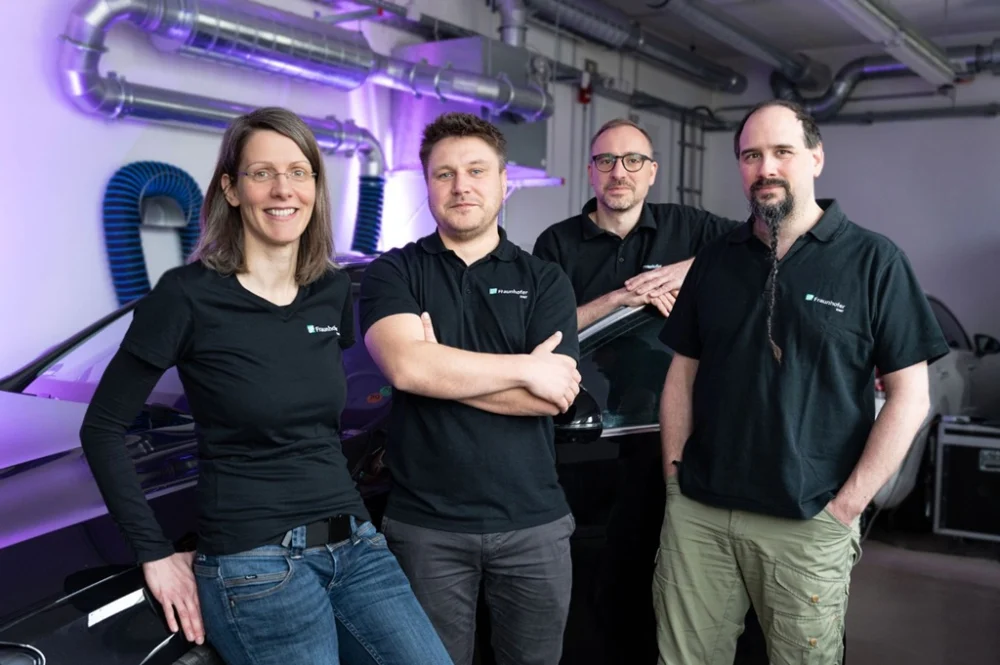
The automotive industry is witnessing a significant shift in cabin experience as high-fidelity, immersive audio moves from a luxury add-on to a central feature of vehicle design. In a landmark collaboration between German engineering and scientific research, Mercedes-Benz has announced the standard integration of "Audiofields"—a 3D spatial audio technology developed by the Fraunhofer Institute for Digital Media Technology (IDMT)—into its latest generation of vehicles. This integration, part of the fourth-generation Mercedes-Benz User Experience (MBUX) infotainment system, marks a definitive transition for the Ilmenau-based institute from professional sound stages to the mass-market automotive sector.
The official announcement took place on February 27, 2026, during a high-profile premiere event in Erfurt, Germany. The event was attended by a cohort of influential figures, including Thuringia’s Minister for Education, Science, and Culture, Christian Tischner, and the President of the Fraunhofer-Gesellschaft, Professor Holger Hanselka. Their presence underscored the economic and scientific importance of this transfer of technology from a research environment to one of the world’s leading luxury automotive manufacturers. Representatives from Mercedes-Benz and the renowned high-end audio specialist Burmester were also on hand to detail the technical synergy required to bring studio-quality sound to the road.
The Evolution of Audiofields: From Concert Halls to the Commute
The technology now known as "Audiofields" began its life under the developmental name SpatialSound Wave. Its roots trace back to the early 2000s, when Fraunhofer IDMT researchers sought to perfect the reproduction of spatial acoustics for professional venues. For nearly two decades, this technology has been the backbone of immersive audio in opera houses, planetariums, and specialized recording studios. Unlike traditional surround sound, which relies on fixed channels to direct audio to specific speakers, Audiofields utilizes an object-based approach. This allows individual sound elements—such as a specific instrument or a vocalist’s breath—to be treated as independent objects positioned within a virtual 3D space.
The transition to the automotive sector began in earnest in 2007. Recognizing that the car interior is one of the most challenging acoustic environments due to its irregular shape, reflective glass surfaces, and varied seating positions, Fraunhofer IDMT spent years refining its algorithms. In 2021, a formal development partnership was established between Fraunhofer, Mercedes-Benz, and Burmester. The goal was to miniaturize the immense processing power required for spatial audio so that it could run efficiently on a vehicle’s head unit without compromising other essential functions, such as navigation or driver-assistance systems.
Technical Integration and the MBUX Ecosystem
The deployment of Audiofields is strategically tied to the fourth generation of the MBUX system. This hardware and software suite serves as the central nervous system of the modern Mercedes-Benz vehicle. By embedding the 3D audio algorithm directly into the MBUX architecture, Mercedes-Benz ensures that the immersive experience is not limited to those who purchase top-tier speaker packages.
According to technical specifications released during the Erfurt event, the 3D sound experience is available in vehicles equipped with the standard Mercedes-Benz sound system as well as those featuring premium or high-end Burmester hardware. The algorithm intelligently maps audio signals to the available speaker layout, creating a perceived soundstage that extends far beyond the physical boundaries of the doors and dashboard.
One of the most significant breakthroughs of the Audiofields algorithm is its ability to "upmix" conventional stereo content. While the industry is moving toward native immersive formats like Dolby Atmos, a vast majority of music consumed via streaming services or radio remains in two-channel stereo. The Fraunhofer technology analyzes these stereo signals in real-time, identifying spatial cues and redistributing them to create a three-dimensional field. This ensures that drivers can enjoy an enhanced experience regardless of the age or format of their music library.
Launch Models and Market Rollout
Mercedes-Benz has confirmed a phased rollout for the technology, prioritizing its high-volume and flagship models. The initial integration will be found in the new CLA, GLC, and GLB models, as well as the flagship S-Class. The choice of the CLA—particularly its all-electric variant—as a primary vehicle for this technology is significant. As electric vehicles (EVs) operate with significantly lower cabin noise compared to internal combustion engines, the quality of the audio system becomes a more prominent factor in the overall luxury experience.
A successful pilot phase was completed in 2025, where the algorithm was tested in the electric CLA to ensure it met the rigorous standards for automotive durability and computational efficiency. Mercedes-Benz intends to expand the availability of Audiofields across its entire lineup as models transition to the fourth-generation MBUX hardware.

User Customization: Personalizing the Acoustic Space
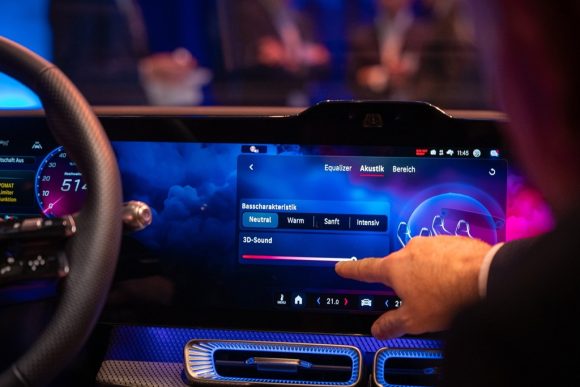
A key feature of the integration is the "Audiofields" control interface within the MBUX display. Recognizing that acoustic preference is highly subjective, the system allows users to adjust the intensity of the spatial effect via an intuitive slider.
As the intensity is increased, the acoustic boundaries of the car seem to disappear. At lower settings, the system provides a subtle enhancement that clarifies the separation between instruments. At higher settings, the soundstage expands to mimic the acoustics of a large concert hall or an epic cinematic environment. Christoph Sladeczek, Head of Development at Fraunhofer IDMT, described the versatility of the system as ranging from "the intimate atmosphere of a small club concert" to "the depth perception of a grand stage."
This level of customization is designed to cater to different driving scenarios. A driver might prefer a focused, intimate sound during a solo commute, while a family on a road trip might opt for a more expansive, room-filling atmosphere that provides a consistent experience for passengers in the rear seats.
Strategic Implications for the Automotive Industry
The collaboration between Fraunhofer and Mercedes-Benz highlights a broader trend in the automotive sector: the commodification of high-end software over hardware. While physical speakers remain vital, the "intelligence" of the audio processing is becoming the primary differentiator for luxury brands.
For Mercedes-Benz, this move is a defensive and offensive maneuver in the luxury market. As competitors like Tesla, Lucid, and BMW invest heavily in proprietary audio solutions, Mercedes-Benz is leveraging the "Made in Germany" scientific pedigree of the Fraunhofer Institute—the same organization that co-developed the MP3 format—to maintain its prestige.

Furthermore, this partnership demonstrates the importance of regional industrial ecosystems. The support from the Thuringian state government and the involvement of local research institutions suggest a concerted effort to keep Germany at the forefront of automotive innovation during the transition to software-defined vehicles (SDVs).
Future Outlook: Beyond Entertainment
While the current rollout of Audiofields focuses on music and entertainment, the roadmap for the technology extends into vehicle safety and user interface (UI) design. Fraunhofer IDMT and Mercedes-Benz are already exploring how object-based audio can improve driver awareness through "directional acoustics."
In future iterations, the system could be used to place safety alerts in a specific spatial location. For example, if a vehicle is approaching from the blind spot on the left, the warning chime could emanate specifically from that direction, prompting a more instinctive reaction from the driver. Similarly, navigation prompts could be positioned so they seem to come from the specific street the driver needs to turn into.
The personalization of the "sound zone" is another area of active research. By utilizing the precise control offered by the Audiofields algorithm, engineers are working toward a cabin environment where the driver can listen to navigation instructions or a phone call while the passengers enjoy music, with minimal acoustic interference between the two zones.
Conclusion
The integration of Fraunhofer IDMT’s Audiofields into the Mercedes-Benz MBUX system represents a milestone in the evolution of the automotive interior. By bridging the gap between professional acoustic research and series production, the two organizations have set a new benchmark for in-car entertainment. As the automotive world continues to prioritize the "digital cabin," the success of this collaboration will likely serve as a blueprint for future partnerships between academic research institutes and global industrial giants. For the consumer, the result is a vehicle that no longer just transports them from point A to B, but serves as a mobile concert hall, tuned to the highest scientific standards.
