

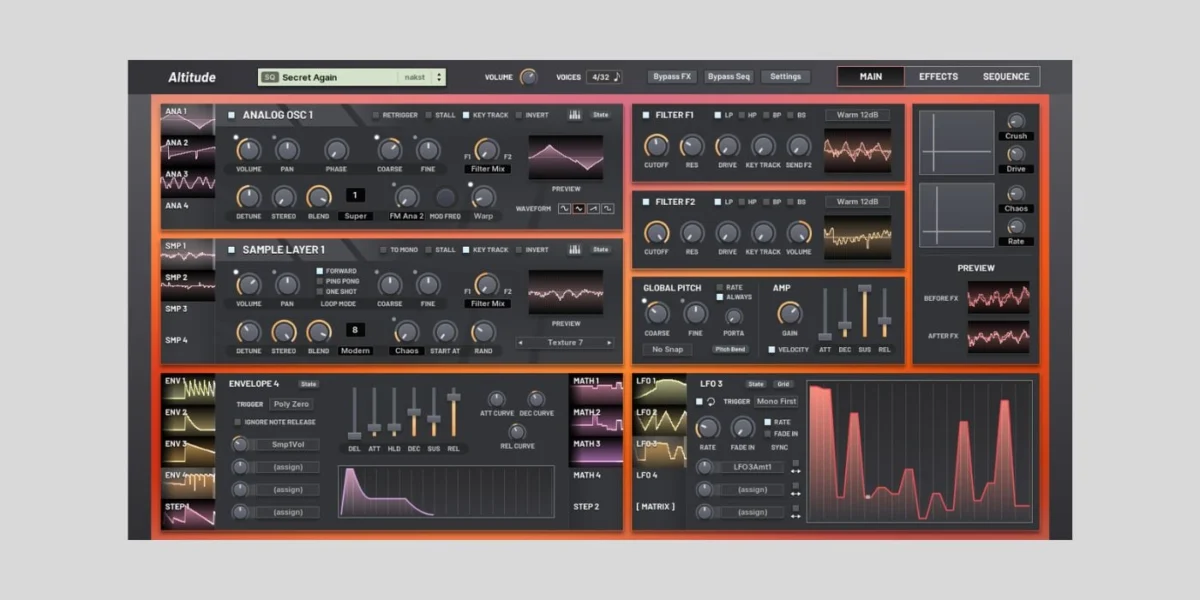
Nakst, a prominent developer known for innovative audio software, has officially released its advanced hybrid synthesis workstation, Altitude, as freeware. This significant move makes a previously paid instrument accessible to a global audience of music producers, sound designers, and audio enthusiasts across Windows, macOS, and Linux platforms. The announcement marks a notable shift in the availability of a sophisticated tool, designed to blend subtractive synthesis, sampling, and FM-style sound design into a singular, powerful interface.
Nakst’s Legacy of Innovation and Community Engagement
The developer, Nakst, has cultivated a reputation within the music production community for crafting high-quality, often experimental, and frequently affordable or free virtual instruments. Over the years, Nakst has introduced a diverse array of plugins that have garnered attention for their unique sonic capabilities and user-friendly designs. Prior releases covered by industry blogs, including Bedroom Producers Blog (BPB), highlight a consistent track record of delivering compelling tools. Instruments such as Apricot, known for its distinctive character, Regency, which explored specific synthesis paradigms, and ExtraBold, a more recent offering, have showcased Nakst’s commitment to pushing the boundaries of software synthesis. Notably, another of Nakst’s instruments, Integrate, also transitioned to a freeware model, signaling a potential long-term strategy for the developer to expand their user base and contribute to the democratisation of advanced music production tools.
Altitude, prior to this announcement, stood as one of Nakst’s commercial offerings. Its transition to a free license is therefore a welcome and somewhat unexpected development, aligning with the developer’s apparent philosophy of making powerful instruments more widely available. This decision is poised to significantly enhance Nakst’s visibility and solidify its standing as a developer that prioritizes community contribution alongside commercial viability. The move was quickly brought to wider attention within the community, with BPB reader "mrg" credited for sharing the news, underscoring the immediate positive reception and the organic spread of such significant updates within the producer ecosystem.
Unveiling Altitude: A Deep Dive into Hybrid Synthesis
Altitude is not merely a synthesizer; it is presented as a comprehensive sound design workstation, meticulously engineered to provide a vast sonic palette through its hybrid architecture. The core strength of Altitude lies in its ability to seamlessly integrate three distinct synthesis methodologies: subtractive synthesis, sampling, and FM-style sound design. This combination allows for an extraordinary range of sounds, from classic analog warmth and gritty digital textures to complex, evolving soundscapes and percussive elements.
At its heart, Altitude features eight generators, providing substantial sonic layering and complexity. These are intelligently split between four virtual analog oscillators and four dedicated sample layers. The virtual analog oscillators are designed to emulate the rich, organic tones associated with classic hardware synthesizers, offering a foundation for powerful basslines, soaring leads, and lush pads. Users can expect a wide array of waveform options, along with traditional parameters such as pulse width modulation, sync, and detuning, allowing for intricate timbral shaping.
Complementing the virtual analog section are the four sample layers, which introduce a world of acoustic realism, percussive impact, and custom sound design opportunities. These layers can be loaded with pre-existing audio, including the substantial factory ROM content, or user-imported samples, allowing for complex multi-sampling, granular textures, or the integration of unique foley and sound effects. The ability to blend these sample layers with the virtual analog oscillators opens up possibilities for creating hybrid instruments that possess both the character of synthesized sound and the detail of recorded audio. For instance, a classic analog synth bass could be layered with a subtle, pitched-down field recording for added texture, or a sampled drum hit could be processed through the synth’s filters and effects for a completely new percussive element.
Sophisticated Sound Shaping: Filters, Effects, and Sequencing
Beyond its robust generator section, Altitude provides an extensive array of tools for further shaping and animating sound. The instrument includes two independent filters, each offering 15 distinct algorithms. This diverse collection of filter types goes beyond standard low-pass, high-pass, and band-pass, likely including more exotic options such as comb filters, formant filters, or various state-variable designs. The availability of multiple algorithms allows for significant timbral manipulation, from subtle tonal adjustments to dramatic sonic transformations. The routing of these filters can be configured in series or parallel, offering additional flexibility in sound design.
For post-processing and spatialization, Altitude integrates eight effect slots, which can host 17 different effect types. This comprehensive effects suite likely includes staples such as reverb, delay, chorus, flanger, phaser, distortion, and compression, alongside potentially more specialized modulation and spectral effects. The ability to chain these effects in various configurations within the eight slots provides immense creative freedom, allowing users to sculpt complex sonic landscapes directly within the workstation, minimizing the need for external plugins.
A standout feature for dynamic sound creation and performance is Altitude’s dual 24-step sequencers. These sequencers are not only capable of traditional melodic and rhythmic patterning but also boast advanced functionalities. Crucially, they include built-in arpeggiators, facilitating the creation of intricate musical phrases and rhythmic motifs. A particularly innovative aspect is the sequencers’ ability to utilize different row lengths, enabling the generation of complex polyrhythmic patterns. This feature is invaluable for composers and producers looking to inject rhythmic complexity and evolving grooves into their music. Furthermore, the routing flexibility of these sequencers allows them to control various parameters across different generators, enabling dynamic changes to pitch, velocity, filter cutoff, or effect send levels over time, creating living, breathing patches.
An Unparalleled Modulation System for Dynamic Expression
One of the most lauded aspects of Altitude, and a critical component for truly expressive sound design, is its exceptionally deep and flexible modulation system. This system empowers users to bring their sounds to life through intricate and evolving parameter changes. Altitude offers:
- Five Envelopes: These typically include ADSR (Attack, Decay, Sustain, Release) envelopes, crucial for shaping the amplitude and other time-variant parameters of a sound. The presence of five suggests extensive control over multiple destinations simultaneously.
- Two Step Modulators: Similar to mini-sequencers, these allow for the creation of stepped, rhythmic, or evolving modulation patterns, often synced to the host tempo.
- Four Math Modulators: These advanced modulators can perform mathematical operations on other modulation sources, allowing for extremely complex and interactive modulation behavior. For example, one LFO’s output could be multiplied by another envelope’s output to create unique and non-linear modulation curves.
- Four LFOs (Low-Frequency Oscillators): Essential for cyclic, rhythmic, or subtle timbral movement, LFOs can modulate parameters like pitch, filter cutoff, pan, or volume, generating anything from subtle vibrato to extreme wobbles.
- A 21-Slot Modulation Matrix: This central hub allows users to connect virtually any modulation source (envelopes, LFOs, step modulators, MIDI CC, etc.) to any of the over 500 modulation destinations within Altitude. This extensive matrix is the key to unlocking the instrument’s full potential for dynamic and responsive sound design, enabling users to create patches that react in sophisticated ways to performance input or internal triggers.
- Four Macro Dials: These assignable controls offer a streamlined way to control multiple modulation parameters simultaneously with a single knob, simplifying complex patch adjustments during performance or automation.
The sheer number of modulation sources and an astounding 500+ modulation destinations mean that almost every parameter within Altitude can be animated and controlled, fostering an environment for truly experimental and evolving soundscapes.
Intuitive User Experience and Rich Content Library
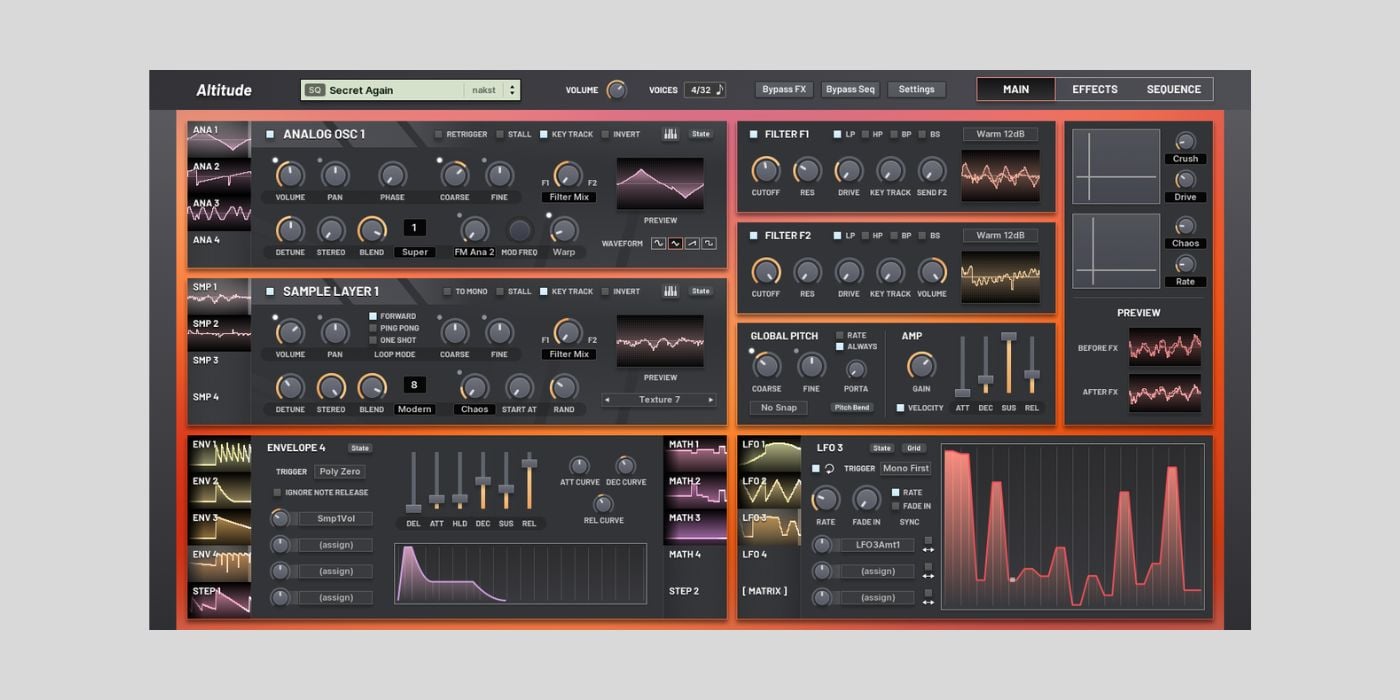
Beyond its technical capabilities, Altitude places a strong emphasis on user experience. The interface is designed to provide abundant visual feedback, which is crucial when dealing with complex synthesis architectures. Modulation previews allow users to see the effect of their modulation assignments in real-time, while reactive displays visually represent the sonic activity, making it easier to understand and sculpt sounds.
Customization extends to the visual aesthetics, with four included skins and support for user-created custom skins, allowing producers to personalize their workspace. The interface also supports scaling from 100% to 300%, ensuring optimal readability and usability across various monitor sizes and resolutions, from compact laptop screens to large studio displays.
To jumpstart creativity, Altitude comes equipped with a comprehensive factory ROM that includes over 300 professionally designed patches. These presets showcase the instrument’s versatility across different genres and synthesis styles, providing excellent starting points or immediate use cases. Complementing these patches is a substantial 265 MB of sample data, which can be used within the sample layers for further patch building and sonic exploration. This rich content library ensures that users have immediate access to a wide array of sounds and building blocks without needing to import their own samples initially.
Platform Compatibility and Technical Considerations
A critical detail for prospective users concerns Altitude’s plugin format support. While many modern plugins standardize on VST3, Altitude notably does not offer VST3 compatibility. Instead, it embraces a multi-format approach to ensure broad accessibility across different digital audio workstations (DAWs) and operating systems.
The workstation supports the CLAP (Common Link Audio Plugin) format, which is gaining traction in the industry for its modern features, efficiency, and open-source nature. The CLAP version of Altitude leverages advanced capabilities such as polyphonic non-destructive modulation, enabling intricate per-note expression; preset discovery, for improved library management; parameter indication, for clearer visualization of controls; and enhanced remote controls, offering deeper integration with compatible hosts.
For macOS users, Altitude is available as an Audio Unit (AU) plugin, ensuring seamless integration with Apple’s native audio framework and DAWs like Logic Pro. On Windows, in addition to CLAP, Altitude supports the native FL Studio plugin format. This specialized version offers unique features tailored for FL Studio users, including support for slide and glide notes, crucial for expressive melodic programming within that specific DAW, and requires FL Studio 9 or later. Furthermore, a standalone version of Altitude is provided, which requires compatible audio and MIDI hardware, allowing users to run the workstation outside of a DAW environment, ideal for live performance or dedicated sound design sessions.
System requirements for Altitude are relatively modest, making it accessible to a wide range of computer setups. Users will need Windows 7 64-bit or newer, macOS 10.14 to 13, or Linux with glibc 2.22 or newer. Hardware requirements include 5 GB of available drive space for the core installation and sample content, 1 GB of RAM, and a 64-bit Intel, AMD, or Apple Silicon processor. These specifications ensure that most contemporary systems can comfortably run Altitude.
In an era of increasing concern over digital rights management (DRM) and emerging technologies, Nakst has made clear that Altitude features no copy protection or DRM, promoting ease of use and installation. Additionally, the itch.io page for Altitude explicitly states that no generative AI was used in its development, addressing a growing point of discussion and concern within the creative software industry regarding intellectual property and ethical development practices.
Broader Implications for the Music Production Community
The release of Nakst Altitude as freeware carries significant implications for the wider music production community. Firstly, it democratizes access to a high-quality, advanced synthesis workstation. Aspiring producers, students, and those with limited budgets can now utilize a tool that offers sophisticated sound design capabilities often found only in expensive commercial plugins. This lowers the barrier to entry for complex sound exploration and enables a broader segment of the creative population to produce professional-sounding music.
Secondly, for established producers, Altitude represents a powerful new addition to their arsenal without any financial outlay. Its hybrid architecture and extensive modulation capabilities mean it can fill unique sonic niches or provide fresh inspiration for existing workflows. The robust feature set, particularly the polyrhythmic sequencers and deep modulation matrix, positions Altitude as a serious contender for intricate sound design tasks, offering possibilities that might even surpass some paid alternatives.
From Nakst’s perspective, making Altitude freeware is a strategic move that can significantly increase its user base and brand visibility. By offering a high-quality product for free, Nakst fosters goodwill within the community, potentially drawing more attention to any future commercial ventures or other freeware releases. It also serves as an excellent showcase for their development capabilities, acting as a high-value "gateway drug" for new users to discover the Nakst ecosystem. This model has proven successful for other developers in the past, transforming free users into loyal fans and potential customers for future products.
The embrace of CLAP over VST3 also highlights a growing trend in plugin development, where developers are exploring alternative, more open, and potentially more performant formats. Nakst’s early adoption of CLAP with a prominent instrument like Altitude could contribute to the format’s broader acceptance and encourage other developers to follow suit, potentially shaping the future of audio plugin standards.
Conclusion: A New Horizon for Sound Designers
The decision by Nakst to make Altitude available as freeware is a momentous occasion for the music production world. It provides an exceptional hybrid synthesis workstation with a rich feature set, deep modulation capabilities, and an intuitive interface, all without cost. This move not only expands the creative possibilities for countless producers but also reinforces Nakst’s commitment to community and innovation. Altitude is poised to become an indispensable tool for anyone looking to explore the vast and intricate world of sound design, offering a new horizon of sonic exploration for beginners and seasoned professionals alike.
