

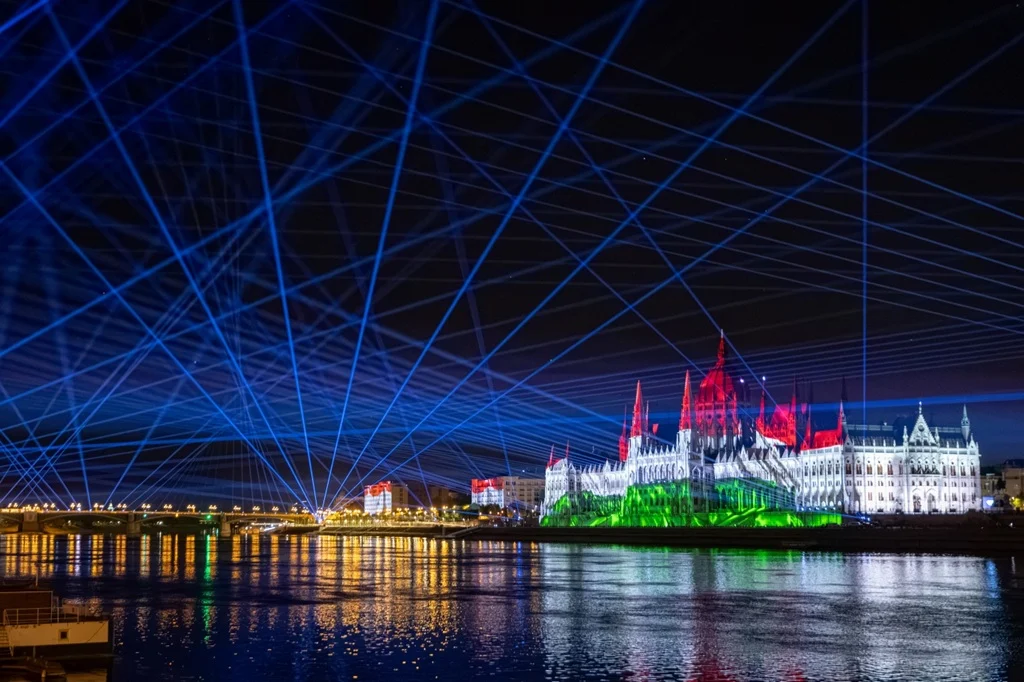
The Hungarian capital of Budapest recently served as the stage for one of the most ambitious audiovisual displays in modern history, marking the annual St. Stephen’s Day celebrations on August 20. In a record-breaking technical feat, the Hungarian Parliament Building and several iconic structures along the Danube River were transformed into a massive architectural canvas through high-performance projection mapping. The installation featured a total of 83 Panasonic laser projectors, including 67 units of the newly released PT-RQ45K and 16 units of the PT-RQ35K. According to Panasonic, this event represents the world’s largest deployment of the PT-RQ45K model to date, a 42,000-lumen 4K projector designed for the most demanding live event environments.
The scale of the production extended far beyond the walls of the Parliament. The show, which combined projection mapping with light shows, lasers, synchronized drone swarms, music, and a traditional fireworks display, spanned the riverfront between the Margaret Bridge and the Széchenyi Chain Bridge. This area was effectively turned into a continuous, immersive projection zone, utilizing the historical facades of the Pest riverbank as secondary screens to complement the central narrative projected onto the Parliament.
Historical Context and Cultural Significance of St. Stephen’s Day
To understand the magnitude of this production, one must consider the cultural weight of the occasion. St. Stephen’s Day, or Szent István napja, is Hungary’s primary national holiday. It commemorates King Stephen I, the first King of Hungary, who is credited with the foundation of the Hungarian state and the Christianization of the region around the year 1000 AD. For centuries, this date has been a symbol of national identity and continuity.
In contemporary times, the festivities have evolved into a massive public spectacle that draws hundreds of thousands of spectators to the banks of the Danube. The Parliament Building, an architectural masterpiece of Neo-Gothic design and the third-largest parliament building in the world, serves as the symbolic heart of these celebrations. Utilizing this building for projection mapping is not merely a technical choice but a symbolic gesture, blending the nation’s thousand-year history with cutting-edge 21st-century technology.
The Technical Core: Panasonic’s Next-Generation Projection Technology
The centerpiece of the technical setup was the Panasonic PT-RQ45K. As the industry moves toward higher brightness and higher resolution in smaller footprints, the PT-RQ45K represents a significant leap forward. Delivering 42,000 lumens of brightness, the projector is designed to overcome the challenges of high ambient light and massive projection distances—factors that are always present in outdoor riverfront installations.
A critical feature of the PT-RQ45K is its Quad Pixel Drive technology. This proprietary system uses high-speed pixel shifting to produce a maximum resolution of 3840 x 2400 pixels, ensuring that even on a building as complex and textured as the Hungarian Parliament, the imagery remains sharp and detailed. The visual content, which included intricate historical depictions and abstract light art, required this level of precision to maintain its impact across the vast surface area of the building’s limestone facade.
Furthermore, the logistical advantages of the PT-RQ45K were paramount for the Budapest production. Despite its high output, the projector maintains a compact chassis similar in size to the 30,500-lumen PT-RQ35K series. This "smallest and lightest in class" designation is vital for technicians who must rig equipment on temporary scaffolding, rooftops, or specialized riverfront enclosures. The compatibility with existing D3LE-series lenses and frames allowed the production team to integrate the new units seamlessly with the 16 PT-RQ35K projectors already in their inventory, optimizing both the budget and the setup time.

Project Chronology and Production Logistics
The execution of a project of this magnitude requires a level of coordination rarely seen outside of Olympic opening ceremonies. The entire production was spearheaded by Centrum Production, under the leadership of Director and Project Manager Dániel Besnyő. The creative vision was further refined by Gergő Geltz, Head of Light Art Content, and Mátyás Kálmán, the Artistic Director.
The timeline for the project was remarkably compressed, with the entire implementation phase—from final design to execution—taking place within a six-week window. This required a Herculean effort from more than 1,000 professionals and the involvement of over 300 individual companies. The creative workload was distributed among six specialized light art studios and eight independent light artists, each tasked with creating specific segments of the visual narrative.
The logistical challenge was compounded by the geography of the site. Projectors had to be positioned across the Danube, requiring precise calculations for throw distances and atmospheric interference. The "Remote Preview" and "Intel SDM-compatible" slots on the Panasonic units proved essential, allowing technicians to monitor and adjust multi-projector setups from a central control point without having to physically access each unit during the high-pressure lead-up to the show.
Content Creation: Merging History with Light Art
The visual content of the show was designed to be more than just a decorative backdrop; it was a narrative journey through Hungarian history. By utilizing both sides of the Parliament building—a rare feat in architectural mapping—the production team was able to create a 360-degree experience for the crowds on both the Buda and Pest sides of the river.
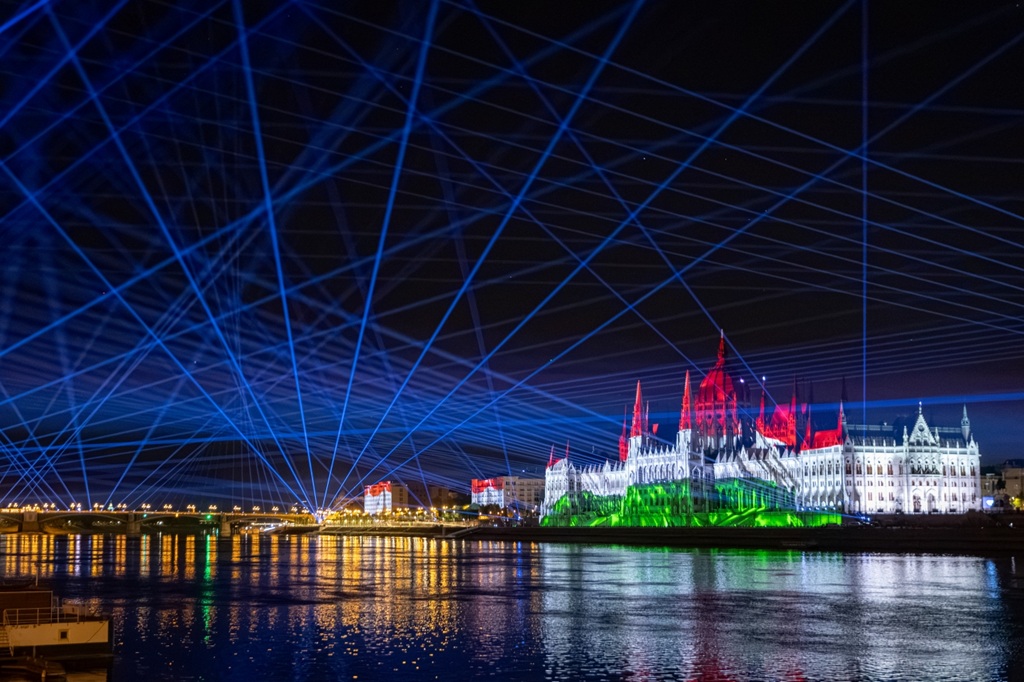
The content focused on themes of national birth, resilience, and the future. Intricate animations highlighted the architectural details of the Parliament, such as its spires, arches, and statues, using them as structural elements in the storytelling. The inclusion of the Széchenyi Chain Bridge in the mapping sequence further unified the cityscape, creating a "theatre of light" that spanned several kilometers of the riverfront. After the main audiovisual show concluded, the architectural projections continued late into the night, allowing the public to appreciate the static and slow-moving light art in a more contemplative atmosphere.
Statements from Project Leadership
Dániel Besnyő, the director of the production, emphasized the necessity of reliability in such a high-stakes environment. "Having worked with Panasonic projectors for the Hungarian national holidays in previous years, we were already well aware of their performance capabilities," Besnyő stated. He noted that for a production of this scale, the team required technology that could deliver consistent brightness and image quality across an exceptionally large installation area.
The decision to utilize the PT-RQ45K was driven by the need for flexibility. Besnyő highlighted that the reliability of the hardware allowed the creative teams to push the boundaries of what was possible, knowing that the technical foundation was secure. This sentiment was echoed by the technical staff, who praised the integrated five-inch color information monitor and the 12G-SDI input for simplifying the complex signal routing required for 83 synchronized 4K sources.
Industry Implications and Future Trends
The Budapest St. Stephen’s Day show serves as a case study for the future of large-scale public events. As cities compete to create "destination events" that drive tourism and civic engagement, the demand for high-end projection mapping continues to grow. The success of this installation proves that with the right technology, entire city districts can be transformed into immersive environments without the need for permanent structural changes.

From a technological standpoint, the event marks a shift toward the normalization of 40,000+ lumen projectors in the rental and staging market. Previously, achieving such brightness required double-stacking lower-output units, which increased the complexity of alignment and doubled the points of failure. The use of single-unit 42,000-lumen projectors like the PT-RQ45K streamlines the workflow and provides a more stable platform for artists.
Moreover, the integration of multiple media—drones, lasers, and projection—into a single synchronized timeline is becoming the new standard for "mega-events." The Budapest production successfully demonstrated how these disparate technologies can be choreographed to create a cohesive sensory experience.
Conclusion
The 2026 St. Stephen’s Day celebrations in Budapest will be remembered as a milestone in the field of audiovisual production. By successfully deploying 83 high-brightness 4K projectors to illuminate one of Europe’s most iconic buildings, Centrum Production and Panasonic have set a new bar for what is achievable in the realm of projection mapping. The project not only honored Hungary’s rich history but also showcased the pinnacle of modern engineering, proving that when historical heritage meets technological innovation, the result is truly spectacular. As the largest installation of PT-RQ45K projectors globally, this event stands as a testament to the power of light to unite, educate, and inspire on a national scale.
