

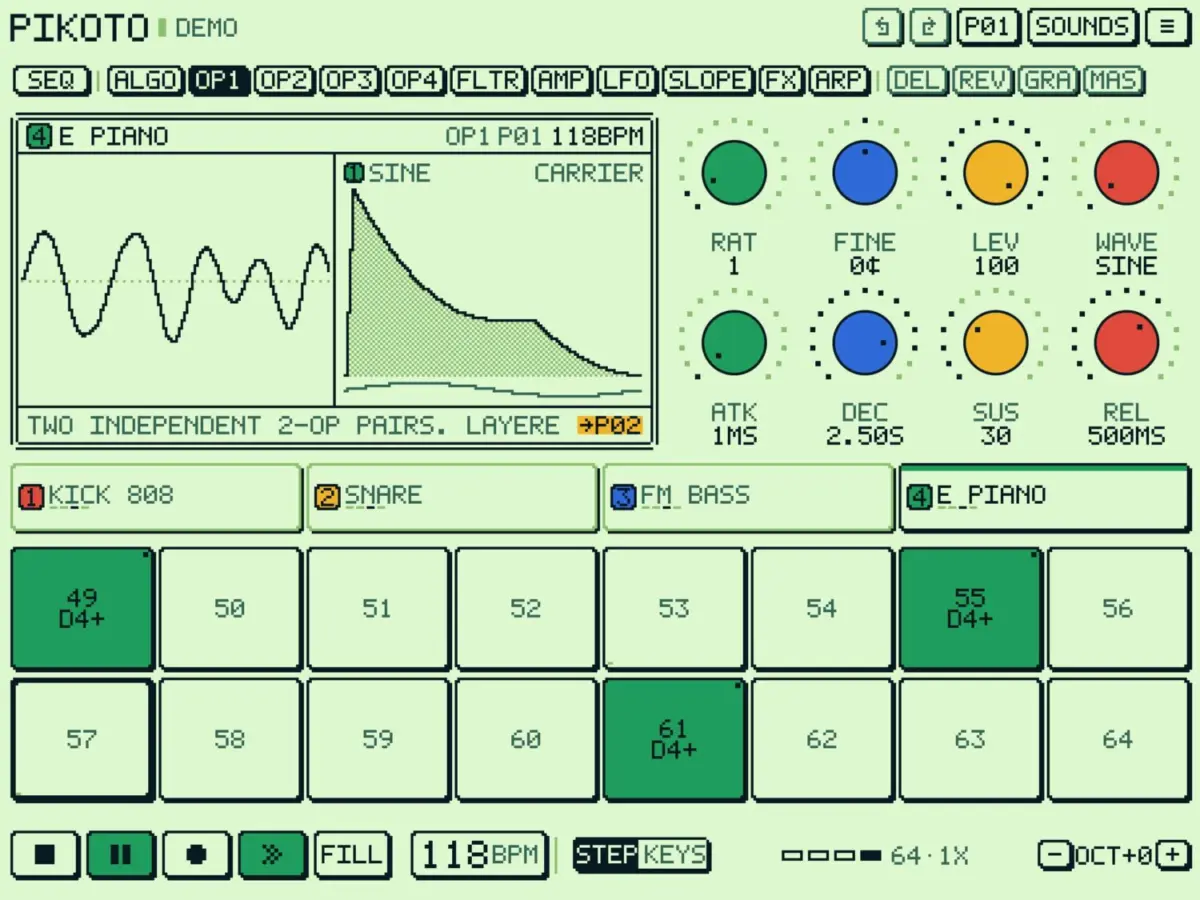
The landscape of mobile music production has witnessed a significant expansion with the official release of Pikoto, a specialized FM (Frequency Modulation) groovebox designed specifically for iOS and Android ecosystems. By integrating a sophisticated four-operator FM synthesis engine with a versatile four-track step sequencer, the application seeks to provide a professional-grade sound design environment within a user interface inspired by the nostalgic aesthetics of handheld game cartridges. This release represents a growing trend in the software industry where high-level synthesis parameters are distilled into portable, touch-centric formats, making complex sound generation accessible to a broader demographic of musicians, hobbyists, and sound designers.
Technical Architecture and Synthesis Engine
At the core of Pikoto is a robust four-operator FM synthesis engine. Frequency Modulation synthesis, popularized in the 1980s by the Yamaha DX7, is renowned for its ability to produce complex, harmonically rich timbres ranging from crystalline bells and metallic percussions to deep, evolving pads. While the original hardware units often featured six operators, the decision to utilize a four-operator architecture in Pikoto reflects a strategic balance between sonic depth and mobile usability.
In FM synthesis, operators function as oscillators that can either act as "carriers" (producing audible sound) or "modulators" (altering the frequency of another operator). By arranging these operators into various "algorithms" or configurations, users can sculpt sounds that are significantly more dynamic than those produced by traditional subtractive synthesis. Pikoto’s engine allows for precise control over these interactions, enabling users to explore the gritty, digital textures that have seen a resurgence in modern electronic music genres such as vaporwave, techno, and IDM.
The synthesis architecture is further augmented by a suite of digital effects and modulation routing. This allows for the refinement of raw FM tones through spatial processing and temporal shifts, ensuring that the output meets contemporary production standards. The inclusion of a four-track sequencer means that users are not merely designing sounds but are constructing entire compositions within the app. Each track can hold independent sequences, allowing for polyrhythmic structures and complex arrangements that defy the app’s playful visual presentation.
Design Philosophy and User Interface
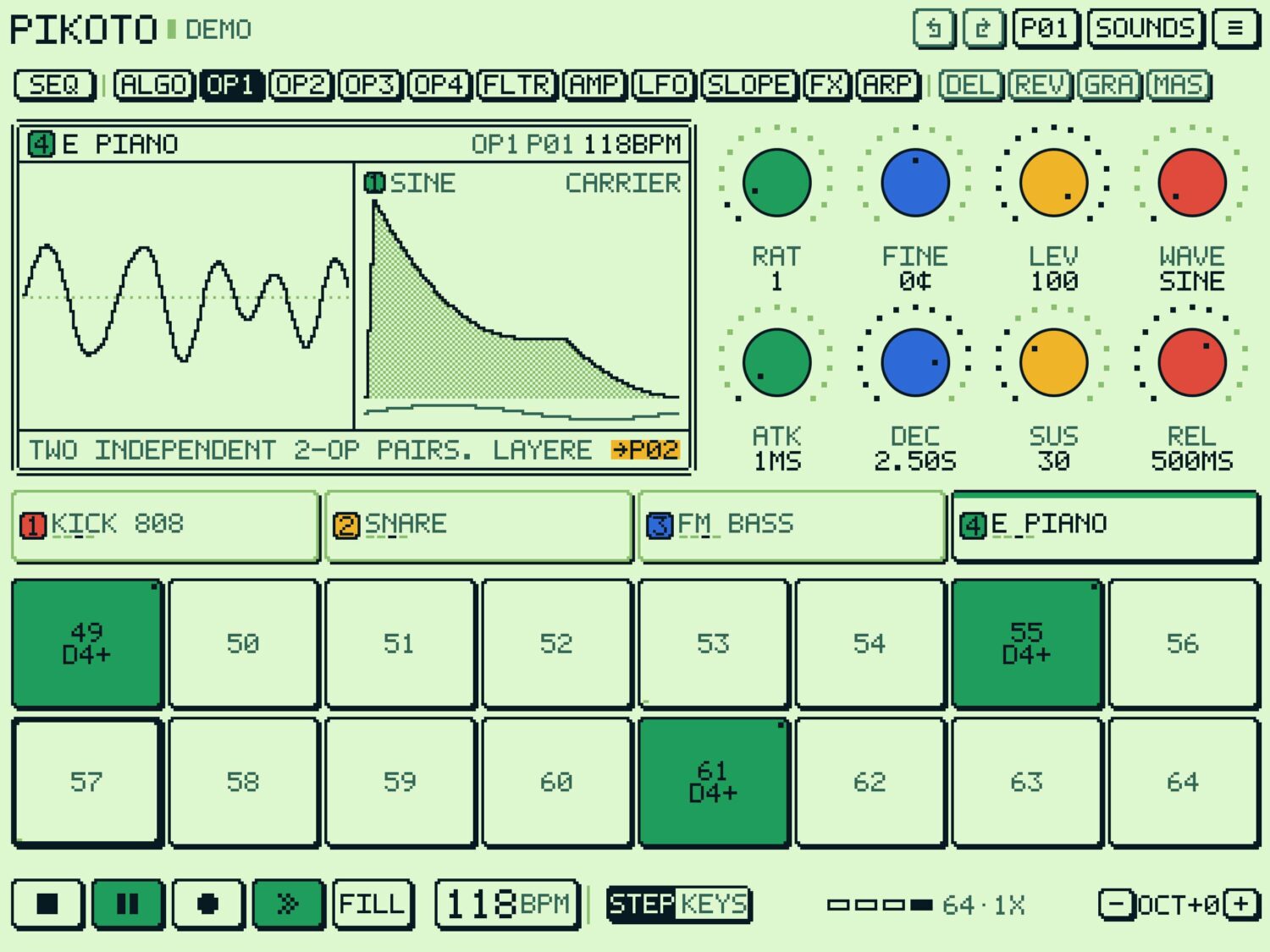
The most striking feature of Pikoto is its visual identity. Eschewing the clinical, knob-heavy interfaces common in professional Digital Audio Workstations (DAWs), Pikoto adopts a design language reminiscent of a 1990s handheld gaming device. The interface is framed as a cartridge-based system, a choice that serves both an aesthetic and functional purpose. By "gamifying" the synthesis experience, the developers aim to reduce the steep learning curve traditionally associated with FM synthesis.
Despite its whimsical appearance, the UI is engineered for high-performance touch interaction. The layout draws inspiration from several heavyweights in the hardware synthesizer world, most notably the Elektron Digitone, the Teenage Engineering OP-Z, the Korg Volca FM, and the industrial Eurorack module Akemie’s Castle. These influences are visible in the way the sequencer handles step-based data and how the FM parameters are grouped for rapid editing. The "Elektron-style" workflow, in particular, suggests the presence of parameter locking—a feature where specific synth settings can be tied to individual steps in a sequence—enabling highly kinetic and evolving patterns.
The Evolution of Mobile Music Production: A Chronology
The release of Pikoto arrives at a pivotal moment in the timeline of mobile music technology. To understand its significance, one must look at the trajectory of the mobile audio market over the last decade:
- The Early Era (2010–2014): Mobile music apps were largely viewed as "toys" or simple sketchpads. Early iterations of apps like ReBirth and the initial release of GarageBand for iPad proved that mobile CPUs could handle real-time synthesis, but professional adoption remained low.
- The Rise of Connectivity (2015–2019): The introduction of technologies like Ableton Link and Inter-App Audio (IAA), followed by the more robust Audio Unit v3 (AUv3) standard, allowed mobile apps to communicate with one another. This era saw the birth of complex "grooveboxes" that could function as the brain of a studio setup.
- The Hardware-Software Convergence (2020–Present): Developers began porting high-end hardware workflows to mobile screens. Devices like the Korg Volca series and the Teenage Engineering Pocket Operators set a precedent for "boutique" hardware that Pikoto now mirrors in software form.
Pikoto represents the culmination of these eras, offering the "boutique" feel of a hardware unit with the convenience and lower price point of a mobile application. Its development cycle focused on optimizing the FM algorithms to run efficiently on a wide range of mobile hardware, ensuring low latency even on mid-range Android devices—a historically difficult feat in mobile audio engineering.
Market Context and Supporting Data
The global market for music production software is projected to grow significantly through 2030, with mobile applications capturing an increasing share of the "prosumer" segment. Data from industry analysts suggests that the accessibility of mobile platforms has lowered the entry barrier for synthesis, leading to a surge in demand for specialized tools like FM grooveboxes.
While hardware units like the Elektron Digitone retail for approximately $750 to $850, and the Korg Volca FM 2 sits around $150, Pikoto’s entry at a $14.99 price point for the full version positions it as a highly competitive alternative. This price-to-performance ratio is a key driver in the "democratization of sound design," allowing users to access sophisticated 4-operator FM synthesis for a fraction of the cost of dedicated hardware. Furthermore, the "freemium" model adopted by Pikoto—offering a functional free version limited to a single save project—allows users to test the workflow before committing financially, a strategy that has proven successful for other mobile hits like the Koala Sampler.
Comparative Analysis of Influences
Pikoto’s identity is built upon the foundations of several iconic instruments. A comparative look at these influences reveals the app’s intended niche:
- Elektron Digitone: Known for making FM synthesis "musical" through a world-class sequencer. Pikoto mimics this by prioritizing the relationship between the sound engine and the step sequencer.
- Teenage Engineering OP-Z: Famous for its screenless, portable workflow and "punch-in" effects. Pikoto adopts the OP-Z’s philosophy of being a "portable powerhouse" that fits in a pocket but sounds like a studio.
- Korg Volca FM: The gold standard for affordable, portable FM. Pikoto provides a more modern, visual way to edit the same types of sounds that the Volca FM popularized.
- Akemie’s Castle: A Eurorack module known for its raw, unpolished digital grit. Pikoto’s engine allows for the same kind of aggressive modulation that modular enthusiasts crave.
Official Positioning and Industry Reaction
While official statements from the development team emphasize the "joy of play," industry reactions have focused on the app’s technical utility. Professional electronic musicians have noted that mobile grooveboxes like Pikoto are increasingly being used as sound sources in larger studio environments. By utilizing the digital output of an iPhone or iPad, producers can sample Pikoto’s FM tones directly into their DAWs, treating the mobile device as an external synthesizer module.
Sound design communities on platforms like Reddit and Discord have reacted positively to the UI, with many users praising the departure from traditional "skeuomorphic" designs (which attempt to look like physical gear). The consensus among early adopters is that Pikoto’s interface encourages experimentation because it feels less like "work" and more like "play," yet the actual output is indistinguishable from professional digital hardware.
Broader Implications for the Music Industry
The launch of Pikoto signifies a broader shift in how musical instruments are perceived. As the line between "gaming" and "content creation" continues to blur, tools that occupy the middle ground are likely to dominate the market. Pikoto’s success could encourage other developers to move away from traditional interface designs in favor of more imaginative, themed environments.
Furthermore, the cross-platform availability on both iOS and Android is a significant move. Historically, Android has lagged behind iOS in music production due to latency issues. However, Pikoto’s release on both platforms suggests that modern Android handsets have finally reached a level of technical parity sufficient for professional audio tasks. This opens up the world of FM synthesis to a global audience that may not have access to Apple’s ecosystem or expensive hardware.
Future Outlook
Looking ahead, the roadmap for Pikoto likely includes expanded MIDI support, allowing it to be played by external keyboards, and potentially AUv3 support for iOS, which would allow multiple instances of the app to run inside a mobile DAW like AUM or Cubasis. As the developer community continues to refine the app, it stands as a testament to the power of modern mobile computing.
In conclusion, the Pikoto FM Synth Groovebox is more than just a nostalgic homage to retro gaming. It is a sophisticated, highly portable instrument that brings the complex world of FM synthesis to the palm of the hand. By combining a powerful sound engine with an intuitive, playful interface and an affordable pricing model, Pikoto is poised to become a staple tool for the next generation of mobile music producers. Its release underscores the ongoing transformation of the smartphone from a communication device into a legitimate, professional-grade musical instrument.
