

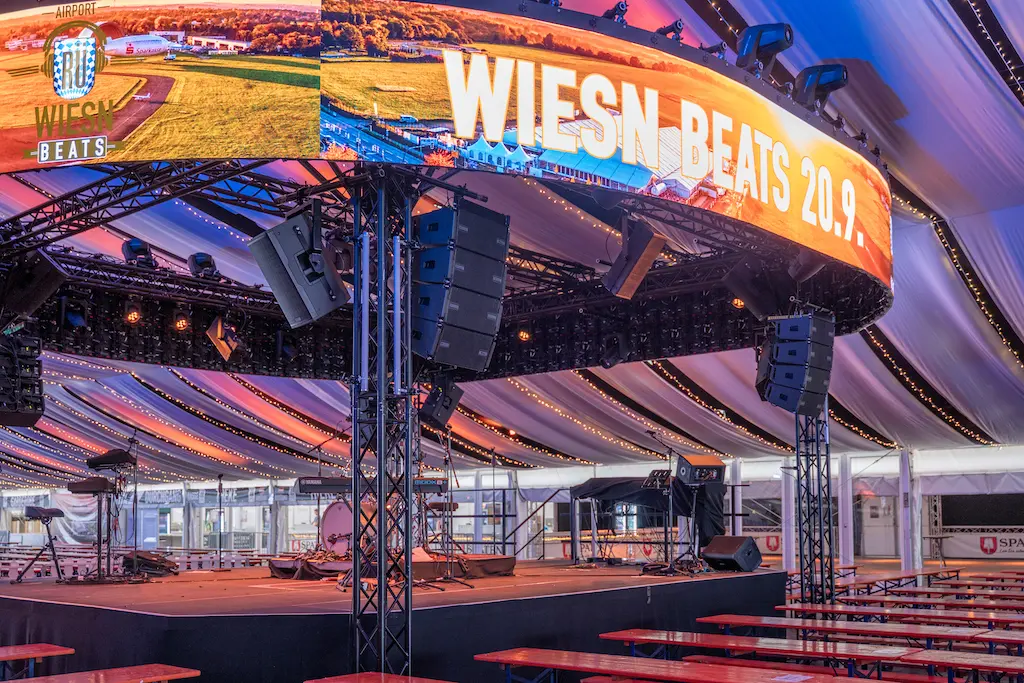
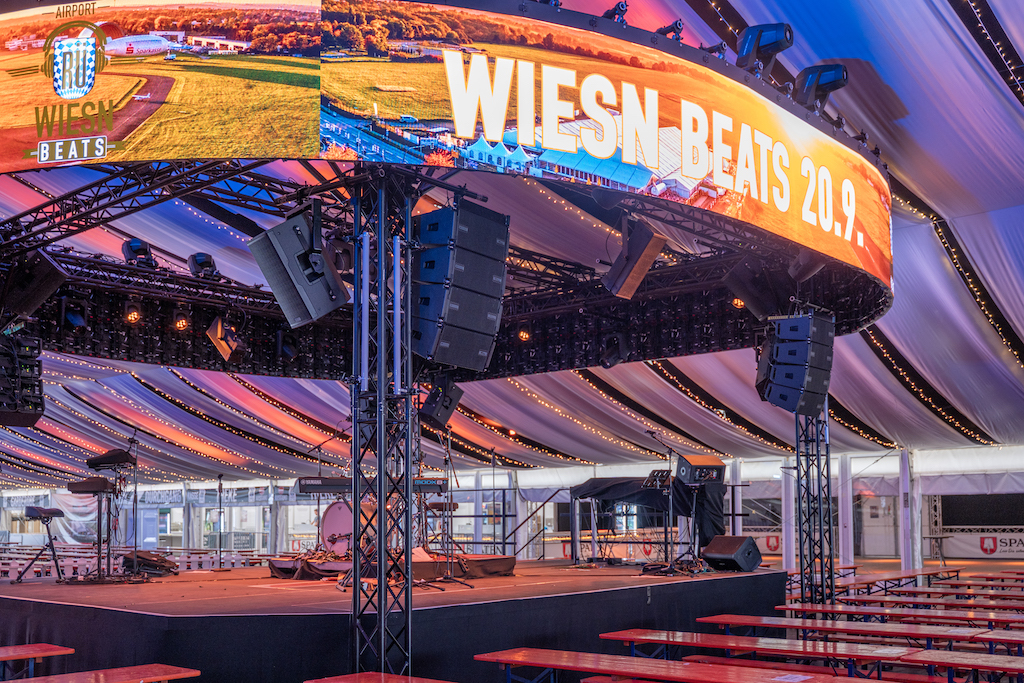
The 13th edition of the RÜ Oktoberfest, held on the expansive grounds of the Essen/Mülheim Airport, represented a significant milestone in the evolution of large-scale event production within temporary structures. Spanning a 2,400-square-meter area within an 80-meter-long festival tent, the 2026 event hosted up to 4,000 guests per session, necessitating a sophisticated audio solution that could deliver the high-energy atmosphere expected of a modern "Wiesn" while adhering to some of the most stringent noise mitigation protocols in the European event industry. The technical execution, spearheaded by the service provider Ton:Media, utilized a complex ecosystem of seven different loudspeaker types from dBTechnologies, all unified into a single, cohesive sonic image.
A Centralized 360-Degree Acoustic Challenge
The architectural layout of the RÜ Oktoberfest tent presented immediate challenges for acoustic designers. Unlike traditional concert setups where audio is projected from a single end-stage, the 2026 event featured a centrally located stage. This 360-degree configuration required the audio system to provide uniform coverage across all four quadrants of the tent simultaneously. Furthermore, the interior of the tent was fully draped in Molton and decorative fabric. While this served to dampen some of the high-frequency reflections typically associated with PVC tent skins, it also increased the weight load on the temporary structure’s trussing, requiring a careful calculation of hang points for the massive loudspeaker arrays.
To address the primary coverage requirements, Ton:Media deployed a Main Hang consisting of four distinct groups of VIO L208 line-array modules. Each group featured four modules, with two groups assigned to each side to cover the long axes of the 80-meter tent. The VIO L208, a compact yet powerful 2-way active line array, was chosen for its ability to provide high SPL (Sound Pressure Level) with a relatively small footprint, ensuring that sightlines remained clear for the thousands of attendees.
Advanced Low-Frequency Management and Cardioid Arrays
In any festival tent environment, the management of low-frequency energy is the most critical factor in both guest experience and noise pollution control. For the 2026 event, twelve VIO S118R subwoofers were deployed in four groups of three. To prevent the "bass buildup" that often plagues stages and causes excessive noise spill outside the venue, the engineering team utilized a cardioid configuration.
In this setup, the middle element of each three-subwoofer stack was physically rotated to face the rear, with its phase and delay settings adjusted electronically. This created a destructive interference pattern behind the subwoofers, significantly reducing the low-end energy directed toward the stage and, more importantly, toward the tent walls. This precision allowed the engineers to maintain a "punchy" and physical bass response on the dance floor while minimizing the structural vibration of the tent, which is a primary source of noise complaints from neighboring residential areas.
Multi-Tiered Delay Lines and Fill Systems
As the distance from the central stage increased toward the far ends of the 80-meter structure, the reliance on a single main hang became unfeasible. To maintain tonal consistency and speech intelligibility, Ton:Media implemented a sophisticated series of staggered delay lines.
The immediate nearfield was handled by VIO X206 units, which filled the sonic gap directly in front of the stage. As the sound moved further into the crowd, the system transitioned to a series of VIO X310 point-source speakers (arranged in 2 × 2 configurations). The final reaches of the tent were covered by four groups of two IG2 column speakers.
The logistical complexity extended to the peripheral areas of the venue. Six additional IG2 units were dedicated to the VIP boxes located along the longitudinal sides of the tent, ensuring that high-paying guests received a premium audio experience without the "muddiness" often associated with hearing the main PA from an off-axis position. Furthermore, the attached terrace tent, a secondary area for guests to congregate, was serviced by four IG3 units.
Notably, the stage itself was kept remarkably "clean" from an acoustic perspective. Ton:Media opted to eliminate traditional floor wedges entirely. Instead, four VIO X12 speakers were suspended as sidefills to provide a general sense of space for the performers, while the primary monitoring for the bands and DJs was handled via In-Ear Monitor (IEM) systems. This further reduced the ambient noise levels within the tent, allowing the front-of-house engineer more headroom to mix the primary PA.

The Regulatory Balancing Act: Wind, Weather, and Noise Limits
The Essen/Mülheim Airport is situated on an elevated plateau, a geographical feature that makes it particularly susceptible to wind. In previous years, this topography acted as a natural amplifier, carrying sound waves toward residential neighborhoods and leading to noise complaints after 10:00 PM. For the 2026 season, the local authorities granted a permit until midnight, but with the caveat of strict, real-time monitoring.
An independent noise control expert was stationed on-site for every day of the festival. This expert conducted three sets of measurements at five pre-defined locations outside the airport perimeter during every event. Because wind speed and direction can dramatically alter how sound travels over distance, the audio team had to be prepared to adjust the system’s output dynamically.
Sven Morsbach, Managing Director of BRT Event GmbH, highlighted the difficulty of this task: "We have to perform a nightly balancing act between providing a high-performance experience for our guests and strictly adhering to the prescribed measurement limits. The ability to partially counter-steer with the system based on wind conditions has worked exceptionally well this year." Morsbach noted that in previous iterations of the event, guests had occasionally complained that the band was not loud enough. However, the precision of the 2026 dBTechnologies deployment eliminated these complaints while simultaneously keeping the neighbors satisfied.
Digital Control and Simulation: The Engineering Backbone
The success of the audio design was rooted in extensive pre-production simulation. Christian Strehl, Sales Application Engineer for Install at dBTechnologies, utilized EASE Focus software to model the tent’s acoustics before a single cable was laid. This allowed the team to predict coverage gaps and potential "hot spots" in the low-end response.
Once on-site, the system was calibrated using Smaart V8 measurement software to ensure that the seven different speaker models were perfectly time-aligned and tonally matched. The entire rig was networked via RDNet, dBTechnologies’ proprietary protocol for real-time monitoring and control. This allowed engineers to see the status of every individual driver and amplifier module from a central laptop running AURORA Net software.
The IG series columns, which are not natively RDNet-compatible, were integrated into the control network via two AD26 digital processors. This level of integration meant that if a sudden gust of wind threatened to carry sound toward a sensitive neighborhood, the engineers could instantly attenuate specific zones of the PA system without affecting the overall balance of the mix.
Chronology of Innovation at RÜ Oktoberfest
The 2026 event marks a decade and a half of growth for the RÜ Oktoberfest. What began as a local celebration has transformed into a major regional attraction that requires the same level of technical infrastructure as a touring stadium concert.
- 2013-2018: The event established its footprint, primarily using traditional point-source systems and standard sub-arrays.
- 2019-2023: As the event moved to the airport grounds, noise complaints became a recurring issue, leading to the first experiments with cardioid subwoofers and limited operating hours.
- 2024-2025: Ton:Media began integrating the dBTechnologies VIO series, moving toward a fully active, networked system.
- 2026: The full implementation of a 360-degree, multi-zone networked system allowed for a midnight permit and the highest guest satisfaction ratings in the event’s history.
Broader Implications for the Event Industry
The success of the RÜ Oktoberfest 2026 project serves as a case study for the future of urban event planning. As cities grow denser and residents become more sensitive to noise pollution, the survival of large-scale festivals depends on "surgical" audio engineering. The transition from "loudness at any cost" to "precision coverage" is no longer a luxury but a necessity for obtaining permits.
The use of active, networked systems like the dBTechnologies VIO and IG series demonstrates how hardware and software can work in tandem to solve environmental challenges. By providing engineers with the tools to control sound dispersion with degree-level accuracy, the industry can continue to host high-energy events in sensitive locations. For the organizers of the RÜ Oktoberfest, the 2026 season proved that with the right technology and a data-driven approach, it is possible to maintain the festive spirit of a traditional beer tent while meeting the rigorous demands of 21st-century urban regulations.
