

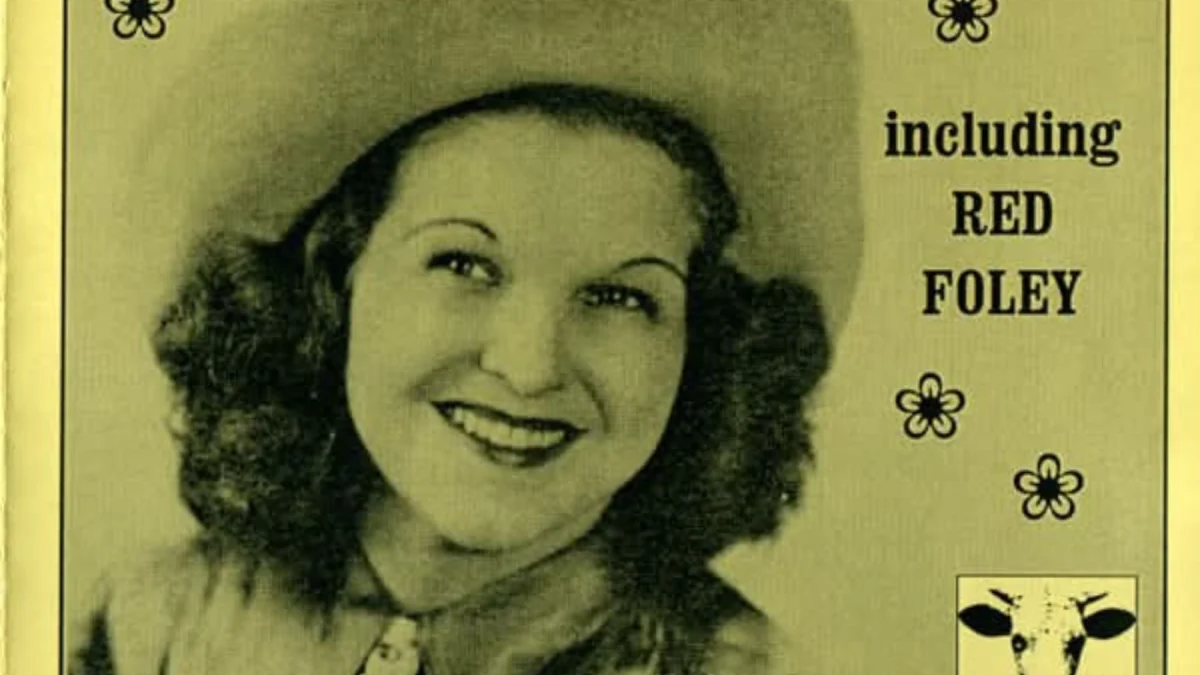
On July 23, 1917, the landscape of American folk and country music was quietly altered by the birth of Eva Alaine Overstake in Decatur, Illinois. Known professionally as Judy Martin, she would rise to become a foundational figure in the early broadcasting era of country music, contributing to the genre’s transition from localized rural entertainment to a national radio phenomenon. While her life was tragically cut short at the age of 34, her legacy remains intertwined with the history of the WLS National Barn Dance and the lineage of the Country Music Hall of Fame.
Early Beginnings and the Overstake Sisters
The musical journey of Eva Alaine Overstake began in the heart of the Great Depression. Growing up in Decatur, she and her older sisters, Evelyn and Lucille, developed a sophisticated three-part harmony style that was unusual for the era’s "hillbilly" music scene. Their first public stages were not concert halls, but the street corners of their hometown, where they performed on behalf of The Salvation Army. By the time Martin was 12 years old, the trio’s vocal blend had already garnered local attention, showcasing a professional discipline that would soon take them to the largest media market in the Midwest.
In 1931, the sisters’ father, Herschel Overstake, recognizing the potential of his daughters’ talent, moved the family to Chicago. This move was strategic; Chicago was the epicenter of the nascent radio industry, and WLS (World’s Largest Store, owned by Sears, Roebuck and Co.) was the most influential station for rural audiences. The audition for the WLS program director proved to be the turning point. The sisters’ ability to execute complex harmonies with a youthful, wholesome image led to an immediate booking on the National Barn Dance, the station’s flagship Saturday night program.
The Rise of the Three Little Maids
By January 1932, the sisters had been rebranded as the "Three Little Maids." This era of their career coincided with the golden age of radio, a time when the National Barn Dance rivaled and often exceeded the popularity of the Grand Ole Opry. The program was a cultural juggernaut, broadcasting from the 1,200-seat Eighth Street Theater in Chicago and reaching listeners across the Great Plains and beyond via clear-channel signals.
The Three Little Maids became a staple of the WLS roster. Their success was quantified not just by their radio presence but by their live appearances. In October 1933, the trio performed at the Chicago World’s Fair (A Century of Progress International Exposition) before a crowd estimated at 10,000 people. This performance solidified their status as national stars. During this period, the sisters also began a daily radio show on WLS, providing them with a platform that was rare for female performers in the early 1930s.
Marriage to Red Foley and the Shift to Nashville Roots
The social circle of the National Barn Dance included the most prominent names in the industry, including Gene Autry, Pat Buttram, and the Hoosier Hot Shots. It was within this professional environment that Judy Martin met Clyde Julian "Red" Foley. Foley was already ascending toward his eventual status as a titan of country music, known for his versatile voice and charismatic stage presence.
The relationship between Martin and Foley was marked by both professional synergy and personal complexity. Foley had recently suffered a profound tragedy; his first wife, Pauline Moore, had died in February 1933 following the birth of their daughter. On August 9, 1933, only six months after Pauline’s passing, Martin and Foley were married.
This union had significant implications for the Overstake sisters as a performing unit. Shortly after the marriage, the Three Little Maids disbanded. While the split ended the trio’s run, it launched the individual sisters into new chapters of music history. Evelyn continued a solo career at WLS, while Lucille Overstake underwent a dramatic transformation. Using the pseudonym Jenny Lou Carson, she became one of the most successful songwriters in country music history. Carson’s 1945 hit, "You Two-Timed Me One Time Too Often," recorded by Tex Ritter, made her the first woman to write a No. 1 country music song.
Professional Career and the Role of Women in Radio
Following the dissolution of the Three Little Maids, Judy Martin did not retire from the spotlight. She adopted her stage name permanently and continued to perform, often appearing alongside her husband or in collaboration with her sister, Jenny Lou Carson. She remained a regular fixture on the National Barn Dance until 1947, a tenure that spanned nearly two decades.
Martin’s career reflects the evolving role of women in the country music industry. During the 1930s and 40s, female performers were often cast in "sweetheart" or "sister" roles, emphasizing domesticity and moral purity. Martin navigated these expectations while maintaining a rigorous recording and touring schedule. In 1949, she recorded "Have I Told You Lately That I Love You?" with Red Foley, a track that remains a classic of the era and highlights the chemistry that made them one of the genre’s first "power couples."
The Foley-Martin Family and the Next Generation
The marriage produced three daughters: Shirley, Julie, and Jenny. The Foley household was deeply embedded in the entertainment world, and the children grew up in the shadow of their parents’ fame. Shirley Foley would later marry singer and actor Pat Boone, further extending the family’s influence into the pop and rock-and-roll eras of the 1950s and 60s. Through this lineage, Judy Martin is the grandmother of the singer Debby Boone, known for the multi-platinum hit "You Light Up My Life."
While Red Foley’s career continued to ascend—eventually leading him to become the first host of the televised Ozark Jubilee and a primary architect of the Nashville sound—the pressures of public life and personal struggles began to take a toll on the family unit.
The Tragedy of 1951 and Its Impact
On November 17, 1951, the country music community was shocked by the news of Judy Martin’s death. At the age of 34, she died by suicide following an overdose of sleeping pills. The event occurred at a time when the music industry was undergoing a massive transition from the radio-centric "hillbilly" era to the modern, television-driven Nashville era.
The circumstances of her death were largely handled with the discretion typical of the early 1950s media, but the impact on Red Foley and their children was profound. Foley, who was at the height of his fame with hits like "Chattanoogie Shoe Shine Boy," struggled with the loss and the subsequent responsibility of raising their daughters. The tragedy cast a long shadow over the Foley family’s public image, though Foley continued to perform and record until his own death in 1968.
Historical Analysis: The Legacy of Judy Martin
Analyzing Judy Martin’s career requires looking past the tragic end of her life to the significant professional milestones she achieved. She was a pioneer of the "Chicago Sound" in country music, which was characterized by cleaner production and more intricate vocal arrangements than the "Delta" or "Appalachian" styles of the same period.
- Broadcasting Pioneer: Martin was part of the first generation of artists to prove that country music could sustain a daily radio audience in a major urban center like Chicago.
- Vocal Influence: The Three Little Maids’ use of close-harmony singing influenced later female groups and sister acts, providing a template for the vocal groups that would dominate the 1940s.
- Industry Matriarch: As part of the Foley-Overstake-Boone lineage, Martin’s life represents the bridge between the vaudeville-inspired radio shows of the 30s and the multi-media entertainment empires of the late 20th century.
Chronology of Key Events
- July 23, 1917: Born Eva Alaine Overstake in Decatur, Illinois.
- 1929: Begins performing with sisters Evelyn and Lucille for The Salvation Army.
- 1931: Moves to Chicago and auditions for WLS.
- January 1932: The "Three Little Maids" debut as regular performers on the National Barn Dance.
- August 9, 1933: Marries Red Foley.
- October 1933: Performs for 10,000 fans at the Chicago World’s Fair.
- 1934–1947: Continues as a solo and collaborative performer on WLS and various recording labels.
- 1945: Sister Lucille (Jenny Lou Carson) achieves the first No. 1 hit by a female songwriter.
- 1949: Records "Have I Told You Lately That I Love You?" with Red Foley.
- November 17, 1951: Dies in Nashville, Tennessee.
Conclusion
The story of Judy Martin is a testament to the rapid evolution of American popular music in the first half of the 20th century. From the street corners of Decatur to the massive broadcast towers of Chicago, she helped define the sound of an era. While her death remains a somber note in the history of the genre, her contributions as a member of the Three Little Maids and her role in one of country music’s most influential families ensure her place in the historical record. On the anniversary of her birth, the industry remembers not just the tragedy of her passing, but the vibrant, harmonic voice that once captivated ten thousand listeners at the World’s Fair and millions more across the airwaves.
