

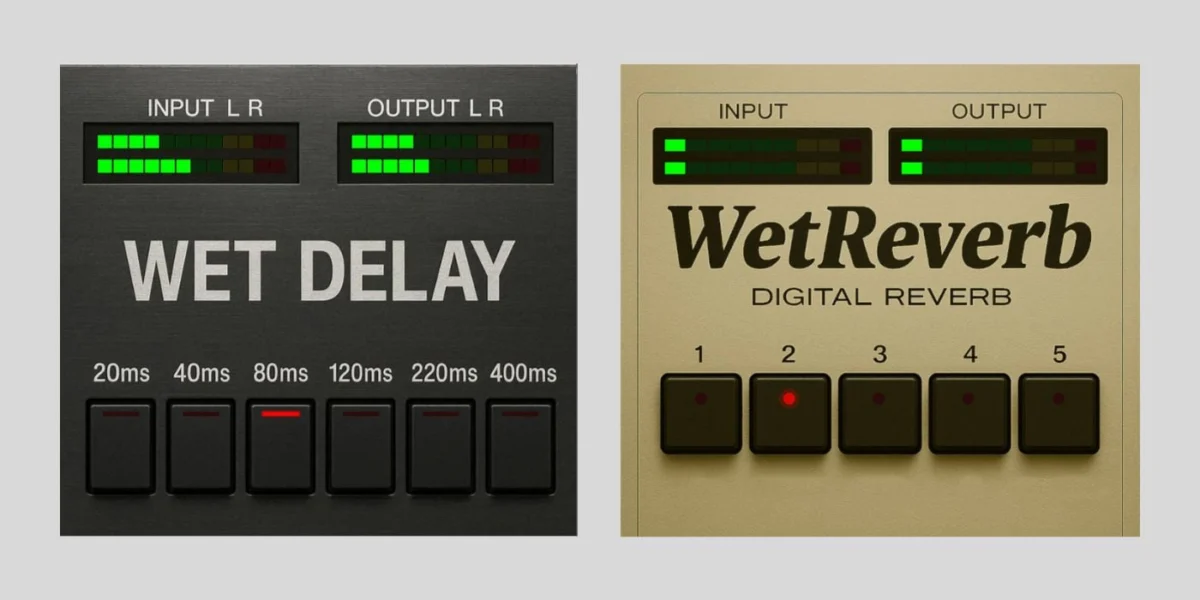
Ronald Klarenbeek has officially released WetReverb and WetDelay, two new VST3 plugins that offer a distinctive 80s rack unit aesthetic and sound. These plugins are made available for free and are fully open-source, representing a significant contribution to the audio production community. Both WetReverb and WetDelay are integral components of the nascent WET VST project, a burgeoning line of audio tools meticulously developed directly on the Steinberg VST3 SDK, notably eschewing the use of JUCE or any other third-party frameworks. This development philosophy underscores a commitment to lean, efficient code and a deep understanding of the VST3 architecture, offering a transparent and customizable foundation for future audio innovation.
The Genesis of the WET VST Project: A Developer’s Long-Awaited Vision
The journey to the release of WetReverb and WetDelay is rooted in a long-standing ambition held by Ronald Klarenbeek. In recent communications, Klarenbeek revealed that the endeavor of building a VST plugin had been a prominent item on his personal development roadmap for over 15 years. This protracted aspiration highlights a profound personal investment in the project, stemming from a unique confluence of his passions: music production, design, and technology. Klarenbeek’s stated goal was not merely to create functional plugins but to do so with a particular emphasis on clean, fast code, achieved by directly engaging with the Steinberg VST3 SDK rather than relying on pre-fabricated frameworks. This approach, while potentially more labor-intensive, ensures a highly optimized codebase and a deeper understanding of the plugin’s core functionality, offering a level of control and transparency that frameworks might obscure. The decision to make the full C++ source code available under an MIT license further amplifies this commitment to transparency and community engagement, inviting developers and enthusiasts alike to study, modify, and even leverage the code as a springboard for their own plugin creations. This open-source philosophy positions the WET VST project not just as a series of tools but as a potential catalyst for collaborative development within the audio software ecosystem.
WetReverb: Capturing the Essence of 80s Digital Reverberation
WetReverb stands out for its faithful emulation of the characteristic "80s digital character" often sought after in contemporary music production. This particular sonic signature, distinct from analog reverbs, is now experiencing a resurgence, appreciated for its ability to add a unique texture to various audio elements. Producers and engineers are finding WetReverb particularly effective on drums, where it can impart a spacious yet defined quality, on synthesizers to create expansive sonic landscapes, and especially on vocals, where it can add a touch of nostalgic depth and presence without clouding the mix.
The technical specifications underpinning WetReverb’s sound profile are crucial to its vintage appeal. The plugin operates at an internal sample rate of 24 kHz, coupled with 12-bit quantization. These parameters are not arbitrary; they are deliberate choices designed to imbue the output with a "gritty and subtly lo-fi" sound. In the context of early digital audio, such specifications were often limitations imposed by the technology of the era. However, in modern production, these characteristics are intentionally harnessed to evoke warmth and a desirable imperfection, differentiating the sound from the pristine, high-fidelity outputs typical of contemporary algorithms. The resulting audio, while technically "lo-fi" by modern standards, is widely regarded as possessing a pleasing warmth and character that complements a wide range of musical genres.
WetReverb offers users a selection of five distinct modes: Room, Plate, Hall, Cathedral, and Cosmos. Each mode is designed to simulate a specific acoustic environment or a classic algorithmic reverb type, providing versatility within its focused aesthetic. The plugin employs Schroeder-style diffusion, a technique widely used in digital reverberation algorithms to create a dense, natural-sounding decay by distributing individual reflections over time. This method is instrumental in achieving the rich, complex tails characteristic of quality reverbs. Furthermore, WetReverb outputs a 100% wet signal, which is a design choice favoring parallel processing in a Digital Audio Workstation (DAW), allowing users complete control over the dry/wet balance within their mixer. Stereo channel crosstalk is also incorporated, subtly blending the left and right channels to enhance the spatial imaging and depth of the reverberated sound. Real-time input/output LED metering provides visual feedback on signal levels, aiding in gain staging and preventing clipping.
One of WetReverb’s most striking features, and indeed a defining characteristic of the WET VST project’s philosophy, is its simplified workflow. The interface deliberately omits an array of complex controls typically found in modern reverb plugins, such as decay time, damping, or early reflection adjustments. Instead, users are presented with a streamlined experience: "you pick a mode, and that’s it." This minimalist approach is not a limitation but a design principle aimed at fostering creativity. By reducing the number of adjustable parameters, the plugin encourages users to focus on the sonic outcome and how it complements the source material, rather than becoming entangled in endless tweaking. This "less is more" philosophy often liberates producers to make quicker, more intuitive decisions, allowing the inherent character of the plugin to shape the sound rather than meticulous parameter adjustments. The effectiveness of this approach is often cited by producers who find themselves more creatively productive when working with simpler, character-driven tools.
WetDelay: Echoes of a Bygone Era with Modern Precision
Following the same design ethos as WetReverb, WetDelay offers a distinct, characterful stereo delay effect. It is also engineered to output a 100% wet signal, aligning with a parallel processing workflow preferred by many audio professionals. The plugin features six fixed delay times, ranging from a tight 20 milliseconds to a more expansive 400 milliseconds. These fixed intervals are a deliberate nod to the operational constraints and design philosophies of original hardware units that inspired the WET VST project, where discrete settings were common due to technical limitations or design choices.
Sonically, WetDelay is characterized by a "nice, a bit dark with no repeating feedback trails." This description suggests a warm, perhaps slightly attenuated high-frequency response in the delay repeats, contributing to its vintage feel. The absence of sustained feedback trails indicates a design focused on single, distinct echoes rather than evolving, self-oscillating patterns, further enhancing its suitability for specific textural applications where clarity and a defined echo are paramount. Technical attributes include stereo processing with a subtle 1% channel crosstalk, which contributes to a wider, more natural stereo image, preventing the delay from sounding too rigidly panned. Real-time metering is also integrated, providing essential visual feedback for input and output levels.
While the fixed delay times are faithful to the original hardware inspiration, some users might express a desire for greater flexibility, such as a freely adjustable delay time knob or synchronization capabilities with a Digital Audio Workstation (DAW). These modern software conveniences have become standard expectations, offering precise timing and rhythmic integration. The balance between maintaining historical fidelity and incorporating contemporary usability features is a constant consideration in plugin development. However, the current design of WetDelay, with its fixed times, encourages a different mode of interaction, where the producer adapts their creative choices to the available settings, much like working with vintage hardware. This can, paradoxically, lead to unique and unexpected sonic outcomes that might not be discovered with more flexible, but potentially overwhelming, controls.
The Technical Foundation: VST3 SDK and the Open-Source Paradigm
The decision by Ronald Klarenbeek to build the WET VST plugins directly on the Steinberg VST3 SDK, without relying on intermediate frameworks like JUCE, is a critical technical and philosophical choice. VST3, or Virtual Studio Technology 3, is Steinberg’s latest iteration of its industry-standard plugin interface, offering numerous advancements over its predecessors. These include improved efficiency, better CPU usage, and enhanced capabilities such as side-chaining, dynamic I/O, and more flexible event handling. Developing directly on the SDK often results in a smaller plugin footprint, potentially higher performance due to less abstraction, and a more intimate control over the plugin’s behavior. However, it also presents a steeper learning curve and requires a deeper understanding of low-level programming, which Klarenbeek’s 15-year ambition suggests he was well-prepared to tackle.
The open-source nature of the WET VST project, under an MIT license, represents a significant contribution to the audio software community. In an industry often dominated by proprietary solutions, open-source initiatives foster transparency, collaboration, and innovation. An MIT license is one of the most permissive free software licenses, allowing users to freely use, modify, distribute, and even sell the software, provided the original license and copyright notice are included. This encourages community-driven development, where enthusiasts and developers can contribute bug fixes, new features, or simply learn from the existing codebase. Such projects democratize technology, making high-quality tools accessible to everyone, and provide valuable educational resources for aspiring plugin developers. The open-source model has historically driven significant advancements in various software sectors, and its application to audio plugins promises similar benefits, potentially leading to a more vibrant and collaborative ecosystem.
Broader Market Context and Implications
The release of WetReverb and WetDelay arrives at a time when the music production landscape exhibits a strong appreciation for characterful, vintage-inspired sounds. The "lo-fi" aesthetic, once a byproduct of technological limitations, is now a coveted creative choice, often employed to inject warmth, grit, and nostalgia into modern productions. Klarenbeek’s plugins tap directly into this trend, offering an authentic 80s digital sound that differentiates itself from the often sterile perfection of high-fidelity processing. This niche appeal positions WetReverb and WetDelay as valuable additions to any producer’s toolkit, especially those working in genres like synthwave, vaporwave, hip-hop, or indie electronic music, where sonic imperfections are celebrated.
Furthermore, the minimalist design philosophy adopted by Klarenbeek—eschewing numerous parameters for a focused, character-driven approach—represents a counter-trend in an industry often saturated with feature-rich, complex plugins. Many producers find themselves overwhelmed by an abundance of options, leading to decision fatigue and hindering creative flow. Simple, "one-knob" or limited-parameter plugins are gaining traction because they encourage intuitive use and allow the inherent sonic qualities of the effect to shine. This design choice by Klarenbeek aligns with a growing movement towards tools that inspire creativity through elegant simplicity rather than overwhelming complexity.
The project also carries significant implications for independent developers. By demonstrating the feasibility and merit of building VST3 plugins directly on the SDK and embracing an open-source model, Klarenbeek could inspire a new generation of developers. It showcases that it is possible to create high-quality, professional-grade audio tools without necessarily relying on established frameworks or proprietary licenses. This could lead to a more diverse and innovative plugin market, driven by passionate individuals and smaller teams. The accessibility of free, open-source plugins also plays a crucial role in democratizing music production, lowering the barrier to entry for aspiring artists and producers who may not have the financial resources for expensive commercial software. This fosters a more inclusive creative environment where talent and creativity can flourish irrespective of economic status.
The Future of the WET VST Line
Ronald Klarenbeek has already outlined an ambitious roadmap for the expansion of the WET VST line, with plans for four additional plugins. These include a chorus, an EQ, a preamp, and a compressor. This projected suite suggests a comprehensive approach to building a virtual rack of essential vintage-inspired effects, each designed with the same minimalist philosophy and character-driven sound. A chorus plugin would likely complement the 80s aesthetic perfectly, given its prominence in that era’s music. An EQ and preamp could introduce subtle tonal shaping and saturation, while a compressor would offer dynamic control with a distinct vintage flavor.
While it has not been officially confirmed whether all future plugins in the WET VST line will also be free and open-source, the established philosophy of the project strongly suggests this will be the case. Maintaining consistency with the initial releases would reinforce the project’s commitment to community, transparency, and accessible innovation. Should these future plugins indeed follow the same model, the WET VST project would become an even more invaluable resource for the audio production community, offering a complete and cohesive set of characterful effects for modern producers seeking a touch of vintage charm.
Availability and Conclusion
Both WetReverb and WetDelay are currently available in VST3 format, ensuring broad compatibility across major Digital Audio Workstations. They support Windows, Linux, and macOS, including native compatibility for both Intel and Apple Silicon architectures, making them accessible to a wide user base. The plugins can be downloaded directly from the WET VST website (wetvst.com) at no cost.
Ronald Klarenbeek’s WET VST project, initiated with the release of WetReverb and WetDelay, represents a notable contribution to the audio plugin landscape. By blending a nostalgic 80s digital aesthetic with modern technical execution and an unwavering commitment to open-source development, Klarenbeek has created tools that are not only sonically distinctive but also philosophically significant. These plugins offer a refreshing alternative to the complex, pristine effects often found in the market, encouraging a more intuitive and character-driven approach to music production. As the WET VST line continues to expand, it promises to further enrich the creative options available to producers worldwide, fostering both innovation and community within the realm of audio software.
