

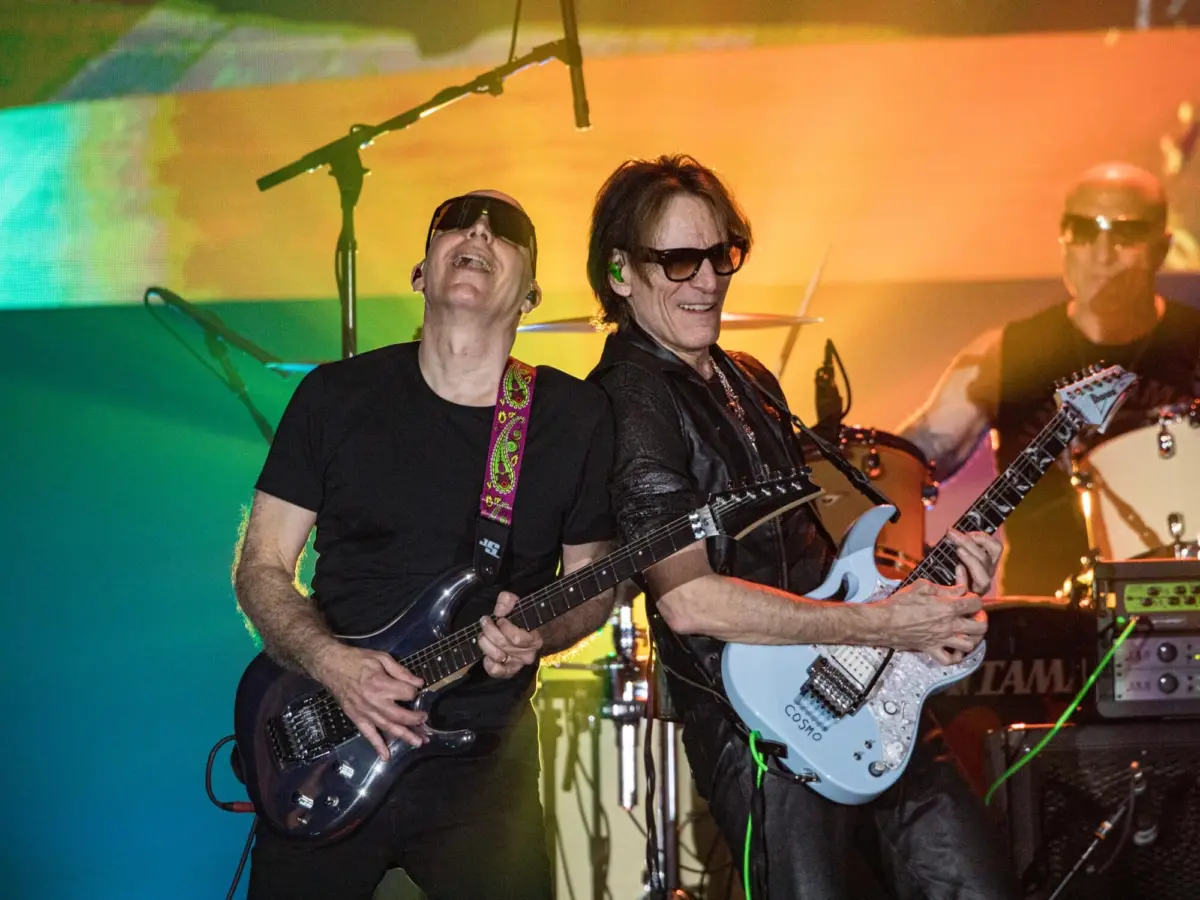
Even the most revered figures in the pantheon of guitar virtuosity are not immune to profound technical challenges, a reality underscored by the recent admissions from Steve Vai and Joe Satriani regarding their collaborative project, SATCHVAI. The duo, celebrated for their groundbreaking contributions to instrumental rock and shred guitar, have openly discussed their struggles with specific instruments and techniques during the creation of their highly anticipated debut album, "The Sea of Emotion." These candid revelations highlight a fundamental truth in artistic development: continuous growth often necessitates stepping far outside established comfort zones, even for those at the apex of their craft. Such instances resonate with past acknowledgements from other legendary musicians; James Hetfield of Metallica, for example, has famously deemed the iconic riffs of "Master of Puppets" to be challenging, while Queen’s Brian May described the intricate main riff of "Bohemian Rhapsody" as "unnatural" to execute. These insights collectively affirm that mastery is not a static state but an ongoing journey of confrontation and conquest, where true professionals embrace adversity rather than shy away from it.
The SATCHVAI project, a collaboration long dreamt of by fans and a natural evolution of their storied mentor-mentee relationship, has served as a crucible for both Vai and Satriani to push their respective artistic and technical limits. While the partnership itself represents a fusion of two distinct yet complementary styles of instrumental guitar, the creative process behind "The Sea of Emotion" demanded personal sacrifices and significant stretches in their comfort zones. One of the most striking examples comes from Steve Vai, who ventured into the notoriously unforgiving territory of the fretless guitar for the track "Old Sins Have Long Shadows."
The Fretless Frontier: Steve Vai’s Ghostly Pursuit
Steve Vai, a guitarist synonymous with precision, innovative techniques, and a seemingly effortless command over the fretboard, found himself grappling with an instrument that fundamentally subverts many of his ingrained habits. "They’re not my expertise… I struggle with them!" Vai confessed in a recent interview with Guitarist magazine. This statement carries significant weight given Vai’s reputation as a technical innovator, often credited with popularizing seven-string guitars and pushing the boundaries of whammy bar articulation and two-handed tapping. His signature style is built upon an almost surgical accuracy, which frets inherently facilitate by providing discrete, fixed points for pitch.
The fretless guitar, by contrast, removes these tactile and visual guides, demanding an entirely different approach to intonation and articulation. It transforms the guitar into an instrument akin to a violin or cello, where pitch is determined solely by the precise placement and pressure of the fingers along a smooth fingerboard. This absence of frets, while offering unparalleled fluidity and microtonal expressiveness, presents a formidable challenge for even the most seasoned guitarists accustomed to fretted instruments. Without the familiar metallic bars, the player must rely on an acutely developed ear and muscle memory to achieve perfect pitch, a task that can feel disorienting and counter-intuitive. Conventional chord shapes, which rely on the fixed intervals provided by frets, largely become obsolete, forcing a reimagining of harmonic structures.
Vai’s decision to employ a fretless guitar for "Old Sins Have Long Shadows" was driven by a specific artistic vision: to evoke a "ghostly" and "weird, offbeat" sonic texture. He elaborated, "[That was] one of the big challenges for me… When I approached [that track] one side of me is thinking ‘My God what am I going to do?’ But to get that ghostly, weird, offbeat riff, it had to be [a fretless guitar], you know? All the vibrato and little shakes – it doesn’t sound like a guitar. It sounds like a ghostly spirit." This demonstrates a commitment to serving the song’s narrative and atmosphere, even at the cost of personal technical ease. The unique timbral qualities of a fretless guitar – its smooth glissandos, vocal-like sustain, and the ability to subtly bend into notes from any microtonal starting point – were deemed essential to capture the ethereal quality Vai envisioned, proving that artistic necessity often trumps personal comfort.
Joe Satriani’s Acoustic Revelation: From Distortion to Delicacy
Joe Satriani, known for his signature blend of melodic sophistication and searing lead guitar tones, also encountered an unexpected hurdle during the album’s production. His challenge lay not in an exotic instrument but in reinterpreting a piece originally conceived in his familiar electric realm for the stark intimacy of a nylon-string acoustic guitar. The track in question, the intro to "The Sea Of Emotion Pt 2," initially featured a heavily processed electric sound.
"The nylon string intro to The Sea Of Emotion Pt 2," Satriani recounted, "When I first composed that, I had full distortion, stereo echo, chorus and I’m playing it on electric guitar… but the song made this journey from a grown man who still thinks like a 14-year-old, sitting by his amplifier, having a rock ‘n’ roll moment, to seeing that I should play it on a nylon-string and leave space for what Steve did, which is that electric violin-type dreamscape." He then added with a laugh, "It was a piece of cake on the electric, but not on the acoustic…"
This transition, while seemingly less radical than Vai’s fretless endeavor, presented its own set of significant technical and interpretive difficulties. Playing on a nylon-string acoustic demands a different touch, dynamic control, and articulation compared to an electric guitar. Electric guitars, especially when amplified and processed with effects like distortion, echo, and chorus, can mask imperfections in technique and sustain notes with ease. The higher string tension and smaller body of an electric guitar allow for faster runs and more aggressive playing styles.
Nylon-string acoustics, conversely, are inherently less forgiving. They require a precise fingerstyle approach, impeccable timing, and a nuanced dynamic range to prevent notes from muddling or decaying too quickly. The softer strings and warmer, more resonant tone demand a delicate yet firm touch, where every subtle movement of the fingers contributes directly to the sound. The absence of sustain-enhancing effects means the player must rely entirely on their physical technique to shape the notes. Furthermore, the wider string spacing and flatter fretboard radius common on classical-style nylon-string guitars can make intricate electric guitar passages feel awkward or impossible to execute with the same fluidity. Satriani’s decision to embrace the nylon-string for "The Sea Of Emotion Pt 2" signifies a mature artistic choice, prioritizing the song’s emotional arc and collaborative dynamic over the familiarity of his preferred electric setup. It allowed him to create a foundational, vulnerable soundscape that complemented Vai’s subsequent "electric violin-type dreamscape," illustrating a shared commitment to the overall musical vision.
A Legacy of Innovation: Vai and Satriani’s Respective Journeys
The struggles faced by Vai and Satriani are particularly noteworthy given their legendary status and extensive histories of pushing guitar boundaries.
Steve Vai’s Path: Born in 1960, Steve Vai’s journey into guitar legend began under the tutelage of Joe Satriani himself. His professional career launched in the late 1970s as a transcriptionist for Frank Zappa, eventually joining Zappa’s band from 1980 to 1982. This period immersed him in complex compositional structures and an unparalleled commitment to musical exploration. Vai’s solo career exploded with albums like "Flex-Able" (1984) and, most notably, "Passion and Warfare" (1990), which became a touchstone for instrumental guitar. He is celebrated for his virtuosic technique, inventive use of the whammy bar, pioneering work with seven-string guitars (popularized through his work with Whitesnake and then with David Lee Roth), and a deeply expressive, almost spiritual approach to his instrument. His playing is characterized by extreme technical proficiency, often incorporating tapping, legato, and intricate phrasing, making his admission of struggle with the fretless guitar all the more compelling.
Joe Satriani’s Trajectory: Joe Satriani, born in 1956, also began his professional life as a guitar instructor, shaping the early careers of numerous future guitar heroes, including Vai, Metallica’s Kirk Hammett, and Testament’s Alex Skolnick. His solo breakthrough came with "Surfing with the Alien" (1987), an album that redefined instrumental rock with its catchy melodies, diverse textures, and breathtaking technicality. Satriani’s style is often described as more melodic and compositionally focused than some of his shred contemporaries, yet his technical prowess is undeniable. He is known for his signature smooth legato, exotic scales, and innovative use of effects to craft expansive sonic landscapes. His role in the G3 concert series, which he founded in 1996, further solidified his reputation as a collaborative leader in the instrumental guitar world, bringing together generations of guitar virtuosos.
SATCHVAI: The Genesis of a Superduo
The SATCHVAI project represents the culmination of a relationship that spans decades, evolving from a mentor-mentee dynamic into a profound friendship and mutual artistic respect. The idea of a full-fledged collaborative album between Vai and Satriani has been a topic of fervent discussion among guitar enthusiasts for years, especially given their sporadic but always electrifying joint appearances on the G3 tours. While G3 showcased their individual brilliance in a shared concert setting, SATCHVAI promised a deeper, more integrated creative endeavor.
The genesis of the SATCHVAI album, "The Sea of Emotion," reportedly involved a deliberate effort from both artists to push their personal and collaborative boundaries. It was not merely about showcasing individual prowess, but about creating something new and synergistic that transcended their individual catalogs. This commitment to pushing past their familiar comfort zones, as evidenced by the fretless guitar and nylon-string acoustic challenges, is central to the project’s artistic integrity. The anticipation for this album has been immense within the guitar community, seen as a landmark event uniting two titans who have profoundly influenced generations of musicians. The project is a testament to the idea that even after achieving iconic status, true artists continue to seek growth, challenge assumptions, and explore uncharted musical territories.
The Broader Implications: Redefining Virtuosity and Artistic Growth
The candid admissions from Vai and Satriani carry significant implications for understanding virtuosity and artistic development in music. Firstly, they dismantle the myth of the effortless genius. While these musicians possess extraordinary natural talent and decades of relentless practice, their struggles underscore that even at the highest echelons, mastery is not about the absence of difficulty, but the willingness to confront and overcome it. This perspective is invaluable for aspiring musicians, demonstrating that challenges are an inherent part of the creative process, not a sign of inadequacy.
Secondly, their approach highlights the importance of artistic intentionality over mere technical display. Vai’s decision to use a fretless guitar, despite his admitted difficulty, was driven by a specific sonic vision for "ghostly" textures. Satriani’s choice to adapt an electric riff to a nylon-string acoustic was guided by the song’s narrative journey and the desire to create space for Vai’s contribution. These instances illustrate that technical prowess, while crucial, ultimately serves a greater musical purpose, prioritizing emotional resonance and collaborative synergy.
Furthermore, the SATCHVAI project itself, built on a foundation of pushing boundaries, sends a powerful message about the continuous evolution of an artist. It shows that even after decades of groundbreaking work, there remains an appetite for self-reinvention and exploration. This commitment to growth ensures that their music remains fresh, relevant, and inspiring, rather than resting on past achievements. In an era where instrumental music continues to evolve, the willingness of these pioneers to step into uncomfortable territory helps redefine what is possible on the guitar and encourages a new generation to similarly challenge conventions.
"The Sea of Emotion": An Eagerly Awaited Release
The debut album from SATCHVAI, "The Sea of Emotion," is scheduled for release on November 6. The album’s lead single and official video, "Mayhem," has already offered a glimpse into the dynamic interplay and sonic landscape crafted by Vai and Satriani. The revelations about the technical challenges faced during its creation only amplify the anticipation surrounding the full album. Fans and critics alike are eager to hear how these personal struggles translated into the final musical product, and how the duo’s commitment to venturing beyond their comfort zones has shaped an album poised to become a significant milestone in the history of instrumental guitar music. The record is expected to be a testament to not just their individual brilliance, but to their shared artistic philosophy of relentless exploration and unwavering dedication to the craft.
