

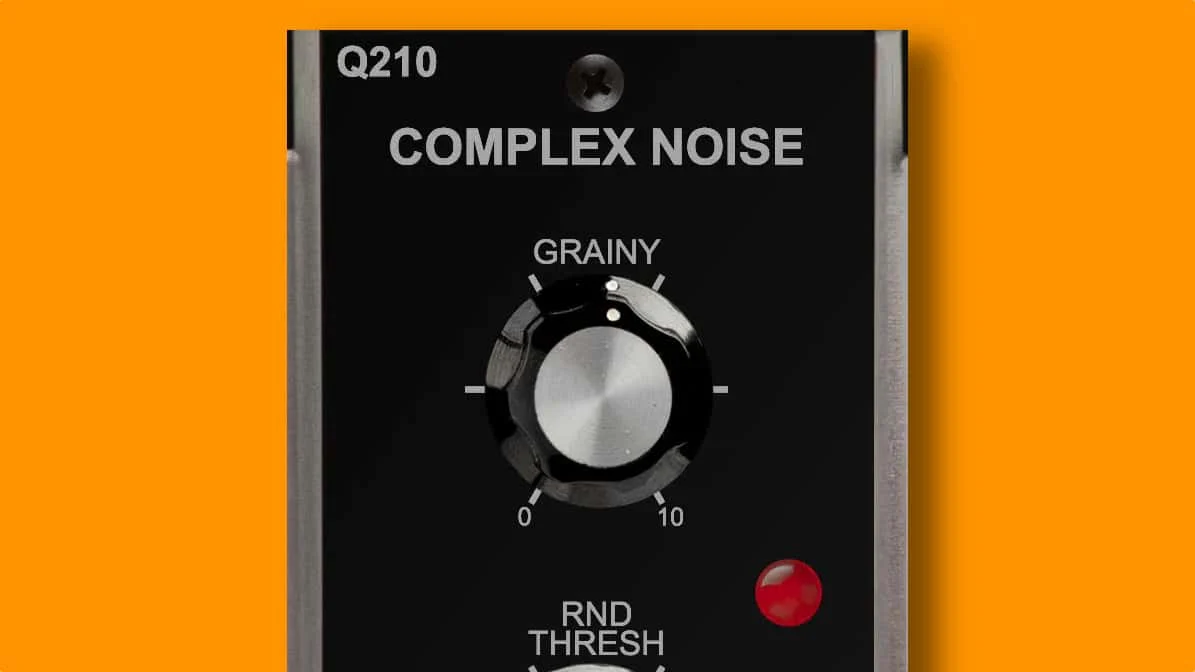
The landscape of professional modular synthesis has seen a significant addition with the official release of the Q210 Complex Noise module by Synthesizers.com, a company widely recognized as the primary architect of the modern Moog-format standard. This new hardware component is designed to transcend the traditional limitations of standard noise generators, offering a multi-faceted toolset that functions as a foundational element for both percussive sound design and evolving generative soundscapes. Positioned as a "noisemaker’s playground," the Q210 represents a strategic expansion of the company’s Q-series, providing users with a sophisticated array of sonic textures and rhythmic triggers within the 5U (Large Format) ecosystem.
Technical Architecture and Functional Capabilities
The Q210 Complex Noise module is engineered to provide a comprehensive suite of noise-based signals, which are essential for subtractive synthesis and various sound design techniques. While standard noise modules often provide basic white and pink noise, the Q210 is characterized by its "complex" designation, implying a higher degree of internal routing or specialized filtering that allows for a broader spectral range. According to technical specifications, the module is capable of generating everything from "tame textures" suitable for subtle atmospheric layering to "dramatic and explosive" sounds that can dominate a mix.
One of the standout features of the Q210 is its ability to generate random gates. In the context of modular synthesis, a gate is a control signal that remains high for a specific duration, typically used to trigger envelopes or advance sequencers. By integrating a random gate generator directly into a noise module, Synthesizers.com has provided a tool that is particularly useful for generative music. In this mode, the module can act as a non-deterministic clock source, firing off triggers at irregular intervals that mimic organic or chaotic patterns. This functionality is often sought after by composers looking to move away from the rigid, grid-based timing of traditional sequencers.
The Evolution of the 5U Modular Standard
To understand the significance of the Q210, it is necessary to examine the history of the format it inhabits. The 5U format, often referred to as the "Moog format," utilizes modules that are 8.75 inches tall, mimicking the physical dimensions of the legendary Moog modular systems of the 1960s and 70s. While the smaller Eurorack format has dominated the hobbyist market in recent decades, the 5U format remains a staple in professional studios due to its ergonomic spacing, high-quality 1/4-inch jacks, and robust physical presence.
Synthesizers.com, founded by Roger Arrick in the mid-1990s, was instrumental in reviving this format at a time when modular synthesis was largely considered obsolete. By standardizing the power connectors and panel dimensions, the company allowed a new generation of musicians to access the "big-knob" experience without the astronomical costs associated with vintage Moog hardware. The Q210 is a continuation of this legacy, maintaining the aesthetic and mechanical standards that have made "Dotcom" systems a benchmark in the industry.
Sonic Versatility: From Textures to Percussion
The utility of a noise module in a modular system cannot be overstated. In traditional subtractive synthesis, noise is frequently used as a secondary sound source to add grit or "air" to an oscillator-based patch. However, the Q210 is designed to be a primary source. When paired with high-resonance filters—such as the Synthesizers.com Q107 State Variable Filter—the Q210 can be transformed into various percussive instruments. By filtering different bands of noise and applying fast envelopes via a Voltage Controlled Amplifier (VCA), users can synthesize snare drums, hi-hats, and cymbal-like crashes.
Furthermore, the "complex" nature of the Q210 suggests a capability for low-frequency noise, often referred to as "red" or "brown" noise. These lower-frequency signals are invaluable for creating environmental sounds, such as wind, rushing water, or the low-frequency rumble of machinery. The addition of random gates further enhances this by allowing the module to "perform" these sounds autonomously, creating a self-generating patch that evolves over time without human intervention.
Integration within the Modern Studio
The release of the Q210 comes at a time when professional composers are increasingly looking for ways to differentiate their sound in a crowded digital marketplace. The organic, unpredictable nature of analog noise provides a "human" element that is often difficult to replicate with software plugins. Industry analysts note that the demand for high-end analog hardware remains strong, particularly among film and game composers who require unique timbres for cinematic soundscapes.

The Q210’s pricing of $265 USD places it in a competitive position within the 5U market. While boutique modular gear can often reach prohibitive price points, Synthesizers.com has maintained a reputation for accessibility while adhering to high manufacturing standards. This module is expected to be a popular addition for existing owners of the "Portable-22" or "Studio-88" systems, as it fills a specific niche that combines audio generation with control voltage (CV) logic.
Market Context and Competitive Landscape
The modular synthesizer market has bifurcated into two primary segments: the massive, fast-paced Eurorack market and the more stable, traditionalist 5U market. While Eurorack offers thousands of modules from hundreds of manufacturers, the 5U market is characterized by a focus on classic synthesis architecture and superior build quality.
The Q210 faces competition from other large-format manufacturers such as Moon Modular and Club of the Knobs, yet Synthesizers.com benefits from a vast existing user base and a highly integrated product line. The Q210 is designed to work seamlessly with the company’s existing power supplies and cabinets, ensuring a "plug-and-play" experience for long-time users. The inclusion of high-quality components ensures that the noise floor of the module—ironically, a critical factor in a noise generator—is managed such that the output is musically useful rather than merely distorted.
Broader Implications for Generative Music
The inclusion of random gate outputs on the Q210 reflects a broader trend in the music technology industry toward generative and algorithmic composition. As musicians seek to break out of standard 4/4 loops, modules that provide "controlled chaos" become essential. The Q210 allows a user to set up a patch where the module decides when a note is played, while other modules determine the pitch and timbre.
This approach to music-making, popularized by pioneers like Brian Eno and Morton Subotnick, relies heavily on the quality of the random source. If the randomness is too predictable, the music becomes boring; if it is too chaotic, it becomes noise in the literal sense. The Q210 aims for the "sweet spot" where the randomness feels intentional and musical. By providing both the audio texture and the logic triggers in a single module, Synthesizers.com has simplified the signal path for complex generative patches.
Official Response and Availability
The announcement has been met with positive feedback from the modular community, particularly from those who appreciate the ergonomic benefits of the 5U format. While no official "artist signatures" have been attached to the launch, the module has already been spotted in several professional studio demonstrations. Synthesizers.com has confirmed that the Q210 is currently in production and available for immediate purchase through their online storefront.
The company’s commitment to the 5U format remains steadfast. In a market where many manufacturers are pivoting to smaller, cheaper formats, Synthesizers.com continues to double down on the large-format experience. The Q210 is a testament to the idea that there is still significant innovation to be found in "old school" synthesis layouts.
Conclusion: A Foundation for Sonic Exploration
The Synthesizers.com Q210 Complex Noise module is more than a simple utility; it is a versatile instrument designed for the modern synthesist. By combining multi-spectral noise generation with random gate logic, it addresses the needs of both traditional sound designers and experimental composers. Its $265 price point, combined with the legendary build quality of the Moog-format standard, ensures that it will likely become a staple in 5U systems worldwide.
As modular synthesis continues to evolve, the Q210 stands as a bridge between the historical foundations of the medium and the future of generative sound design. Whether used to create the subtle hiss of a vintage recording, the explosive crack of a synthesized snare, or the unpredictable rhythms of an ambient soundscape, the Q210 provides the raw materials necessary for high-level sonic exploration. For the professional musician or the dedicated enthusiast, it represents a significant and welcome addition to the toolkit of analog synthesis.
