

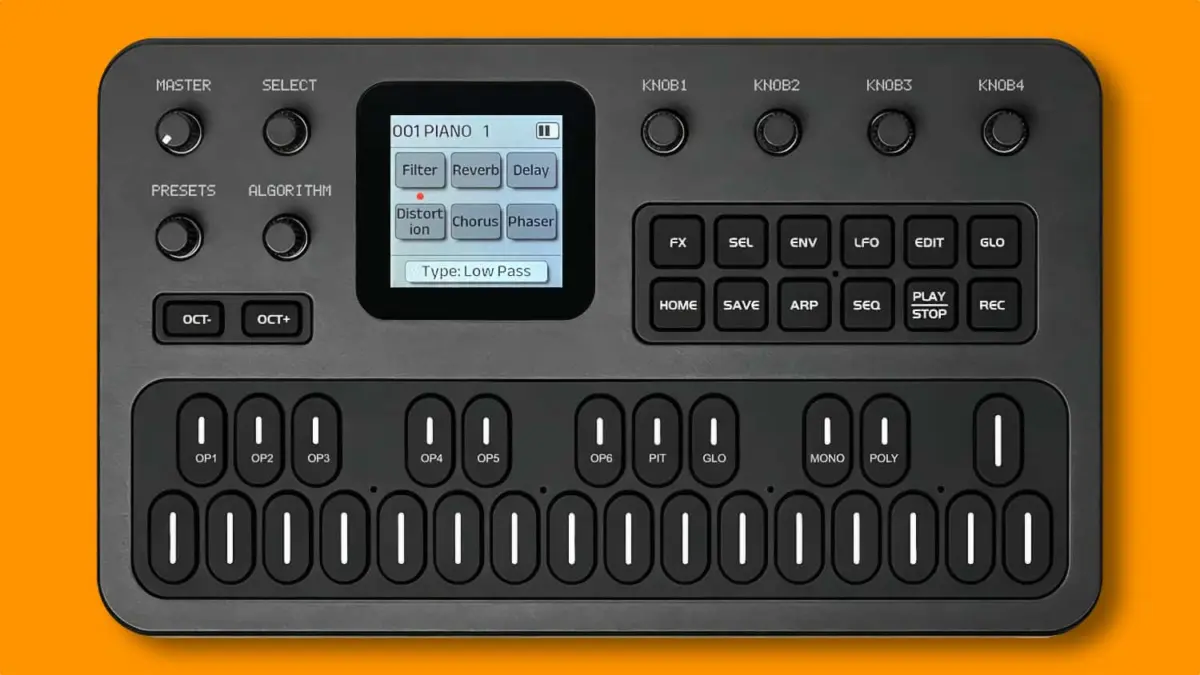
The landscape of digital synthesis is undergoing a radical transformation, driven by a convergence of ultra-affordable hardware and a burgeoning community of independent developers. At the center of this shift is the M-Vave FM-1, a compact frequency modulation (FM) synthesizer that has transcended its status as a budget consumer electronic to become a versatile platform for open-source innovation. Originally released as a low-cost entry into the world of FM synthesis, the FM-1 has recently been dubbed by industry observers and community leaders as a defining instrument of the mid-2020s. This surge in popularity is not merely due to its sub-$100 price point, but rather the ease with which users can now overhaul its internal logic, effectively transforming the device into entirely new instruments through alternate firmware.
Synthesist and technical educator Floyd Steinberg recently released an in-depth analysis and tutorial highlighting the FM-1 as a "turning point" in the industry. His work focuses on the transition from passive consumption of hardware to active development, specifically through a process known as "vibe coding." This method utilizes modern artificial intelligence and simplified coding frameworks to allow musicians without formal programming backgrounds to write, compile, and flash their own custom firmware onto the device.
The Rise of the M-Vave FM-1 Platform
The M-Vave FM-1 initially entered the market as a straightforward 4-operator FM synthesizer. In its stock configuration, it offers a respectable array of features, including multiple voices of polyphony, built-in effects, and a portable form factor powered by a rechargeable battery. However, the hardware’s true potential lies in its internal architecture. Built upon the ESP32 micro-controller—a powerful, Wi-Fi and Bluetooth-enabled chip favored by the "Maker" community—the FM-1 possesses significantly more computational overhead than its stock firmware utilizes.
The realization that the FM-1 was essentially a hackable development board with a built-in keyboard, MIDI ports, and an audio interface sparked a community-led revolution. Within months of its release, repositories began appearing on platforms like GitHub, offering alternate firmwares that added features such as expanded polyphony, new filter types, custom sequencers, and even entirely different synthesis engines, such as virtual analog or wavetable synthesis.
Technical Specifications and Hardware Architecture
To understand why the FM-1 has become a focal point for firmware development, one must examine the hardware specifications that make it such a viable target for modification:
- Processor: ESP32-S3 series microcontroller, providing high-speed dual-core processing capable of complex digital signal processing (DSP).
- User Interface: A 25-key velocity-sensitive keybed, assignable rotary encoders, and a high-contrast OLED display.
- Connectivity: 5-pin MIDI DIN In/Out, USB-C for MIDI and charging, and a 3.5mm headphone/line output.
- Power: Internal lithium-ion battery, making it a self-contained mobile workstation.
This hardware suite, which typically retails for between $40 and $70 depending on the vendor, represents a price-to-performance ratio that was previously unthinkable in the musical instrument industry. For comparison, dedicated "boutique" synthesizers with similar DSP capabilities often retail for three to five times that amount.
The Chronology of the Firmware Revolution
The evolution of the FM-1 from a budget toy to a professional-grade development platform followed a distinct timeline:
- Late 2023 – Initial Release: The FM-1 launched primarily on international e-commerce sites. Early reviews praised its portability but noted limitations in its stock sound design capabilities.
- Early 2024 – The "ESP32 Discovery": Technical users disassembled the unit to find a standard ESP32 chipset. This discovery allowed the community to apply existing Arduino and MicroPython libraries to the hardware.
- Mid 2024 – First Alternate Firmwares: Developers released the first "hacks" that unlocked hidden parameters in the FM engine and improved MIDI stability.
- 2025 – The Ecosystem Explosion: A "community-standard" bootloader was established, allowing users to swap firmwares in seconds. Dozens of unique operating systems became available, ranging from drum machines to generative ambient tools.
- 2026 – The Era of Vibe Coding: As demonstrated by Floyd Steinberg, the integration of Large Language Models (LLMs) allowed users to describe desired features in plain English, which the AI then converted into functional C++ code for the FM-1.
Analysis of "Vibe Coding" and AI Integration
The term "vibe coding" refers to a high-level approach to software development where the programmer focuses on the "vibe" or intent of the software—describing logic, signal flow, and user interface behavior—while an AI assistant handles the syntactical heavy lifting. In his tutorial, Steinberg demonstrates how to use tools like Claude or ChatGPT to generate firmware components.
Starting at the 16:39 mark of his presentation, Steinberg illustrates the workflow:
- Conceptualization: Defining the synth’s architecture (e.g., "I want a two-oscillator subtractive synth with a resonant low-pass filter controlled by the FM-1’s first knob").
- Prompt Engineering: Feeding the hardware’s specific pinouts and library requirements into an AI model.
- Iteration: Compiling the code in the Arduino IDE and using the AI to debug errors in real-time.
This democratization of development means that the bottleneck for musical innovation is no longer a person’s ability to write low-level code, but rather their creative vision for sound design.
Market Implications and Industry Reaction
The success of the M-Vave FM-1 and its open-source ecosystem has significant implications for established synthesizer manufacturers. For decades, the industry operated on a "closed box" model where the features a consumer purchased on day one were the only features they would ever have.
Industry analysts suggest that the M-Vave phenomenon is forcing a pivot toward "extensible hardware." Larger companies like Korg and Arturia have already begun dabbling in this area with the "Logue SDK" and open-source components, but the FM-1 represents a more radical, bottom-up shift. When a $50 device can be reprogrammed to emulate a $500 vintage classic, the value proposition of proprietary hardware is called into question.
While official responses from M-Vave have been minimal—largely because the company benefits from increased sales driven by the modding community—the unofficial response from the user base has been overwhelmingly positive. Community forums are populated with testimonials from users who claim the FM-1 is their most-used piece of gear due to its "ever-evolving nature."
Challenges and Considerations
Despite the enthusiasm, the transition to custom firmware is not without risks. Flashing third-party software onto hardware carries the potential for "bricking" the device, rendering it unusable if the bootloader is corrupted. Furthermore, the reliance on AI-generated code can lead to optimization issues, where the software consumes more processing power than necessary, leading to audio artifacts or latency.
However, for the majority of the "FM-1 generation," these risks are outweighed by the rewards. The low cost of entry makes the device an ideal "sacrificial" platform for learning the intricacies of digital signal processing and embedded systems.
The Future of Community-Driven Instruments
As we move further into 2026, the M-Vave FM-1 stands as a case study for the future of the music technology industry. It proves that there is a massive global appetite for hardware that is not just a finished product, but a "blank canvas." The "turning point" identified by Steinberg suggests a future where the distinction between a "user" and a "developer" continues to blur.
The broader impact of this movement extends beyond synthesis. It challenges the "planned obsolescence" cycle of modern electronics. Instead of discarding a device when its original software becomes dated, the FM-1 model encourages users to simply "re-vibe" the hardware with a fresh set of code. This sustainability, combined with the educational value of learning to code through musical experimentation, positions the M-Vave FM-1 as a landmark achievement in 21st-century instrument design.
The synthesis community now looks forward to what the next iteration of "vibe coding" will bring. With hardware becoming cheaper and AI becoming more proficient at understanding the nuances of musical logic, the M-Vave FM-1 is likely only the first of many instruments that will empower musicians to take full control over the silicon and copper inside their gear. For those interested in joining this movement, the path is clear: acquire the hardware, join the community, and begin defining the "vibe" of your own sonic future.
