

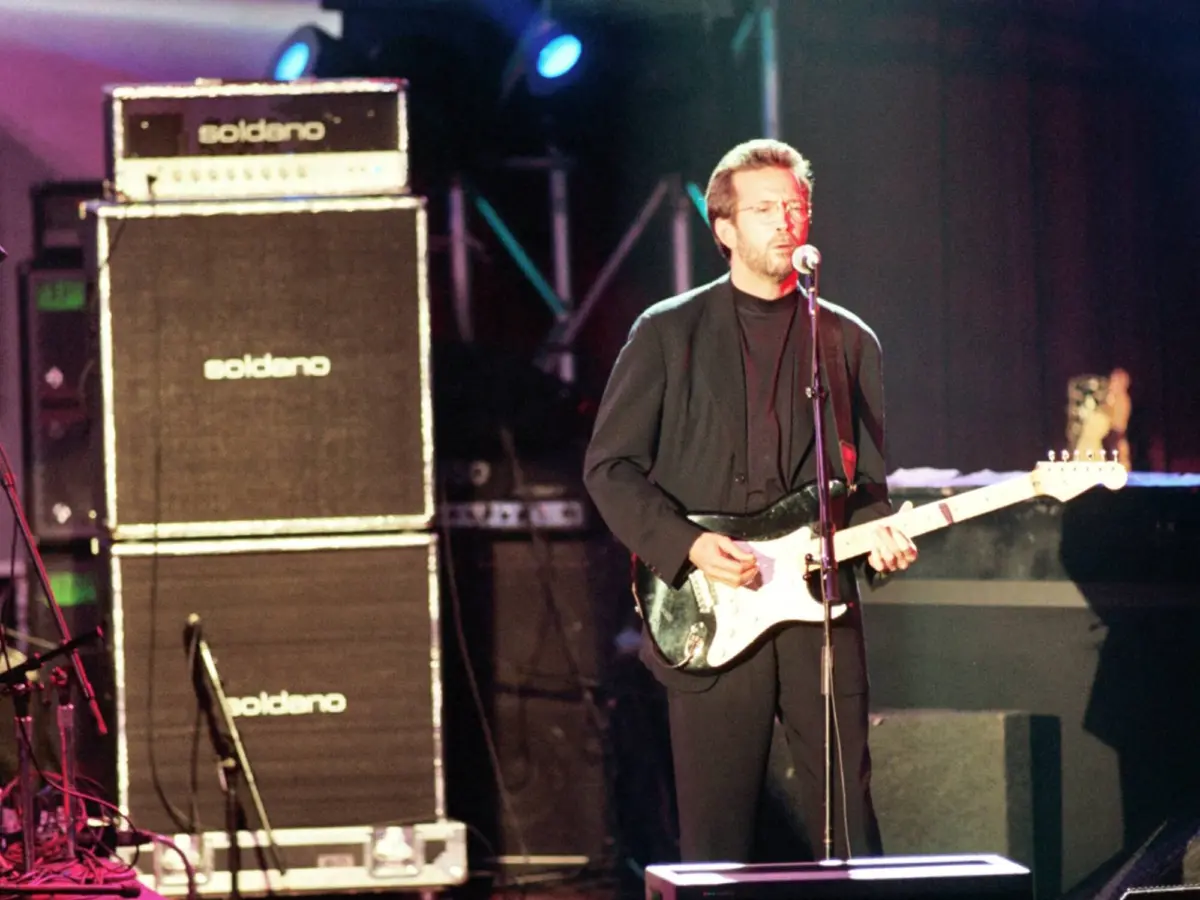
The esteemed world of music memorabilia is once again captivated as a historically significant guitar rig belonging to rock legend Eric Clapton is being offered for public acquisition. This comprehensive setup, featuring his precise 1988 Fender Custom Shop Stratocaster and a Soldano SLO-100 amplifier stack, represents a crucial period in Clapton’s illustrious career, notably having been wielded during Cream’s momentous 1993 induction into the Rock and Roll Hall of Fame. Following recent high-profile auctions of instruments from fellow luminaries like Johnny Marr, whose collection fetched $3.6 million, the market for such artifacts continues to demonstrate robust demand, cementing their status not merely as instruments but as tangible pieces of music history.
The Historical Significance of a Legendary Rig
The rig currently being auctioned by ANALOGr is far more than just a guitar and amplifier; it is a meticulously preserved snapshot of Eric Clapton’s artistic journey between 1989 and 1993, a period marked by significant personal and professional evolution for the artist known as "Slowhand." This specific Stratocaster holds the unique distinction of being Clapton’s very first signature model Strat, a collaboration that would go on to define his association with Fender for decades. Its pairing with the formidable Soldano SLO-100 stack underscores a deliberate choice of amplification that shaped his tone during a vibrant touring and recording phase. The estimated sale price of up to $3,000,000 reflects not only the intrinsic value of the instruments but also the unparalleled provenance associated with a musician of Clapton’s stature and the specific, iconic events at which this gear was present.
A Chronicle of Iconic Performances
The operational life of this particular Stratocaster and Soldano stack reads like a "who’s who" of late 20th-century rock history. Its most celebrated appearance was undoubtedly at the 1993 Rock and Roll Hall of Fame induction ceremony, where Clapton reunited with his Cream bandmates, Jack Bruce and Ginger Baker, to deliver an electrifying performance of classics like "Sunshine of Your Love." This reunion was a poignant moment, showcasing the enduring power of one of rock’s first supergroups and Clapton’s continuing mastery of the instrument.
Beyond the Hall of Fame, the rig served as Clapton’s primary setup for a series of other high-profile engagements. In 1991, it accompanied him on a memorable Japanese tour supporting his long-time friend and collaborator, George Harrison, then touring for his album "Live in Japan." This period saw Clapton not only as a featured performer but also as a bandleader, further solidifying the Strat’s role in his diverse musical endeavors. The following year, 1992, saw the rig grace the stage of Madison Square Garden for Bob Dylan’s star-studded 30th Anniversary Concert Celebration. This event, a tribute to one of music’s most influential songwriters, featured an array of legendary artists, and Clapton’s contribution, often alongside other guitar greats, placed this Stratocaster squarely in the pantheon of instruments present at truly landmark musical gatherings. Its journey also included performances at the hallowed Royal Albert Hall, a venue synonymous with Clapton’s live career, particularly during his annual residencies that became a staple for fans. The extensive touring and performance history have imbued the instruments with a character that speaks volumes of their time on the road, bearing the authentic marks of a working musician’s beloved tools.
The Stratocaster: A Prototype and a Personal Relic
This 1988 Fender Custom Shop Stratocaster is not just any guitar; it is a prototype that laid the groundwork for one of Fender’s most successful artist signature series. Lee Dixon, Clapton’s long-serving personal guitar technician, offers invaluable insight into its origins and unique characteristics. "This to me is one of the killer guitars," Dixon recounts, emphasizing its heavy use throughout the early 1990s. The absence of a serial number further supports its status as an early, almost experimental model. Dixon explains, "It has no serial number on it because it’s the first [black] one, almost like a prototype. It was Eric’s suggestion at the time; he said we should really have a black one in the range. So this is the first officially sanctioned black [EC Signature] Strat." This revelation highlights Clapton’s direct involvement in the design and aesthetic choices that would define his signature model.
Designed by Fender Custom Shop’s founder and Master Builder Mike Stevens, the guitar incorporates a trio of Lace Sensor single-coil pickups, renowned for their low-noise operation and clear, articulate tone, a departure from traditional single-coils that offered Clapton a new palette of sounds. It also features an onboard active mid-boost circuit, a signature modification that allowed Clapton to achieve the fat, powerful lead tones he favored without sacrificing the Stratocaster’s inherent clarity.
Beyond its technical specifications, the Stratocaster bears unique physical "battle scars" that tell a deeply personal story. Most notably, a burn mark on the headstock captures a specific, bygone era in Clapton’s life—his nicotine-addled years when he habitually secured cigarettes beneath the strings on his headstock. "I think this is the last smoking guitar," Dixon muses, pointing to the significance of this detail, as Clapton famously gave up smoking in 1993, the very year of the Cream induction. This singular mark transforms the instrument from a mere tool into a poignant relic, charting the artist’s personal journey alongside his musical evolution. Additionally, worn paint on the back of the body provides further testament to its extensive use, a testament to countless hours of playing, rehearsal, and performance. Such imperfections, far from detracting from its value, enhance its authenticity and connection to "Slowhand."
The Soldano SLO-100: A Sonic Powerhouse
Complementing the iconic Stratocaster is the formidable Soldano SLO-100 (Super Lead Overdrive 100) amplifier stack, comprising a slanted Soldano 4×12 cabinet and a straight 4×12 cabinet. The SLO-100, introduced in the late 1980s by Mike Soldano, quickly gained legendary status for its unparalleled high-gain capabilities, exceptional clarity, and robust build quality. It became a favorite among a diverse range of guitarists, from blues and rock to metal, due to its versatile tone, responsive dynamics, and ability to deliver articulate saturation at high volumes.

For Eric Clapton, the adoption of the Soldano SLO-100 in the late 1980s marked a significant shift in his amplification choices. Known previously for his reliance on Fender and Marshall amplifiers, the Soldano offered him a more modern, yet still classic, high-gain sound that provided immense sustain and harmonic richness. This amplifier allowed Clapton to achieve a powerful, cutting tone that was both aggressive and refined, perfectly suited for the arena rock settings and blues-rock explorations of his late 80s and early 90s output. The inclusion of the full stack in this auction underscores its integral role in Clapton’s sound during this pivotal period, forming a symbiotic relationship with the Custom Shop Stratocaster to create the tones heard on some of his most memorable performances. The sheer power and sonic presence of the SLO-100, combined with its legendary status among guitar aficionados, contribute significantly to the overall valuation of the auctioned rig.
The Enduring Appeal of Rock Memorabilia
The current auction of Clapton’s rig is part of a broader trend of escalating values for rock and roll memorabilia. In recent years, instruments owned and played by legendary musicians have shattered auction records, reflecting a robust and competitive market driven by collectors, investors, and ardent fans. Johnny Marr’s recent sale of over 100 instruments, which amassed $3.6 million, included guitars that were integral to The Smiths’ sound and Marr’s solo career. Similarly, David Gilmour’s "Black Strat" sold for nearly $4 million in 2019, while Kurt Cobain’s "MTV Unplugged" acoustic guitar fetched $6 million in 2020. These sales highlight a significant appreciation in the value of such artifacts, often far exceeding their original purchase price or even their value in previous auctions.
The investment aspect of these items is becoming increasingly pronounced. Beyond sentimental value, these instruments are viewed as tangible assets, often appreciating faster than traditional investments. The scarcity of truly iconic, provenance-rich items, combined with the enduring cultural impact of artists like Clapton, ensures sustained demand. The opportunity to own a piece of equipment used by an artist of Clapton’s caliber, particularly one tied to a significant event like a Rock and Roll Hall of Fame induction, represents not just a purchase, but an acquisition of cultural legacy.
Provenance and Valuation: A Deep Dive into the Auction Process
The current auction, hosted by ANALOGr, a platform specializing in unique and high-value collectibles, leverages the power of digital reach to connect potential buyers worldwide with this extraordinary piece of music history. The estimated sale price of up to $3,000,000 for the complete rig reflects a sophisticated valuation process that considers multiple factors: the artist’s enduring global fame, the historical significance of the specific instruments, their excellent provenance (the detailed history of ownership and use), and the current market trends for high-end musical memorabilia.
It is noteworthy that this exact Stratocaster has been through the auction circuit before. In 2004, it was sold at Christie’s, one of the world’s leading auction houses, for a significant $231,500. The substantial increase in its estimated value for the current auction—more than ten times its previous selling price—can be attributed to several factors. Firstly, the inclusion of the complete Soldano SLO-100 stack, which was not part of the 2004 offering, adds immense value. The amplifier is an integral component of the "rig" and critical to recreating Clapton’s sound from that era. Secondly, the general appreciation of rock memorabilia values over the past two decades has been dramatic. As time progresses, such items become rarer and more coveted, particularly as the generation who grew up with these artists reaches peak collecting age. Furthermore, the detailed narrative surrounding the guitar’s use—its "last smoking guitar" status, its prototype nature, and its presence at the Rock and Roll Hall of Fame induction—has been further solidified and publicized, enhancing its desirability.
The auction package also includes additional curated "goodies" that enhance its appeal to collectors: an authentic Eric Clapton pick, a vinyl record, and a signed booklet from the 2004 Christie’s auction. These supplementary items not only provide tangible connections to Clapton but also reinforce the item’s robust provenance, offering additional layers of authenticity and historical context for the fortunate bidder.
The Legacy of "Slowhand"
Eric Clapton’s influence on guitar playing is immeasurable. From his early days with The Yardbirds, through the explosive power of Cream, the soulful blues of Derek and the Dominos, and his enduring solo career, Clapton has consistently redefined the role of the electric guitar. His ability to blend blues traditions with rock innovation, coupled with his emotive phrasing and distinctive tone, earned him the moniker "God" in the 1960s and a lasting place in the pantheon of guitar heroes.
This auction offers a rare opportunity to acquire a tangible piece of that legacy. The 1988 Fender Custom Shop Stratocaster and Soldano SLO-100 stack represent a period when Clapton was both reflecting on his past (through the Cream reunion) and continuing to innovate and perform at the highest level. The eventual owner of this rig will not merely be acquiring musical instruments; they will be safeguarding a significant artifact of popular culture, a symbol of musical excellence, personal evolution, and the enduring power of rock and roll. The sale underscores the profound connection between artists, their instruments, and the indelible marks they leave on the fabric of music history, solidifying these items as prized possessions for generations to come.
