

The Rise of Freeware Innovation: Context and Developer Philosophy
The digital audio workstation (DAW) ecosystem has long been characterized by a blend of proprietary software and a vibrant, albeit often niche, freeware community. However, recent years have seen a surge in exceptionally well-crafted freeware plugins that challenge the conventional divide between free and paid tools. These developments are often driven by passionate individual developers or small teams who aim to fill gaps in the market, provide accessible alternatives to expensive software, or simply share their innovative ideas with the global music production community. The proliferation of powerful freeware is a testament to the increasing accessibility of development tools and the collaborative spirit prevalent in online communities. According to industry reports, the market for music production software and plugins has seen consistent growth, with an increasing segment showing preference for cost-effective or free solutions, especially among emerging artists and home studio enthusiasts.
Sirial is a prime example of this phenomenon, developed by Tiago Rodrigues (identified as ‘tiagolr’ from the GitHub repository), who has a demonstrated history of delivering high-caliber freeware. Rodrigues’s approach, as evidenced by previous releases such as FILT-R—a plugin that intelligently reinterprets functionalities found in commercial offerings like Cableguys FilterShaper—is not merely to clone existing products but to distill their core innovations and present them in an accessible, often enhanced, freeware package. This philosophy is crucial; it avoids direct replication and instead focuses on the underlying principles that make certain effects indispensable to modern production. By taking inspiration from established benchmarks like EchoBoy, Sirial doesn’t just offer an alternative; it provides a fresh perspective on rhythmic delay, making advanced sound design more attainable. This continuous contribution by independent developers significantly enriches the plugin landscape, offering invaluable resources to bedroom producers, aspiring artists, and seasoned professionals alike, particularly those operating on limited budgets.
Unpacking Sirial’s Core Architecture: A Deep Dive into its Features
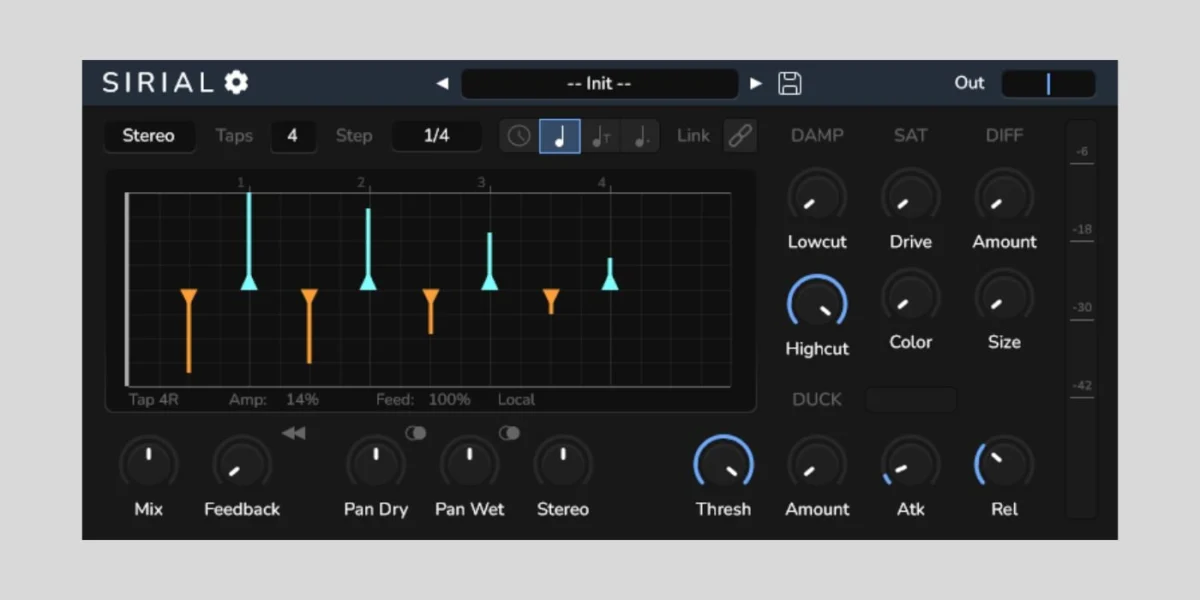
At its heart, Sirial distinguishes itself through its sophisticated architecture centered around 16 serial delay lines. Unlike parallel delay systems where multiple delay lines operate independently, a serial configuration routes the output of one delay line into the input of the next. This sequential processing allows for the creation of far more complex and evolving rhythmic patterns, as each "tap" builds upon the previous one, fostering intricate interdependencies that are difficult to achieve with simpler delay structures. This architectural choice positions Sirial as a highly specialized tool for intricate temporal manipulation, diverging from the more common parallel delay structures found in many stock plugins.
A cornerstone of Sirial’s design is the granular control offered over each individual delay tap. Producers can precisely adjust the amplitude and feedback for every one of the 16 lines. This level of per-tap customization is fundamental to sculpting dynamic and nuanced rhythmic textures. For instance, fading in or out specific taps, or creating resonant feedback loops on select taps, opens up a vast palette for sound manipulation. This goes beyond the capabilities of many standard delay units, which typically offer global controls that apply uniformly across all delay repeats, thus limiting the potential for complex, evolving delay patterns.
Beyond basic timing and volume, Sirial incorporates a suite of sophisticated sound-shaping tools:
- Saturation: This effect introduces harmonic richness and warmth, emulating the desirable characteristics of analog equipment. When applied to delay lines, saturation can make echoes feel more present and vibrant, helping them cut through a mix without simply increasing their volume. It can also be used creatively to introduce subtle distortion or grit, adding character to the delayed signal, reminiscent of vintage tape delays.
- Diffusion: Inspired by reverb algorithms, diffusion smears and blurs the individual delay taps, transforming sharp echoes into a more spacious, ambient wash. This is particularly effective for creating lush pads, ethereal soundscapes, or simulating the natural decay of sound in a large acoustic space. It can soften the attack of each repeat, making the overall delay sound smoother and more integrated into the track, moving away from distinct, percussive repeats.
- Damping: This feature allows for the attenuation of specific frequencies within the delay feedback loop. By damping high frequencies, for example, echoes can sound darker and more vintage, mimicking the natural absorption of sound in real environments or the characteristic decay of analog tape delays. Conversely, damping low frequencies can prevent the delay from muddying the mix, ensuring clarity and definition, especially in bass-heavy tracks. These three parameters—saturation, diffusion, and damping—collectively contribute to a more realistic and sonically pleasing echo decay, moving beyond simple repetitions to create complex timbral evolutions that respond dynamically to the source material.
Intuitive Interface and Rhythmic Precision
User experience is paramount in modern plugin design, and Sirial addresses this with an intuitive grid interface. This visual representation allows producers to quickly configure offset and amplitude for each delay tap, transforming what could be a complex numerical task into an accessible, graphical interaction. The grid simplifies the process of drawing rhythmic patterns, enabling quick experimentation and fine-tuning. This visual approach is a significant advantage, particularly for those who prefer an intuitive, hands-on method of sequencing rather than purely numerical input.
Crucially, Sirial is designed for seamless integration with any host DAW’s tempo, offering host BPM synchronization. This ensures that all delay patterns remain perfectly in time with the project, regardless of tempo changes. Furthermore, the plugin provides a selection of different rhythmical subdivisions (e.g., quarter notes, eighth notes, sixteenth notes, dotted notes, triplets, and more granular options). This flexibility is vital for crafting delays that range from straightforward rhythmic repetitions to complex, polyrhythmic textures that add intricate groove to a track. The combination of visual programming and precise rhythmic synchronization unlocks a wealth of creative possibilities, making Sirial a powerful tool for rhythmic manipulation across diverse musical genres, from electronic dance music to film scoring.
Additional operational modes enhance its versatility:
- Global vs. Individual Feedback: While individual feedback control per tap offers maximum creative freedom, Sirial also allows users to choose a global feedback amount. This option streamlines workflow when a consistent echo decay across all taps is desired, offering a practical balance between detailed control and efficient operation, catering to both meticulous sound designers and those seeking quick results.
- Stereo Mode: Processes the audio signal in a standard stereo fashion, preserving the spatial information of the input.
- Ping-Pong Mode: Alternates delay repeats between the left and right channels, creating a dynamic, stereo-widening effect that can add movement and space to sounds, particularly effective for percussive elements or short synth stabs.
- Delay Reverse Mode: Plays the delay repeats backward, generating unique, often ethereal and otherworldly textures that are excellent for sound design and experimental music, creating suspense or abstract sonic landscapes.
- Mix Knob and Panning Controls: A dedicated mix knob allows for precise blending between the dry (unaffected) and wet (processed) signals, essential for integrating the effect into a track. Additionally, dedicated panning knobs for each part (left/right or individual taps in certain configurations) offer further spatial control, allowing producers to precisely place echoes within the stereo field, enhancing stereo imaging.
Advanced Dynamics: The Ducking Feature
One of Sirial’s most compelling features, particularly for maintaining mix clarity, is its integrated ducking mechanism. Ducking, a form of sidechain compression, automatically reduces the volume of the delay repeats when the dry input signal is present, and then allows the delay to swell back up when the dry signal fades. This prevents the delay tails from cluttering the mix and competing with the original sound, ensuring that the primary instrument or vocal remains prominent. This intelligent dynamic processing is crucial in modern production, where dense arrangements can easily become muddy without careful management of effects.
The ducking feature includes standard controls:
- Threshold: Determines the level at which the ducking effect begins to engage, allowing precise control over when the delay recedes.
- Attack: Controls how quickly the delay volume is reduced once the dry signal crosses the threshold, influencing the smoothness or responsiveness of the ducking.
- Release: Governs how quickly the delay volume returns to its normal level after the dry signal falls below the threshold, dictating how gracefully the echoes re-emerge.
These controls provide comprehensive dynamic management, making Sirial an invaluable tool for both creative sound design and practical mixing applications, ensuring that even complex delay patterns remain controlled and musical, avoiding common pitfalls of excessive effect usage.
Beyond Basic Echoes: Creative Applications and Sound Design Potential
The cumulative effect of Sirial’s robust feature set is a plugin that transcends the capabilities of basic delay units, offering immense potential for creative expression across various musical genres and production contexts. Its versatility is a key factor in its appeal to a broad spectrum of users.
Rhythmic Enhancement for Guitars and FX Stabs
For instruments like electric guitars, particularly in funk, rock, or electronic contexts, Sirial can transform static riffs into dynamic, grooving patterns. By programming specific taps to occur at precise subdivisions and adjusting their amplitudes, a guitarist can create intricate counter-rhythms or fill spaces between notes with ghost-like echoes that "jam" in time with the rest of the track. This can inject a new level of rhythmic complexity and excitement into performances. Similarly, for short, impactful FX stabs or synth chords, Sirial can add a rhythmic tail that extends their presence without becoming repetitive, creating a sense of evolving texture that enhances their impact and contributes to the overall groove of a piece.
Atmospheric Pads and Ambient Productions
The combination of serial delay lines with diffusion and damping makes Sirial exceptionally well-suited for crafting lush, evolving atmospheric pads and ambient soundscapes. By diffusing the echoes, sharp repetitions can be softened into a smooth wash, while damping can introduce timbral changes over time, creating a sense of subtle rhythmic movement and textural evolution across the stereo field. When layered with external reverbs or granular effects, Sirial can generate immersive, otherworldly textures that are rich in detail and spatial depth. Imagine a shimmering pad whose echoes gently shift in timbre and position, being further smeared by a long, dark reverb – this is where Sirial truly shines, offering a tool for creating expansive and emotionally resonant sonic environments.
Sound Design and Experimental Music
For sound designers and experimental musicians, Sirial offers a playground for sonic exploration. The ability to reverse delay lines, combine complex rhythmic patterns with saturation and diffusion, and precisely control individual tap characteristics allows for the creation of unconventional effects. From glitchy, fragmented echoes to swirling, modulated textures, Sirial can push the boundaries of traditional delay, becoming a tool for generating entirely new sounds rather than just repeating existing ones. Its flexibility makes it a valuable asset for crafting unique sonic identities for various media, including film scores, game audio, and abstract musical compositions.
Mixing and Mastering Contexts
While primarily a creative tool, Sirial also offers practical benefits in a mixing context. The ducking feature, for example, is indispensable for keeping mixes clean and transparent, preventing delay tails from masking lead elements. Furthermore, the precise control over panning and frequency damping allows producers to place echoes strategically in the stereo field and frequency spectrum, adding depth and width to a mix without introducing muddiness or phase issues. This level of control ensures that even complex, creative delay effects can be integrated seamlessly into a professional mix, contributing to a polished and balanced final product.
Navigating the Digital Audio Landscape: Sirial’s Place in the Ecosystem
Sirial’s inspiration from SoundToys EchoBoy places it within a lineage of highly regarded delay processors. EchoBoy, a staple in many professional studios, is celebrated for its versatile delay algorithms, classic emulations, and innovative "tap mode" that allows for rhythmic pattern creation. Sirial’s ability to offer a similar, perhaps even more detailed, approach to rhythmic tap delay in a freeware package is a testament to the ongoing innovation within the independent developer community. It provides an accessible entry point for producers who admire the capabilities of such premium tools but may not have the budget for them, thereby fostering a broader adoption of advanced delay techniques.
The vibrant freeware ecosystem also offers complementary tools that pair well with Sirial. The article specifically recommends Unplugred’s SunBurnt and Davisynth’s Spiral. SunBurnt, a free convolution reverb plugin, excels at creating realistic and imaginative spatial environments, which can beautifully smear and expand Sirial’s rhythmic echoes into vast soundscapes. Convolution reverbs, by capturing the impulse responses of real spaces or simulated environments, offer a unique textural quality that can augment Sirial’s rhythmic output. Davisynth’s Spiral, another notable free delay plugin, focuses on unique, often experimental delay types, offering a different flavor of temporal manipulation that can complement Sirial’s rhythmic precision. Together, these plugins represent a powerful, cost-effective suite for advanced creative effects, perfect for dedicated FX tracks or for adding significant depth and character to crucial elements within a song. The availability of such high-quality freeware democratizes advanced sound design, making sophisticated production techniques accessible to a broader audience.
Accessibility and Impact: Democratizing Advanced Sound Design
The ease of acquiring Sirial is another factor contributing to its appeal. As a direct download from GitHub, the process is straightforward: users simply select their operating system (macOS, Windows, or Linux) and download the corresponding Zip file. This direct, no-fuss approach aligns with the freeware ethos of accessibility and removes common barriers such as complex registration processes or mandatory email subscriptions.
The release of Sirial, alongside other commendable freeware like FILT-R, SunBurnt, and Spiral, represents a significant cultural and technological shift in music production. It highlights the power of open-source principles and community-driven development to foster innovation and democratize access to tools that were once the exclusive domain of professional studios. For emerging artists and producers, these tools are invaluable, lowering the barrier to entry for high-quality music creation and enabling them to experiment with complex sound design techniques without financial constraints. This trend supports the growth of independent music production and the diversification of sonic aesthetics, as more creators gain access to sophisticated tools.
Looking ahead, the continued development of such freeware plugins is likely to push the boundaries of what is expected from audio software, potentially influencing commercial developers to innovate further or reconsider their pricing strategies. The community aspect, often fostered through forums and direct interaction with developers on platforms like GitHub, creates a feedback loop that can lead to rapid improvements and tailored features, benefiting the entire user base. Sirial, therefore, is not just another delay plugin; it is a symbol of an evolving landscape where creative power is increasingly placed directly into the hands of the creators, regardless of their economic standing. It serves as a reminder that when the stock delay plugins feel stale or limited, the ingenuity of independent developers offers a vibrant and powerful alternative.
Acquisition and Future Prospects
For those interested in exploring Sirial’s capabilities, the plugin is available for free download via its official GitHub repository: https://github.com/tiagolr/sirial. The simple download process ensures immediate access to this powerful tool, reflecting the developer’s commitment to broad accessibility.
While no specific future updates or versions were detailed at the time of this report (last updated March 22, 2026), the nature of open-source-inspired development often implies ongoing refinement and potential community contributions. This model ensures that plugins like Sirial can evolve, adapting to new technologies and user feedback, further solidifying their place in the digital audio production toolkit. Its impact is poised to extend beyond its immediate functionality, serving as a testament to the thriving ecosystem of independent innovation within the music technology sector.
