

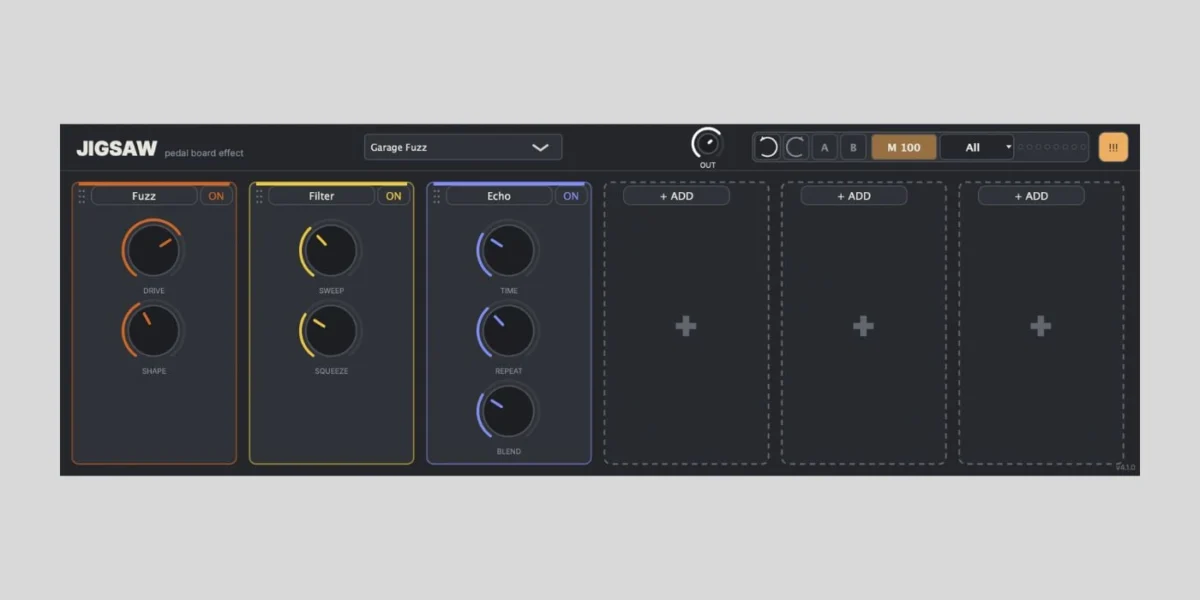
Tweakbench, a name synonymous with the early independent software development scene, has officially released Jigsaw, a new and entirely free pedal board effect plugin. This latest offering is designed to be cross-platform, supporting macOS, Windows, Linux, and iOS, providing a versatile tool for digital audio workstations (DAWs) and mobile production environments alike. The release of Jigsaw signifies more than just a new plugin; it represents a significant moment for a developer who has recently re-emerged from a prolonged hiatus, rekindling a legacy that resonated deeply with a generation of music producers.
Jigsaw is presented as a modular multi-effect unit, allowing users to construct a six-slot serial chain of effects using a selection of twelve distinct "lego-style" blocks. These blocks include Fuzz, Crush, Tape, Filter, Wobble, Phase, Echo, Spring, Hall, Hiss, Warble, and Ring. This design philosophy emphasizes user-friendly customization and experimental sound design, enabling producers to quickly stack and reorder effects to achieve unique sonic textures. The plugin’s intuitive interface facilitates dragging and dropping blocks to reorder the signal chain seamlessly and swapping effects without introducing audible clicks or glitches. Additionally, a "randomizer" feature provides an avenue for instant sonic exploration, allowing users to generate entire pedal board configurations with a single click, fostering creativity and serendipitous discoveries.
A Legacy Rekindled: Tweakbench’s Return to the Forefront
The re-emergence of Tweakbench into active plugin development earlier this year marked a notable event for long-time enthusiasts of freeware audio tools. After a considerable period of inactivity, the developer initiated a comprehensive effort to rebuild and update many of its classic plugins for compatibility with contemporary operating systems and DAWs. This process involved transitioning many of their previously free offerings to a commercial model, albeit with updated features, cross-platform compatibility, and enhanced stability. The introduction of Jigsaw as a free plugin, therefore, serves as a poignant nod to Tweakbench’s roots, providing an accessible tool that embodies the spirit of its early contributions to the music production community. This strategic move suggests a nuanced approach by Tweakbench, balancing the need for sustainable development through commercial releases with a continued commitment to offering high-quality, free resources to its user base.
The initial announcement of Tweakbench’s return and the subsequent rollout of updated plugins generated considerable discussion within online music production forums and communities. Many producers expressed a sense of nostalgia for the developer’s unique sound and unconventional approach to effect and instrument design. The decision to make Jigsaw available for free, coupled with the promise of lifetime free updates and a DRM-free distribution model, further reinforces a user-centric philosophy that aligns with the expectations of the independent developer ethos. This approach is particularly welcomed in an industry where software licensing and subscription models are increasingly prevalent, offering a refreshing alternative that prioritizes accessibility and user autonomy.
The Golden Age of Freeware VSTs: A Historical Perspective
To fully appreciate the significance of Tweakbench’s return and the release of Jigsaw, it is crucial to understand the historical context of the early 2000s freeware VST (Virtual Studio Technology) scene. This era was characterized by a burgeoning community of independent developers who leveraged the nascent VST standard to create a diverse array of audio plugins. These tools, often quirky, experimental, and sometimes technically unrefined by today’s standards, played a pivotal role in democratizing music production. They provided aspiring musicians and sound designers with access to powerful sonic manipulation capabilities without the prohibitive costs associated with commercial studio hardware and software.
Tweakbench established itself as a prominent figure within this landscape, gaining recognition for its distinctive and often unconventional plugins. Tools like "Tapeworm," a tape emulation effect, and "Peach," known for its unique NES-style chiptune sounds, became staples in many early digital music projects. "Peach," in particular, stood out for its ability to generate sounds reminiscent of 8-bit video game consoles, offering a distinct sonic palette that appealed to experimental artists and electronic music producers exploring retro aesthetics. These plugins were not merely functional; they possessed a unique character and charm that made them memorable and widely utilized.
This period also saw the rise of collectives like Smartelectronix, a loose association of independent developers that included influential figures such as Bram de Jong, Destroy FX, and Tobybear. While Tweakbench operated independently and was not formally part of Smartelectronix, their work shared a common ethos: pushing the boundaries of what was possible with software effects, often with a playful and experimental approach. These developers fostered a vibrant ecosystem where knowledge was shared, and innovation thrived, laying much of the groundwork for the sophisticated plugin market we see today. The collective output of these pioneers significantly influenced how producers approached sound design, encouraging experimentation with digital artifacts, lo-fi aesthetics, and unconventional processing chains long before these became mainstream trends. The absence of strict corporate oversight allowed for a level of creative freedom that resulted in truly unique and often groundbreaking tools.
Jigsaw: Architectural Design and Feature Set
Jigsaw’s design philosophy centers on a modular, user-configurable effect chain, a concept that offers both simplicity and profound depth for sound manipulation. The core of Jigsaw is its six-slot serial chain, which means that audio signals pass sequentially through each effect block, with the output of one block feeding directly into the input of the next. This architecture allows for complex interactions between effects, where the settings of an earlier block can dramatically influence the behavior of subsequent blocks, opening up a vast landscape of sonic possibilities.
The twelve available "lego-style" effect blocks each offer a distinct character:
- Fuzz: A classic distortion effect designed to create a thick, often harmonically rich, and sometimes aggressive tone, commonly used on guitars but highly effective on synths and drums.
- Crush: Likely a bit-crusher or sample rate reducer, introducing digital aliasing and grit, perfect for lo-fi textures and destructive sound design.
- Tape: Emulates the characteristics of analog tape recording, including subtle saturation, compression, and wow/flutter effects, adding warmth and vintage character.
- Filter: A versatile tool for shaping frequency content, allowing users to cut or boost specific ranges, often used for dynamic sweeps or static tonal adjustments.
- Wobble: Suggests a tremolo or vibrato effect, introducing rhythmic amplitude or pitch modulation, useful for creating movement and psychedelic textures.
- Phase: A phaser effect, creating a characteristic "swirling" or "whooshing" sound by shifting the phase of a signal, often associated with funk and psychedelic music.
- Echo: A delay effect, creating repetitions of the input signal that decay over time, essential for adding space, depth, and rhythmic interest.
- Spring: Emulates the distinct reverberation of a spring reverb unit, known for its metallic, splashy, and sometimes chaotic decay, often used in surf rock and dub.
- Hall: A more conventional reverb effect designed to simulate the acoustics of a large hall, providing lush, expansive spatialization.
- Hiss: A noise generator, typically adding analog-style background noise to a signal, useful for creating lo-fi ambience or simulating vintage equipment.
- Warble: Implies a subtle, irregular pitch or amplitude modulation, similar to wow and flutter on old tape machines, adding organic imperfection.
- Ring: A ring modulator, an effect that multiplies the input signal with an oscillator, producing metallic, dissonant, and often alien sounds.
The user interface of Jigsaw is designed for efficiency and clarity. The ability to drag and drop blocks allows for immediate experimentation with effect order, a critical factor in how effects interact in a serial chain. The click-free swapping mechanism ensures a smooth workflow, preventing interruptions during creative exploration. The "!!! randomizer" button is a standout feature, offering an instant gateway to unexpected sonic landscapes. This tool can be particularly valuable for breaking creative blocks or discovering novel combinations that might not have been conceived through deliberate design. This blend of structured modularity and serendipitous generation positions Jigsaw as a highly adaptable tool for both meticulous sound sculptors and spontaneous experimenters.
Technical Specifications and Broad Compatibility
Jigsaw’s broad compatibility across multiple operating systems and plugin formats underscores Tweakbench’s commitment to accessibility in modern production environments. The plugin is available in AU (Audio Unit), VST3, CLAP, and LV2 formats for macOS, Windows, and Linux. For iOS users, an AUv3 version is provided.
- AU (Audio Unit): Apple’s native plugin format for macOS and iOS, offering deep integration with Logic Pro, GarageBand, and other AU-compatible hosts.
- VST3 (Virtual Studio Technology 3): The latest iteration of Steinberg’s ubiquitous VST standard, widely supported across virtually all major DAWs on Windows, macOS, and Linux, known for its efficiency and modern features.
- CLAP (CLever Audio Plugin): A newer, open-source plugin standard gaining traction, particularly among independent developers, promising improved performance and developer-friendly features.
- LV2 (LADSPA Version 2): A plugin standard primarily used in Linux audio environments, ensuring native compatibility for a significant portion of the open-source music production community.
- AUv3: The mobile version of Audio Units for iOS, enabling Jigsaw to function seamlessly within iOS DAWs like GarageBand for iOS, Cubasis, AUM, and other compatible hosts, extending its utility to mobile music creators.
This extensive format support ensures that Jigsaw can be integrated into nearly any contemporary digital audio workflow, from professional studio setups on desktops to portable creative sessions on tablets and smartphones. The decision to offer the plugin completely free of charge, with no digital rights management (DRM) restrictions, and including lifetime free updates, further enhances its appeal. This policy not only removes barriers to entry but also instills confidence in users regarding ongoing support and future enhancements, fostering a loyal community around the product.
Implications for Music Production and the Freeware Ecosystem
The release of Jigsaw carries significant implications for the broader music production landscape, particularly concerning the role of freeware and the evolving dynamics of plugin development. For sound designers and synth users, Jigsaw presents an immediate, no-cost solution for adding character and texture to their audio. Guitar pedal-style effects are highly prized in sound design for their ability to impart unique sonic coloration, often emulating the imperfections and rich harmonics of analog circuitry. Jigsaw’s diverse range of blocks makes it an ideal tool for processing synthesizers, vocals, drums, and field recordings, allowing for rapid experimentation and the creation of complex, layered effects that might otherwise require multiple individual plugins.
The "return of the indie legend" narrative surrounding Tweakbench’s resurgence could also inspire other long-dormant independent developers to reconsider their contributions. In an era dominated by large commercial plugin manufacturers, the success and positive reception of a free, high-quality tool from an independent source underscore the enduring value of passion-driven development. This could potentially invigorate the freeware ecosystem, encouraging a new wave of innovative and accessible tools.
Moreover, Jigsaw’s accessibility, both in terms of cost and cross-platform compatibility, contributes to the ongoing democratization of music production. Aspiring producers with limited budgets can access professional-grade effects, fostering creativity and lowering the barrier to entry for high-quality sound design. For seasoned professionals, it offers a quick, CPU-efficient alternative for creative processing, especially for experimental work where speed and flexibility are paramount. The inclusion of iOS compatibility is particularly forward-thinking, recognizing the increasing prevalence of mobile-first production workflows and expanding the reach of advanced sound design tools to an even wider audience.
Community Reception and Future Outlook
While Tweakbench has not issued formal statements beyond the product release, the implied sentiment from the developer, and the anticipated reaction from the music production community, is overwhelmingly positive. Long-time users, in particular, are expected to welcome Jigsaw as a testament to Tweakbench’s enduring creative vision and generosity. The combination of a familiar developer name, a free offering, and a genuinely useful and versatile tool is likely to generate significant enthusiasm and adoption.
Looking ahead, Jigsaw’s release might signal a new phase for Tweakbench, where new free tools coexist alongside updated commercial versions of their classic plugins. This hybrid model could allow the developer to sustain their operations while continuing to contribute to the freeware community that initially championed their work. The success of Jigsaw could also influence future development decisions, potentially leading to more free offerings or expansions to the Jigsaw platform itself, such as additional effect blocks or routing options. The commitment to lifetime free updates suggests a long-term vision for the product and its users.
In conclusion, Tweakbench’s release of Jigsaw is more than just another plugin; it is a significant event that bridges the past and present of digital audio production. It offers a powerful, flexible, and entirely free multi-effect pedal board plugin that caters to modern production needs while simultaneously paying homage to a pivotal era of independent software development. By providing Jigsaw free of charge, cross-platform, and DRM-free, Tweakbench has not only delivered a valuable tool but has also reaffirmed its commitment to accessibility, innovation, and the enduring spirit of the freeware community it helped to shape. This release is poised to become an indispensable tool for countless producers, further cementing Tweakbench’s legacy as a pioneer in the realm of audio software.
