

As the legal dust begins to settle on a New York jury’s landmark antitrust verdict against Live Nation, the live entertainment industry and consumers alike are grappling with the profound implications of this ruling. The verdict, delivered on Wednesday, April 15, following a month-long trial and four days of intense jury deliberations, found Live Nation to be operating an unlawful monopoly that pervades multiple facets of the concert industry. This decision marks a significant milestone in a protracted legal saga, but as industry observers and legal experts note, the journey to definitive consequences for the entertainment titan is far from over.
The jury’s findings were explicit and comprehensive, focusing solely on the question of liability. Jurors were tasked with determining whether Live Nation unlawfully monopolized the market for primary concert ticketing and whether it illegally leveraged its market power by requiring artists to utilize its promotion services in exchange for playing its extensive network of amphitheaters. Their unequivocal “yes” to all counts signals a powerful endorsement of the prosecution’s core arguments, particularly those advanced by the coalition of state attorneys general who spearheaded this particular legal challenge. This verdict represents a critical juncture, validating long-standing concerns about Live Nation’s dominant position and its alleged anticompetitive practices.
The Genesis of a Monopoly: Live Nation and Ticketmaster’s Contested Merger
To fully appreciate the weight of this verdict, it is essential to revisit the origins of Live Nation’s formidable market presence. The company’s journey to becoming the undisputed behemoth of live entertainment began in 2010 with its controversial merger with Ticketmaster. At the time, Live Nation was the world’s largest concert promoter, while Ticketmaster held an overwhelming share of the primary ticketing market, reportedly controlling over 70-80% of major venue ticket sales. Critics, including consumer advocates, artists, and smaller industry players, immediately raised alarms about the potential for a combined entity to stifle competition, increase ticket prices, and limit choices for both performers and fans.
Despite these widespread concerns, the U.S. Department of Justice (DOJ) ultimately approved the merger, albeit with a consent decree designed to mitigate anticompetitive behavior. This decree mandated certain conditions, such as the divestiture of Live Nation’s Paciolan ticketing business and Ticketmaster’s TicketsNow resale division, along with requirements to license Ticketmaster’s software to AEG Presents, a major competitor. The intent was to ensure that the combined entity would not exploit its expanded power to the detriment of the market. However, over the ensuing decade, allegations of Live Nation’s non-compliance with these terms and its continued exercise of monopolistic control became a persistent drumbeat, eventually leading to renewed government scrutiny.
A Decade of Scrutiny: The Path to Trial
The seeds of the recent lawsuit were sown over years of growing public dissatisfaction and renewed governmental investigation. By late 2019 and early 2020, reports surfaced that the DOJ was actively investigating Live Nation for potential violations of the 2010 consent decree. This period saw increasing complaints from artists, venue owners, and consumers regarding inflated ticket prices, exorbitant fees, and a perceived lack of alternative options in the live entertainment ecosystem.
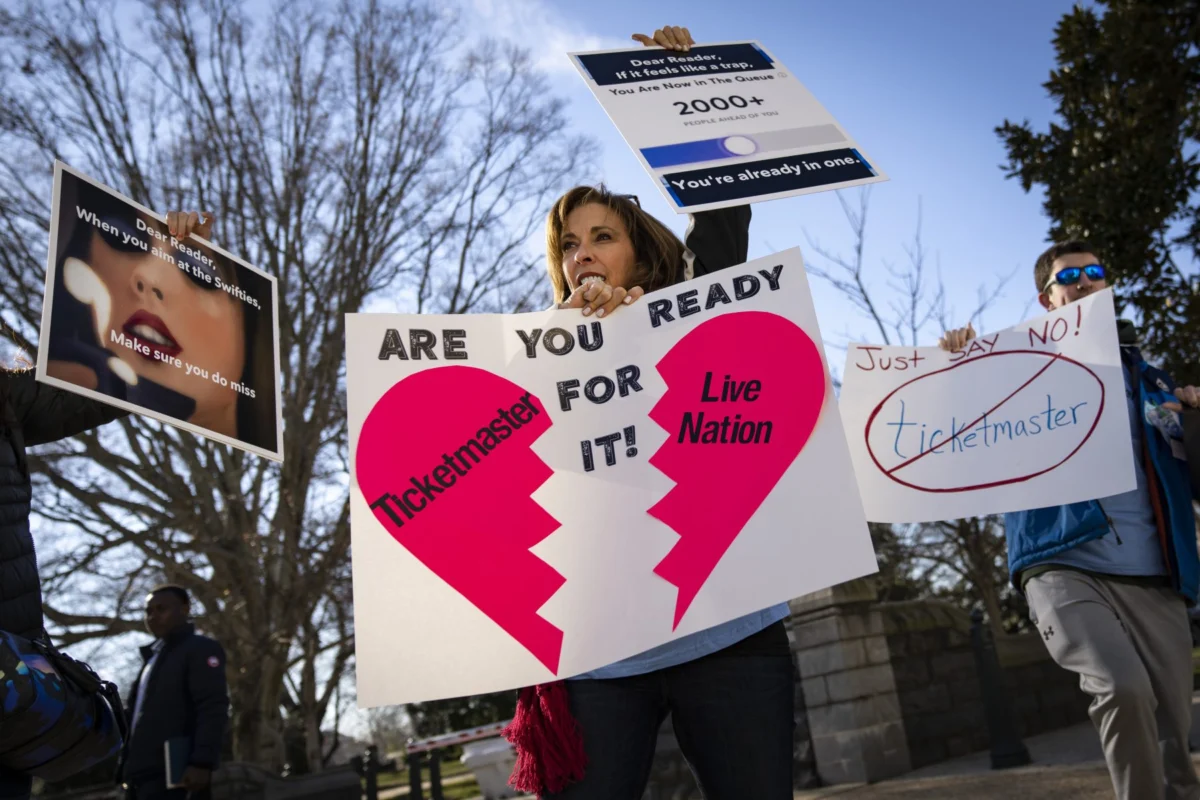
Public frustration boiled over, becoming particularly palpable in the wake of highly publicized ticketing debacles, such as the chaotic rollout for a major artist’s tour in late 2022. This widespread outcry galvanized lawmakers and regulators. On January 24, 2023, just as depicted in the accompanying image showing Penny Harrison and her son Parker rallying outside the U.S. Capitol, the Senate Judiciary Committee convened a hearing. The stated purpose was to explore whether the merger of Live Nation and Ticketmaster had indeed stifled competition and harmed the consumer marketplace, providing a prominent platform for critics to voice their grievances.

Building on years of evidence gathering and escalating public pressure, the DOJ, along with a significant coalition of state attorneys general, officially filed a federal lawsuit against Live Nation in May 2024. The lawsuit explicitly accused Ticketmaster and its parent company, Live Nation, of illegally monopolizing the live entertainment industry, causing detriment to concertgoers, artists, and smaller competitors alike. The filing sought not only to restructure how the company operates but also, crucially, included a call for the breakup of the two entities.
While the federal lawsuit progressed, a separate, but related, antitrust case brought by several state attorneys general proceeded to trial in New York. It was this specific trial that culminated in the April 15 verdict, marking a decisive legal victory for the states and a significant setback for Live Nation.
The Jury’s Resounding "Yes": Unpacking the Verdict
The New York jury’s verdict was a comprehensive affirmation of the prosecution’s claims. It specifically found Live Nation liable on two critical fronts:
-
Monopoly in Primary Concert Ticketing: The jury concluded that Live Nation effectively holds an unlawful monopoly in the market for primary concert tickets. This finding validates arguments that Ticketmaster’s dominant market share, coupled with Live Nation’s control over a vast network of venues, creates an insurmountable barrier for new entrants and limits competition. Industry data has consistently shown Ticketmaster processing billions of dollars in ticket sales annually, with estimates placing its market share for major concert venues well above 70%, sometimes even nearing 90% in certain regions. This extensive control was argued to allow the company to dictate terms, suppress innovation, and levy substantial service fees with little competitive pressure.
-
Unlawful Tying of Artist Promotion Services to Venue Access: The second key finding was that Live Nation unlawfully required artists to use its promotion services in order to secure bookings at its owned or operated amphitheaters and other venues. This practice, known as "tying," is a classic antitrust concern where a dominant firm leverages its power in one market (venue access) to gain an unfair advantage in another (artist promotion). Critics argued that this coerced artists into signing with Live Nation as their promoter, limiting their choices, potentially impacting their earnings, and making it exceedingly difficult for rival promoters to secure talent or venues. Live Nation owns or operates a significant number of the largest amphitheaters and venues across the United States, giving it unparalleled leverage in the touring market.
These findings are not merely symbolic; they provide a strong legal basis for significant structural or behavioral changes within Live Nation. The verdict underscores the jury’s belief that Live Nation’s business model, as currently constituted, actively harms competition and, by extension, consumers and artists.
The Critical "Remedy" Phase: What Lies Ahead for Live Nation?
With the liability verdict established, the focus now shifts to the "remedy" phase, a complex and potentially lengthy process that will determine the practical consequences for Live Nation’s future operations. U.S. District Judge Arun Subramanian, who presided over the trial, will now be tasked with deliberating on and issuing an order for appropriate remedies. These remedies could range from financial damages to mandated changes in business practices, or even the forced divestiture of assets.

Critics of Live Nation, particularly the state attorneys general who brought the successful case, have made their preferred remedy clear: the forced divestiture of Ticketmaster. Their antitrust case was fundamentally built on the theory that Live Nation’s dual control over both ticketing and artist promotion creates an insurmountable anticompetitive edge. They argue that this integrated structure allows Live Nation to threaten venues with the withholding of popular concerts if those venues do not commit to using Ticketmaster as their exclusive primary ticketer. The jury’s verdict, by validating the tying claim, can be seen as directly endorsing this argument for a structural separation.
However, divestiture, while a powerful tool, is not the only option available to Judge Subramanian. He could alternatively allow Live Nation to retain Ticketmaster but compel the company to sell off other significant assets, such as a portion of its owned amphitheaters or other venues. Lauren Spahn, an entertainment partner at the law firm Buchalter, suggests this could be a strategic approach: "This could be a way for the judge to weaken [Live Nation and Ticketmaster] without completely killing the combined companies." Such a move would aim to reduce Live Nation’s market power by diminishing its footprint in venue ownership, thereby loosening its grip on the concert ecosystem.
Historical Precedents and Modern Antitrust
The prospect of a forced corporate breakup, or divestiture, echoes some of the most famous antitrust cases in U.S. history. Landmark rulings like the breakup of Standard Oil in 1911 and AT&T in 1982 fundamentally reshaped entire industries by dismantling monopolies. However, such drastic measures have become increasingly rare in the modern court system.
A recent example is the Google antitrust case from 2024, where Google was found liable at trial for monopolizing the online search market. Yet, when it came time for remedies, the federal judge declined to order the forced divestiture of Google’s Chrome browser or its Android operating system. Instead, the judge opted for behavioral remedies, requiring the tech giant to alter its contracting practices and make certain data accessible to rivals.
This precedent suggests that Judge Subramanian might also lean towards a similar outcome for Live Nation. Potential behavioral guardrails could include:
- Limiting exclusive ticketing contracts: Preventing Live Nation from entering into or enforcing long-term, exclusive agreements that lock venues into using Ticketmaster.
- Capping fees: Imposing limits on the service fees and other charges Ticketmaster can levy on tickets.
- Opening up amphitheaters: Requiring Live Nation to make its owned and operated venues more accessible to rival promoters, fostering a more competitive environment for concert bookings.
- Data sharing: Mandating that Live Nation share certain anonymized data with competitors to promote transparency and fair competition.
Divergent Paths: DOJ vs. States’ Attorneys General
Adding a layer of unprecedented complexity to the remedy phase is the curious divergence between the DOJ and the state attorneys general. A few days into the antitrust trial, the DOJ reached a proposed settlement with Live Nation. This settlement, while requiring Live Nation to make several changes to its business practices and establish a $280 million payment fund, notably did not include a provision for the forced divestiture of Ticketmaster. Live Nation, in a statement released after the jury’s verdict, expressed confidence that "the ultimate outcome of the states’ case will not be materially different than what is envisioned by the DOJ settlement."
However, numerous state attorneys general who initially joined the DOJ in suing Live Nation vehemently criticized this deal as too lenient, believing it failed to address the core structural issues of Live Nation’s market dominance. Consequently, they broke ranks with the federal government and pressed ahead with their separate trial, which ultimately yielded the liability verdict.

This situation places Judge Subramanian in an extraordinary position. He is now simultaneously being asked by two different sets of government agencies, who were once litigation partners, to either approve a settlement (the DOJ’s deal) or order a more stringent structural remedy (the states’ request for divestiture) based on the same set of facts. Kenneth Dintzer, an antitrust partner at Crowell & Moring and a former DOJ attorney with 33 years of experience, described the scenario as "unprecedented." "Nobody’s ever seen something quite like this," Dintzer told Billboard, highlighting the uncertainty surrounding how these conflicting demands will be reconciled.
Industry and Consumer Reactions
The verdict has been met with a mix of cautious optimism and anticipation across the live entertainment industry and among consumer advocacy groups. For years, independent promoters and venue owners have voiced concerns about Live Nation’s leverage, suggesting that a more level playing field could foster greater innovation and diversity in the concert market. Artists, too, have often felt constrained by the limited options for touring and ticketing, and a shift in Live Nation’s practices could offer them more autonomy and potentially better financial terms.
Consumer advocates, who have long campaigned against the rising costs and opaque fee structures associated with concert tickets, see the verdict as a vindication of their efforts. Rallies and public outcries, like the one witnessed outside the U.S. Capitol in 2023, underscore the widespread public desire for fairer ticketing practices. While the immediate impact on ticket prices might not be felt, the potential for increased competition and regulatory oversight offers hope for a more transparent and consumer-friendly marketplace in the long run.
The financial markets will also be closely watching the developments. Live Nation’s stock could experience volatility as investors weigh the potential costs of remedies, whether they involve financial penalties, forced sales of assets, or significant operational restructuring. The company’s long-term strategy and competitive landscape could be fundamentally altered, necessitating a re-evaluation of its business model.
Long-Term Implications and the Road to Appeal
The resolution of this complex legal battle will not be swift. Judge Subramanian’s deliberation on the remedies could span several months, possibly up to a year, as he gathers all necessary arguments and evidence to formulate detailed decisions on both the DOJ settlement and the states’ proposed remedies. Even once a remedy order is issued, Live Nation has made it clear that it "can and will appeal any unfavorable rulings." This appeal process could easily add another year or more to the proceedings, potentially pushing a final resolution several years into the future.
As Lauren Spahn aptly concludes, "It’s going to take a while before anything trickles down to the consumer level." While the jury’s verdict is a powerful statement, the practical effects on ticket prices, fees, and the overall concert-going experience will not be immediate. However, this landmark ruling undeniably sets a precedent, sending a strong signal to other dominant players in various industries about the renewed vigor of antitrust enforcement. It marks a significant step towards potentially reshaping the live entertainment landscape, fostering greater competition, and ultimately, a more equitable environment for artists, venues, and the millions of fans who flock to concerts each year.
