

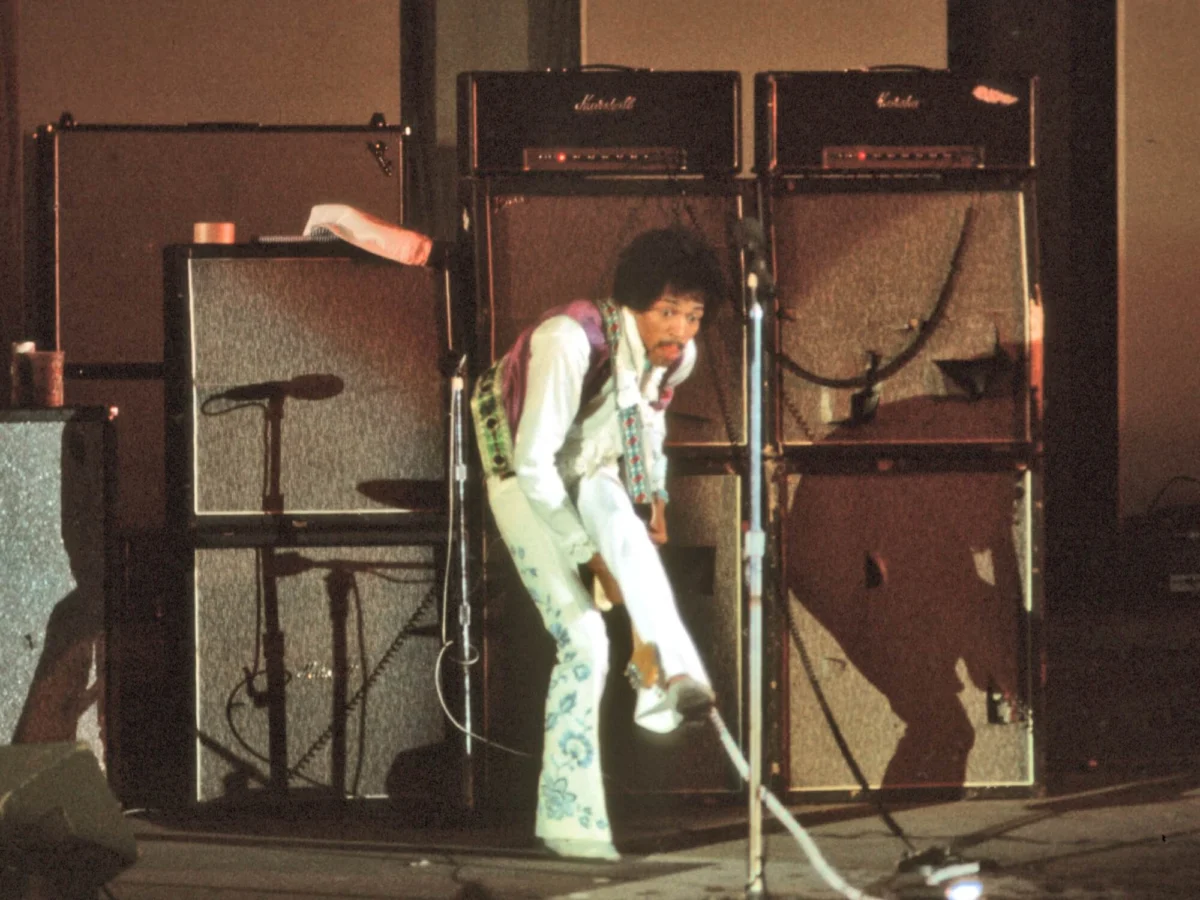
Jimi Hendrix’s legendary onstage guitar destruction, an image indelibly seared into the annals of rock history, was driven by profound artistic frustration rather than mere rock ‘n’ roll excess, according to his former roadie, Eric Barrett. This revelation, detailed in Barrett’s forthcoming memoir, Experienced: On the Road with Jimi Hendrix and Beyond, scheduled for release on August 4th, offers a deeper understanding of one of music’s most iconic and perplexing performance rituals. Barrett’s firsthand accounts paint a picture of an artist so deeply immersed in his craft that he would physically annihilate his instruments once he felt they could yield no more sonic innovation.
The Enigma of Destruction: Beyond Theatrics
For decades, the spectacle of Jimi Hendrix setting his guitar ablaze or systematically dismantling it on stage has been interpreted as the ultimate act of rebellious showmanship. From the searing flames at the Monterey International Pop Festival in 1967 to countless smashed instruments during encores across Europe and America, these moments cemented Hendrix’s image as a wild, untamed genius. However, Barrett’s memoir challenges this simplistic narrative, proposing that the destruction was less about theatrical posturing and more about a visceral, almost spiritual, exhaustion of the instrument’s musical potential. This insight transforms the act from a sensational stunt into a profound, albeit destructive, form of artistic expression.
Eric Barrett’s Revelation: A Roadie’s Perspective
Eric Barrett, who served as Hendrix’s roadie during the Experience’s meteoric rise in the late 1960s, bore witness to the frequent and often unpredictable acts of instrument destruction. His memoir provides an intimate, behind-the-scenes look at the logistical nightmares and emotional toll of touring with an artist who regularly vented his creative frustrations on his equipment. Barrett vividly recalls seeing "countless smashed guitars" throughout Hendrix’s tours, including a particularly agonizing instance during an encore in Bologna where a "pristine Fender Stratocaster" was ruthlessly obliterated.
Barrett’s recollections, excerpted via The Sunday Times, describe Hendrix taking "all of his frustrations out on the equipment" at the culmination of a performance. This wasn’t limited to guitars; "He beat the hell out of the amplifiers and poked bloody great holes in the speakers with the neck of his guitar," Barrett writes. The sheer intensity and frequency of these destructive outbursts were so overwhelming that they reportedly led the previous roadie to "take a bucketload of acid and fucked off mid-tour," highlighting the unique pressures of working for such an uninhibited artist. The unpredictable nature of these acts further underscores their spontaneous, almost involuntary, origin. "He’d never warn me before a performance," Barrett recounts, adding, "I don’t think he knew himself until it came time for the encore."
The Crucible of Creativity: Hendrix’s Artistic Intent
Driven by a desire to preserve at least some of the band’s valuable gear, Barrett often attempted to steer Hendrix towards older or already damaged instruments. "Before he went on stage, I’d always point out an old guitar, or one I’d rebuilt, and say, ‘Jimi, if you’re gonna smash a guitar tonight, please use that one.’" While Hendrix sometimes complied, other nights saw treasured instruments meet their untimely end, as with the beautiful Fender Stratocaster in Bologna.
Eventually, Barrett directly confronted Hendrix, posing the question that has long puzzled fans and critics alike: "Why destroy perfectly good guitars at all?" Hendrix’s response, free from any hint of calculated showmanship, was revelatory. "Eric, I just couldn’t get any more out of it, man," the guitarist confided. "I squeezed every note and every sound that guitar was ever going to give me. It had nothing left to give." This powerful statement reframes Hendrix’s destruction as the ultimate act of artistic exhaustion, a symbolic shedding of an instrument that, in his mind, had reached its absolute limit in his hands. It speaks to an almost spiritual connection between the artist and his tool, where destruction became a necessary conclusion to a profound creative journey.
A Historical Precedent: The Roots of Instrument Destruction in Rock
While Jimi Hendrix popularized guitar smashing on a global scale, he was not the first to engage in such acts. The Who’s Pete Townshend is widely credited with pioneering instrument destruction in rock music, famously smashing his guitars and drums from the mid-1960s onwards. Townshend’s motivations were varied, often cited as frustration with poor sound systems, audience indifference, or an existential angst that found expression in violence against his instrument. His early acts were raw, confrontational, and deeply embedded in the mod and art-school sensibilities of the time, challenging the reverence traditionally accorded to musical instruments.
Hendrix, who moved to London in 1966 and quickly became a sensation in the burgeoning psychedelic scene, was undoubtedly aware of Townshend’s groundbreaking performances. While he may have initially been inspired by the theatricality, Barrett’s account suggests Hendrix’s interpretation of the act evolved into something more personal and deeply artistic. It became less about external frustrations and more about an internal, creative imperative. This distinction is crucial in understanding Hendrix’s unique contribution to the spectacle of rock destruction, elevating it from mere punkish rebellion to a form of intense, almost ritualistic, artistic climax.
The Iconic Moment: Monterey Pop Festival, 1967
The single most enduring image of Jimi Hendrix’s guitar destruction occurred on June 18, 1967, at the Monterey International Pop Festival. Performing "Wild Thing," Hendrix concluded his electrifying set by dousing his white Fender Stratocaster with lighter fluid and setting it alight before smashing it repeatedly and tossing pieces into the awe-struck crowd. This performance, captured on film and broadcast globally, instantly elevated Hendrix to superstar status and cemented his legend.
The Monterey act was a calculated risk that paid off spectacularly. Coming after a blistering set that included his innovative renditions of "Hey Joe" and "Like a Rolling Stone," Hendrix’s decision to sacrifice his instrument was a deliberate attempt to outdo the preceding act, Otis Redding, and leave an unforgettable impression on the American audience. The sight of the burning Stratocaster, a symbol of rock’s burgeoning power and rebellion, became a defining moment of the counter-culture era. It was a visceral statement against conformity, an explosion of pure, unadulterated artistic energy. This event not only showcased Hendrix’s unparalleled showmanship but also underlined his willingness to push boundaries, both musically and performatively, demonstrating a fearless approach to his art that few have matched since.
The Logistics of Destruction: A Roadie’s Daily Challenge
For roadies like Eric Barrett, Hendrix’s proclivity for destruction presented significant practical challenges. Guitars, particularly high-quality instruments like Fender Stratocasters, were expensive, even in the 1960s. A new Fender Stratocaster in 1967 might have retailed for approximately $200-$300, a substantial sum at the time. Replacing these instruments regularly placed a considerable financial burden on the band and its management. Furthermore, the constant repair and procurement of new gear added immense logistical pressure to already demanding touring schedules.
Barrett’s attempts to guide Hendrix towards "older" or "rebuilt" guitars for smashing underscore the economic realities behind the spectacle. It wasn’t just about the visual impact; it was about managing resources. The fact that Hendrix often disregarded these pleas further emphasizes the spontaneous and deeply personal nature of his destructive acts. They were not planned budget items but rather unpredictable outbursts stemming from his intense creative process, making the roadie’s job a constant negotiation between artistic temperament and practical necessity. The story of the previous roadie’s departure due to the stress highlights the extreme environment in which Hendrix operated, where the line between genius and chaos was often blurred.
The Value and Veneration of the Sacrificial Instrument
Ironically, the very act of destruction has often imbued these instruments with immense historical and monetary value. The remnants of Hendrix’s Monterey Stratocaster, though charred and fragmented, became highly coveted artifacts. Pieces have reportedly been sold and exhibited, testifying to their cultural significance. A Stratocaster believed to have been used and partially burned by Hendrix at the 1967 Miami Pop Festival later sold for over £280,000 at auction in 2007. This transformation from destroyed tool to revered relic highlights the profound impact Hendrix’s performances had, turning acts of vandalism into acts of art.
The paradox of an instrument increasing in value precisely because it was destroyed by an icon speaks volumes about the mystique surrounding artists like Hendrix. It’s a testament to the power of artistic association, where the physical object becomes imbued with the spirit and legend of the performer. This phenomenon extends beyond Hendrix, as seen in the recent case of Phoebe Bridgers, where her smashed Danelectro guitar, initially valued at around $500, later fetched over $100,000 at auction, demonstrating the enduring market for rock ‘n’ roll artifacts, especially those touched by legendary moments of performance art.
Modern Echoes: Contemporary Reactions to Guitar Smashing
While guitar smashing remains part of rock’s theatrical lexicon, its reception in contemporary music is markedly different from the era of Hendrix and Townshend. In 2021, singer-songwriter Phoebe Bridgers sparked considerable debate when she smashed a stage monitor with her Danelectro guitar during a performance on Saturday Night Live. The incident, intended as an act of artistic expression and perhaps a nod to rock tradition, drew mixed reactions.
Veteran musician David Crosby famously dismissed it as "childish stage drama," reflecting a sentiment among some who view such acts as derivative or lacking the original subversive power. Herman Li of DragonForce offered a more pragmatic, albeit humorous, critique, stating, "Come on, you’re on Saturday Night Live, you can’t be smashing a $500 guitar – too cheap!" Li’s comment, though facetious, points to an expectation among some fans that if one is to smash an instrument, it should at least be a significant sacrifice, akin to the expensive Fenders Hendrix often destroyed. These reactions highlight a shift in cultural perception: what was once seen as an authentic, raw expression of rebellion or artistic frustration is now often scrutinized for its authenticity, cost, or perceived theatricality in a more cynical and digitally connected world. The rise of environmental consciousness and anti-consumerist sentiment also contributes to a different contemporary lens through which such acts are viewed.
Fender’s View: Balancing Legacy and Longevity
Even guitar manufacturers, whose products are often the victims of such destruction, have had to navigate this complex legacy. Justin Norvell, Chief Product Officer at Fender, acknowledged the "long-standing tradition" of guitar smashing in rock music. While noting that Fender was "alright with it," he also emphasized that "there’s always a balance that we have to strike." This statement reflects the dual nature of these events for a brand like Fender: on one hand, they contribute to the iconic status of their instruments, linking them to rock legends and unforgettable moments; on the other, they represent the literal destruction of their products. The balance lies in appreciating the cultural impact while also ensuring the brand continues to be associated with craftsmanship and musical longevity. For Fender, a brand synonymous with rock history, the destruction of a Stratocaster by Jimi Hendrix is not just a loss of product but a paradoxical validation of its instrument’s role in shaping music history.
The Enduring Legacy of Jimi Hendrix’s Fiery Artistry
Eric Barrett’s memoir, Experienced: On the Road with Jimi Hendrix and Beyond, promises to offer invaluable insights into the mind of one of music’s most influential figures. His revelation that Hendrix’s guitar smashing was primarily an act of artistic exhaustion, rather than mere showmanship, recontextualizes a crucial aspect of his legend. It underscores Hendrix’s unparalleled commitment to pushing the boundaries of sound, where the instrument itself eventually became a limitation to be transcended, even through its violent demise.
This understanding elevates Hendrix’s destruction from vandalism to a profound form of performance art, deeply intertwined with his improvisational genius and his relentless pursuit of new sonic frontiers. It reinforces the image of an artist so intensely connected to his music that the physical instrument became an extension of his soul, and its destruction, the ultimate statement of having wrung every last drop of expression from it. Jimi Hendrix’s legacy, marked by his unparalleled musicianship and iconic stage presence, continues to resonate, and Barrett’s memoir offers a vital new perspective on why, for this extraordinary artist, sometimes the only way forward was to break the mold, quite literally.
