

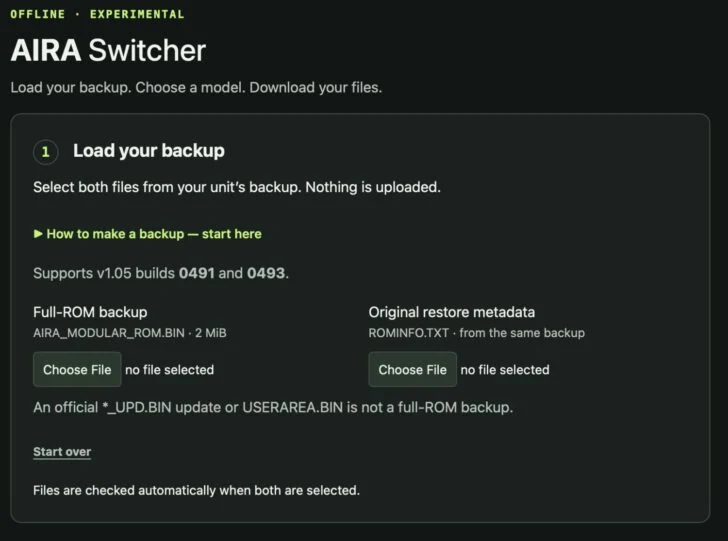
The Roland Aira modular series, long regarded as a versatile bridge between traditional analog Eurorack systems and modern digital signal processing, has entered a new era of utility following the release of an experimental firmware switching tool. Developed by a programmer known as tracelistener, the "Aira Switcher" project utilizes a breakthrough in firmware analysis to allow owners of the Scooper, Demora, Torcido, and Bitrazer modules to interconvert their hardware. This development effectively renders the four distinct modules interchangeable, revealing that the primary differences between the units are rooted in a single byte of code rather than physical hardware architecture.
The emergence of this tool represents a significant milestone for the modular synthesizer community, particularly for users of legacy digital hardware. For years, the Roland Aira series—comprising the Bitrazer (bitcrusher), Demora (delay), Torcido (distortion), and Scooper (looper)—were marketed as specialized effects units with unique internal algorithms. While it was widely suspected within technical circles that the internal components of these units were largely identical, the software barriers prevented users from accessing the full suite of Roland’s Aira effects on a single piece of hardware. The new switcher tool, hosted via GitHub, provides a streamlined interface for backing up existing firmware and flashing the identity of a different module onto the host unit.
Technical Discovery and the Role of Artificial Intelligence
The catalyst for this project was the developer’s use of artificial intelligence to assist in the reverse-engineering of the Roland firmware backup process. According to the developer, identified by the handle tracelistener, AI tools were instrumental in deciphering the data structures required to successfully extract a firmware image from a Roland Scooper unit. Upon comparing the firmware images of the various modules in the Aira line, it was discovered that the Bitrazer, Demora, Torcido, and Scooper share an almost identical codebase.
The technical analysis confirmed that the hardware identifies itself to the system based on a specific "identity byte." By modifying this byte, the firmware of one module can be successfully loaded and operated on the hardware of another. This discovery highlights a common practice in modern electronics manufacturing known as hardware binning or platform unification, where a single hardware design is utilized across multiple products to reduce production costs, with specific features enabled or disabled via software. In the case of the Aira series, this unification allows a user who owns a Torcido distortion module to theoretically transform it into a Scooper looper or a Demora delay with minimal effort.
Background: The Roland Aira Modular Legacy
Roland launched the Aira modular series in 2015 during a period of rapid expansion in the Eurorack market. At the time, the modules were praised for their high-fidelity audio processing, operating at 24-bit/96kHz resolution. Unlike traditional analog modules, the Aira units were designed as "software-defined hardware." Each unit featured a set of physical controls—large, high-resolution knobs and patch points—that could be reconfigured using the Aira Modular Customizer app.

The Customizer app allowed users to "re-patch" the internal architecture of the modules by dragging and dropping virtual sub-modules such as LFOs, ADSR envelopes, filters, and mixers. This hybrid approach allowed the modules to function as standalone effects or as complex, customized utility blocks within a larger Eurorack system. Despite their flexibility, the core identity of the module (e.g., whether it was primarily a delay or a looper) remained fixed to the specific firmware installed at the factory. The discontinuation of the series several years ago led to a surge in the secondary market, with certain modules, particularly the Scooper, often fetching higher prices due to their unique looping and "scatter" capabilities.
Functional Breakdown of the Affected Modules
To understand the impact of the firmware switcher, it is necessary to examine the four modules that comprise this interchangeable ecosystem:
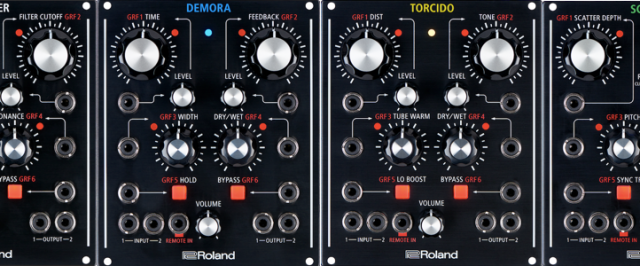
- Bitrazer: A powerful bit and sample rate crusher. It features internal filters and allows for aggressive digital destruction of audio signals.
- Demora: A high-resolution delay module with a range from sub-millisecond flanging to long, ambient echoes. It is noted for its smooth parameter control and high-fidelity repeats.
- Torcido: A versatile distortion module capable of emulating classic tube warmth as well as heavy, saturated clipping. It includes an internal NOR-type gate and a bypass switch.
- Scooper: A combination looper and "Scatter" effect. It allows for the capturing of audio loops which can then be sliced, reversed, and manipulated in real-time.
Under the new firmware switching paradigm, a user possessing any one of these four units now effectively possesses all of them. This maximizes the value of the hardware and provides a level of versatility that was previously unavailable without purchasing multiple units.
Chronology of the Aira Switcher Development
The timeline of the Aira series and the subsequent development of the switcher reflects the evolving relationship between manufacturers and the "maker" community:
- April 2015: Roland unveils the Aira Modular series at the Musikmesse trade show in Frankfurt. The units are marketed as the world’s first modules to feature "internal re-patching."
- 2015–2018: The modules gain a dedicated following. Roland releases various "virtual sub-modules" for the Customizer app, expanding the internal library to over 15 utility blocks.
- 2019: Production of the Aira modular line begins to wind down as Roland shifts focus toward the Boutique series and Cloud-based software instruments.
- 2020–2023: The Aira Modular Customizer app faces compatibility issues with newer versions of iOS and macOS, leading to community-led efforts to preserve the functionality of the hardware.
- Late 2023: The developer tracelistener begins investigating the firmware structure of the Scooper, utilizing AI-assisted analysis to bypass proprietary hurdles.
- September 2024: The Aira Switcher tool is made public on GitHub, providing a browser-based interface for firmware interconversion.
Supporting Data and Specifications
The Aira modules are built on a robust digital platform that remains competitive by modern standards. Key specifications that apply to all four interchangeable modules include:
- Processing Resolution: 24-bit / 96kHz.
- Physical Interface: 6 high-resolution knobs (16,384 steps), 2 inputs, 2 outputs, and 6 CV/Gate inputs for external modulation.
- Power Requirements: 950mA (+12V), 30mA (-12V).
- Form Factor: 21 HP (Eurorack compatible) or tabletop (using the included AC adapter).
- Internal Patching: Up to 15 virtual sub-modules can be active simultaneously within the internal signal path.
The discovery that these modules differ by only a single byte is supported by the fact that the physical PCB (Printed Circuit Board) layouts across the four units are identical. The only external differences are the faceplates and the default color schemes of the LED lighting behind the knobs.
Industry Implications and User Risks
The release of the Aira Switcher carries significant implications for the synthesizer industry and the secondary market. From a consumer perspective, the "unlocking" of hardware capabilities increases the longevity and utility of legacy gear. It also challenges the traditional manufacturing model where software locks are used to differentiate products with identical hardware costs.
However, the use of third-party firmware tools is not without risk. Journalistic inquiry into the project suggests several potential caveats for users:
- Warranty and Support: As the Aira modules are largely discontinued, official warranties have expired for most users. However, Roland does not officially support the use of third-party firmware tools, and any attempt to flash the units could result in a "bricked" device if the process is interrupted.
- Technical Proficiency: While the tool is designed to be accessible, it requires a stable connection and a specific backup process to ensure that the original firmware can be restored if the swap fails.
- Hardware Labels: A "swapped" module will no longer match its physical faceplate. For example, a Torcido running Scooper firmware will have knobs labeled for distortion parameters that now control looping functions. Users must rely on memory or custom overlays to navigate the new interface.
Broader Impact on Digital Preservation
The Aira Switcher project is part of a larger trend in the music technology world toward digital preservation and community-led maintenance. As manufacturers move toward subscription models and app-dependent hardware, there is a growing concern that functional hardware will become "e-waste" once the official software is no longer updated.
By reverse-engineering the firmware and providing a platform-independent tool (the switcher runs in a web browser via WebMIDI), developers like tracelistener are ensuring that these instruments remain functional and flexible for decades to come. This movement mirrors similar efforts in the gaming industry to preserve software for consoles that are no longer supported by their original creators.
Conclusion
The Roland Aira firmware switcher is a testament to the power of community-driven innovation and the increasing role of artificial intelligence in hardware analysis. By breaking down the software barriers between the Bitrazer, Demora, Torcido, and Scooper, the tool has effectively unified the series into a single, multi-functional platform. While Roland has not issued an official response to the project, the modular community has reacted with cautious optimism, viewing the tool as a vital resource for maximizing the potential of their digital instruments. As the line between hardware and software continues to blur, projects like the Aira Switcher serve as a reminder that the true capabilities of a device are often limited only by the code residing within its memory.
