

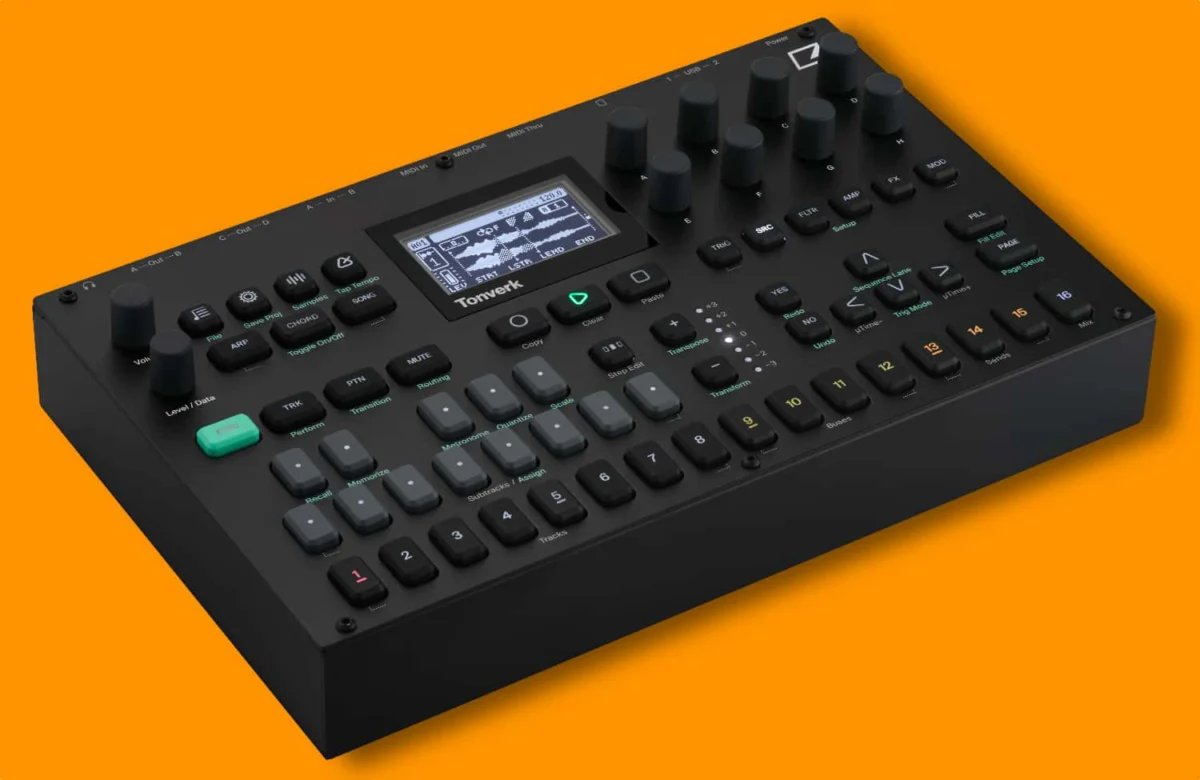
The Integration of Overbridge Multitrack Streaming
Perhaps the most consequential addition in Tonverk OS 1.4.0 is the implementation of Overbridge multitrack streaming. Overbridge is Elektron’s proprietary software suite designed to integrate hardware instruments into a computer-based environment as if they were software plugins. Prior to this update, users often had to rely on the stereo main outputs or complex physical routing to capture individual tracks within a DAW.
With version 1.4.0, the Tonverk can now stream multiple channels of high-resolution audio directly over a single USB cable. This allows producers to process individual tracks—such as kick drums, leads, and percussive elements—with external VST effects, EQ, and compression in real-time. The technical achievement of multitrack streaming over USB requires significant bandwidth management and low-latency processing, a feat that Elektron has refined over several years across its "Trinity" and "Digi" lines. For the professional engineer, this means the Tonverk is no longer an isolated "island" of sound but a fully integrated component of a sophisticated studio matrix.
Advanced Modulation and Track Setup
Beyond connectivity, OS 1.4.0 deepens the internal synthesis and sequencing architecture of the Tonverk. The update introduces additional options within each track’s modulation setup, providing users with more granular control over how parameters evolve over time. In the context of Elektron’s "Parameter Locking" workflow, where every step in a sequence can contain unique values for every knob on the machine, the addition of new modulation destinations and sources is a force multiplier for sound design.
These improvements allow for more complex interactions between Low-Frequency Oscillators (LFOs), envelopes, and the internal synthesis engines. By expanding the modulation matrix, Elektron enables users to create "living" sounds that shift and breathe throughout a performance, reducing the repetitive nature often associated with hardware sequencers. This level of control is particularly beneficial for genres such as techno, ambient, and IDM, where subtle timbral shifts are essential for maintaining listener engagement.
Performance-Oriented Workflow Enhancements
The update places a heavy emphasis on live performance, a domain where Elektron hardware traditionally excels. Several key features have been introduced to facilitate "on-the-fly" composition and manipulation:
Pattern Transpose in Semitones
The ability to transpose patterns in semitones is a critical addition for melodic flexibility. Previously, shifting the key of a sequence often required manual adjustment of individual trigs or tracks. With the new global and track-level transpose options, performers can shift the harmonic center of their entire composition instantly. This allows for seamless transitions between musical sections and enables the Tonverk to interact more fluidly with other melodic instruments in a live ensemble.
FX Order Swap
Signal chain flexibility is a hallmark of high-end studio processing, and OS 1.4.0 brings this capability to the Tonverk. The "FX Order Swap" feature allows users to change the position of effects within the internal signal path—for instance, switching between a Delay-into-Reverb configuration and a Reverb-into-Delay setup. This seemingly small change has a profound impact on the texture and "wash" of the sound, providing a broader palette for atmospheric soundscapes.
Reload Parameter Page
One of the most requested "safety net" features for live performers is the "Reload Parameter Page" function. During a live set, performers often tweak multiple knobs simultaneously to build tension, sometimes pushing the sound into chaotic or dissonant territory. The reload function allows the user to instantly snap all parameters back to their saved state on a per-page basis. This encourages radical experimentation during performance, knowing that the "home" state of the sound is only a button press away.
Chronology of Development and Community Response
The development of OS 1.4.0 follows a traditional Elektron release cycle, characterized by meticulous beta testing and community feedback. Elektron has historically utilized its "Elektronauts" forum as a sounding board for user grievances and feature requests. The Tonverk, being a newer entry or a highly anticipated evolution in their product line, has been under intense scrutiny since its inception.
The timeline leading to 1.4.0 suggests a focus on stabilizing the core OS before introducing the resource-heavy Overbridge features. Matthew Piecora’s analysis in his EZBOT video serves as a bridge between the technical documentation provided by Elektron and the practical application of these features in a performance context. Piecora, known for his expertise in "performance templates" and complex routing, noted that the stability of the 1.4.0 build represents a significant step forward for those using the Tonverk as the "brain" of their setup.
Initial reactions from the user community have been overwhelmingly positive, particularly regarding the "FX Order Swap" and "Pattern Transpose." Users have noted that these features address specific bottlenecks that previously required workarounds or external gear.
Technical Specifications and Fixes
In addition to the headline features, OS 1.4.0 includes a comprehensive list of bug fixes and minor improvements designed to enhance the overall user experience. These include:
- Improved UI Responsiveness: Optimizations in the graphical interface ensure that visual feedback matches the tactile input of the encoders and buttons without lag.
- Sequencer Timing Stability: Enhancements to the internal clocking mechanism ensure tighter synchronization when the Tonverk is acting as a MIDI leader or follower.
- File Management: Refinements to the way samples and projects are stored and recalled, reducing load times and preventing data corruption.
- MIDI Implementation: Expanded MIDI CC (Continuous Controller) maps, allowing external hardware or software controllers to manipulate a wider range of Tonverk parameters.
These "under the hood" changes are essential for professional reliability. In a high-stakes live environment, the stability of the operating system is as important as the quality of the sound engines themselves.
Analysis of Implications for the Synthesizer Market
The release of Tonverk OS 1.4.0 reflects a broader trend in the music technology industry: the move toward "hybrid" workflows. As companies like Akai, National Instruments, and Ableton continue to blur the lines between hardware and software, Elektron’s refinement of Overbridge keeps the Tonverk competitive.
By offering a device that functions as a standalone tactile instrument while maintaining a transparent link to the DAW, Elektron appeals to two distinct demographics: the "DAW-less" purist who values the tactile experience of hardware, and the modern studio producer who requires the efficiency of digital integration. The inclusion of multitrack streaming effectively eliminates the need for expensive multi-input audio interfaces for many users, potentially lowering the barrier to entry for high-quality hardware production.
Furthermore, the "Pattern Transpose" and "Modulation Setup" updates signal that Elektron is listening to the evolving needs of the performance community. As electronic music performances become more sophisticated, the tools used to create them must offer more than just playback; they must offer real-time expressive agency.
Conclusion and Future Outlook
Tonverk OS 1.4.0 is more than a simple patch; it is a comprehensive retooling of the instrument’s capabilities. By integrating Overbridge multitrack streaming, Elektron has solidified the Tonverk’s position as a versatile tool for both the stage and the studio. The workflow enhancements—specifically the transpose and reload functions—demonstrate a deep understanding of the stresses and requirements of live performance.
As Matthew Piecora demonstrated in his technical deep-dive, the 1.4.0 update transforms the Tonverk into a more agile and interconnected machine. For existing owners, the update provides a wealth of new creative possibilities at no additional cost, a practice that has earned Elektron significant brand loyalty over the decades. For prospective buyers, the enhanced DAW integration and expanded modulation options make the Tonverk an even more compelling proposition in a crowded market of boutique and mass-market synthesizers.
Moving forward, the industry will likely look to Elektron to see how they continue to leverage the Tonverk’s hardware architecture. With the foundation of 1.4.0 now in place, the path is clear for further sound engine expansions and perhaps even more radical sequencer innovations in future iterations. For now, users are encouraged to visit the official Elektron site to download the update and consult the full changelog for a detailed breakdown of all fixes and enhancements.
