

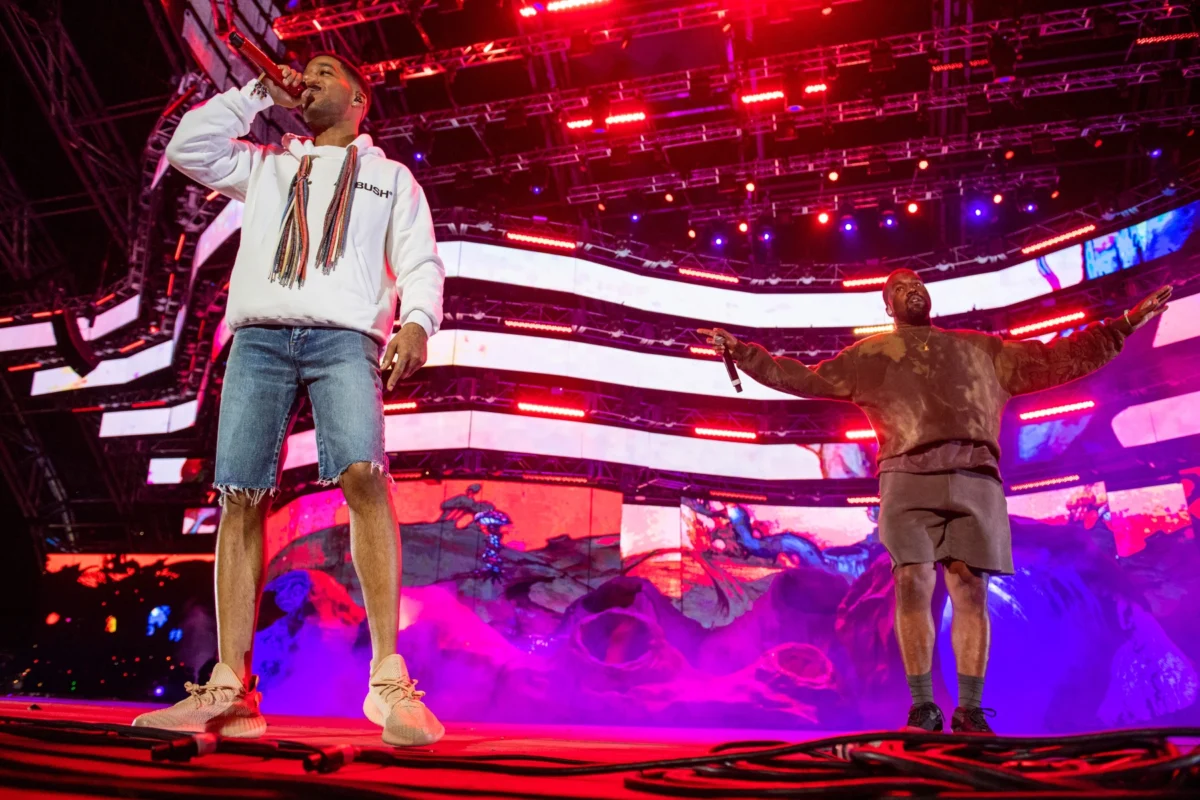
The recent on-stage reunion of Kid Cudi and Kanye West at Soldier Field in Chicago marked a pivotal moment in contemporary hip-hop, symbolizing a complex tapestry of artistic collaboration, personal reconciliation, and ongoing public debate surrounding accountability and mental health. The highly anticipated appearance, which saw the pair perform a trio of their beloved tracks, generated significant buzz among fans but also reignited discussions about Kanye West’s controversial past and the nature of forgiveness in the public eye. This weekend’s performance was the first live collaboration between the two artists in years, signaling a potential new chapter in their two-decade-spanning relationship.
The Soldier Field Spectacle: A Homecoming and a Reunion
On Friday, September 4, during the guest-filled second night of Kanye West’s two homecoming concerts at Chicago’s iconic Soldier Field, the atmosphere was charged with anticipation. The sprawling three-hour set, already notable for its scale and production, reached an emotional crescendo with the surprise introduction of Kid Cudi. The crowd erupted as Cudi joined Ye on stage, a sight many fans had yearned for after a period of public estrangement. Together, they delivered powerful renditions of "Father Stretch My Hands, Pt. 1" and "Ghost Town," two tracks emblematic of their profound collaborative synergy. The set was further enriched by a performance of "Pursuit of Happiness (Nightmare)," a Kid Cudi anthem that underscored the depth of their shared artistic journey, even as it transcended their direct collaborations. This three-song segment was instantly hailed by many attendees and online observers as one of the most unforgettable moments of the entire concert series, cementing the night’s place in the annals of Chicago’s music history. The energy between the two artists, visually and audibly, suggested a genuine warmth and connection, seemingly putting an end to a public rift that had spanned several years.
A Decades-Long Bond: The Cudi-West Collaboration
The relationship between Scott Mescudi, known professionally as Kid Cudi, and Ye, formerly Kanye West, is one of the most creatively fertile and personally complex partnerships in modern music. Their bond, which now spans two decades, began in the mid-2000s, leading to Ye signing Cudi to his G.O.O.D. Music imprint in 2008. This signing propelled Cudi into the mainstream, with Ye serving as a mentor and frequent collaborator. Their early work together, notably on Ye’s seminal album 808s & Heartbreak (2008), where Cudi’s melodic approach and introspective lyrics heavily influenced Ye’s stylistic shift, laid the groundwork for a unique artistic chemistry. Cudi’s debut album, Man on the Moon: The End of Day (2009), executive produced by Ye, further solidified his status as a groundbreaking artist.
Over the years, their collaborations continued to yield critically acclaimed music, including appearances on Ye’s My Beautiful Dark Twisted Fantasy (2010) and The Life of Pablo (2016), which features "Father Stretch My Hands, Pt. 1." The pinnacle of their direct collaborative efforts arrived in 2019 with the release of their joint album, Kids See Ghosts. This seven-track project was lauded for its innovative sound, raw emotional honesty, and exploration of themes like mental health, spirituality, and redemption, earning widespread critical acclaim and solidifying their status as a formidable duo. The album debuted at number two on the Billboard 200 chart, demonstrating their enduring commercial appeal. Beyond the music, their bond often appeared as a brotherhood, with both artists publicly acknowledging the profound impact they had on each other’s lives and careers.
The Chasm of Controversy: West’s Recent Past
The recent years, however, saw a significant strain on this cherished relationship, primarily due to Ye’s highly publicized and controversial behavior. Beginning in late 2022 and extending into early 2023, Ye engaged in a series of erratic public rants, hate speech, and antisemitic remarks that drew widespread condemnation globally. His comments on various platforms, including social media, interviews, and public appearances, often veered into conspiracy theories and offensive rhetoric. Notably, during an appearance on Alex Jones’ Infowars in December 2022, West made highly inflammatory statements, including praising Adolf Hitler, a move that shocked audiences and industry observers alike. He also publicly wore a "White Lives Matter" shirt, further alienating many.
These actions led to severe professional repercussions for Ye. Major brands, including Adidas, Gap, and Balenciaga, terminated their lucrative partnerships with him, resulting in significant financial losses estimated to be in the billions of dollars. His music was pulled from certain platforms, and his public image suffered an unprecedented decline. The widespread backlash led to calls for accountability and sparked a broader discussion about the responsibility of public figures, particularly those with a history of mental health struggles, to temper their influence. For many, Ye’s actions crossed a line that made reconciliation, particularly with Jewish communities and those impacted by hate speech, seem nearly impossible.
Kid Cudi’s Stance: Accountability and Forgiveness
During this tumultuous period, Kid Cudi was among the prominent figures who publicly distanced themselves from Ye. In a revealing interview with CBS in 2025, Cudi candidly expressed his heartbreak and frustration, stating that Ye had uttered things "there was no coming back from." He affirmed, "I’m done with you. And it breaks my heart because I loved Kanye. I really loved him. He was part of my life changing and at some point, he was a really good friend, but the man that he has become… I just don’t know that guy anymore." This powerful statement underscored the gravity of Ye’s actions and the profound impact they had on even his closest confidantes.
However, the recent reunion suggests a significant shift in Cudi’s stance, rooted in a belief in forgiveness and the enduring power of brotherhood. Following the Soldier Field performance, Cudi took to X (formerly Twitter) to address both the celebratory messages and the criticism directed at his reconciliation with Ye. In response to Peter Rosenberg’s pointed remarks, Cudi articulated his perspective: "I understand ur frustration Peter, I f–s w u, but I don’t really care if ur disappointed in me. That man is my brother. U don’t have a relationship w him like I do. Damn near 2 decades of art and friendship. U not family. So I get it. Ive been around Ye, and I can honestly say talking to him now is how it use to be when I first signed to him, but even better. He was dealing w mental health struggles for years and now hes good. Everyone deserves some grace when they family. I was the hardest on him out of anybody. I held him accountable. He apologized and it was sincere. But like I said, u not family so I get it."
Cudi’s statement emphasizes several key points: the profound, familial nature of his bond with Ye; his belief in Ye’s recovery from mental health struggles, specifically bipolar disorder; and the sincerity of Ye’s apology. He positioned himself as an insider who had held Ye accountable, suggesting that his forgiveness was not easily given but earned through genuine remorse and visible improvement in Ye’s well-being. This narrative places Cudi not as an enabler, but as a supportive brother witnessing a difficult journey towards healing.
The Public Reckoning: Reactions and Rebuttals

The reunion ignited a fervent debate across social media and within the broader music industry, highlighting the complex intersection of artistry, personal conduct, and public perception. New York radio personality Peter Rosenberg, a respected voice in hip-hop, was among the most vocal critics of the enthusiasm surrounding Ye’s Chicago concerts and the reunion with Cudi. On X, Rosenberg expressed his disappointment, noting that "a lot of people I love are being openly lame about Kanye" during his Chicago weekend. He unequivocally stated, "I am not saying no one deserves forgiveness or empathy but this man sang Heil Hitler ONE YEAR AGO." Rosenberg’s comments encapsulated the sentiment of many who felt that West’s actions, particularly his antisemitic remarks, were too recent and too egregious to warrant such immediate celebration or a perceived "hero" status.
Cudi’s direct response to Rosenberg underscored the deep divide in public opinion. While Cudi defended his personal decision based on a familial bond and perceived change in Ye, Rosenberg reiterated his concerns, replying, "well i wasnt disappointed in you @KiDCuDi (i meant fans) but if you saw me running out to support an artist a year after they made a song called ‘all hail the klan’ you would prolly feel a way. I am ALL for forgiveness and empathy but this man is being hailed as a HERO … f that. go get real help and sit down for a few years then lets talk before im going to run to put money in ur pocket." Rosenberg’s argument shifted the focus from personal forgiveness to the broader societal implications of supporting an artist whose past actions remain highly controversial and whose rehabilitation process, in his view, appeared incomplete. The debate highlighted the tension between personal relationships and public responsibility, and the differing views on how quickly, and under what conditions, a public figure should be reintegrated after significant transgressions. Many fans echoed Rosenberg’s sentiments, questioning the sincerity of Ye’s apology and the speed of his return to the spotlight, while others championed Cudi’s message of empathy and the power of second chances, particularly in the context of mental health challenges.
A Chronology of Their Tumultuous Relationship
The journey of Kid Cudi and Kanye West has been marked by periods of intense collaboration, public adoration, and painful estrangement.
- Mid-2000s: Kid Cudi and Kanye West first meet, laying the groundwork for a future partnership.
- 2008: Ye signs Kid Cudi to his G.O.O.D. Music label. Cudi makes significant contributions to Ye’s 808s & Heartbreak.
- 2009: Kid Cudi releases his debut album, Man on the Moon: The End of Day, executive produced by Ye, achieving critical and commercial success.
- 2010s: Frequent collaborations on Ye’s albums like My Beautiful Dark Twisted Fantasy and The Life of Pablo, and Cudi’s own projects. Their bond deepens, often described as a brotherhood.
- Early 2016: The first major public fallout. Cudi expresses frustration with Ye and Drake on social media, accusing them of not supporting him. Ye initially reacts negatively but later reconciles, publicly stating, "I am Kid Cudi."
- 2018: The pair announces and releases their joint album, Kids See Ghosts, which is met with widespread critical acclaim and solidifies their artistic synergy.
- Late 2022 – Early 2023: Ye embarks on a series of controversial public rants, hate speech, and antisemitic remarks, leading to widespread condemnation and professional fallout.
- 2025: Kid Cudi publicly distances himself from Ye in a CBS interview, stating, "I’m done with you" due to Ye’s actions.
- Early 2026: Ye issues a public apology for his antisemitic remarks, referencing his struggles with bipolar disorder and "disconnected moments."
- Summer 2026: Kid Cudi reveals in interviews that he and Ye are in the process of rebuilding their friendship, indicating a path toward reconciliation.
- September 4, 2026: Kid Cudi joins Kanye West on stage at Soldier Field in Chicago for their first live performance together in years, performing "Father Stretch My Hands, Pt. 1," "Ghost Town," and "Pursuit of Happiness (Nightmare)."
- September 5, 2026: Cudi responds to public criticism, particularly from Peter Rosenberg, on X, defending his decision to reconcile with Ye based on their long-standing brotherhood and Ye’s mental health journey.
Kanye West’s Apology and Mental Health Journey
Central to the narrative of reconciliation is Ye’s public apology in early 2026. In a full-page advertisement taken out in the Wall Street Journal in January of that year, Ye directly addressed his past actions. His apology was notably framed within the context of his ongoing battle with bipolar disorder, a condition he has openly discussed for years. He wrote, "You don’t think you’re sick. You think everyone else is overreacting. You feel like you’re seeing the world more clearly than ever, when in reality you’re losing your grip entirely… One of the difficult aspects of having bipolar type-1 are the disconnected moments — many of which I still cannot recall — that led to poor judgment and reckless behavior that oftentimes feels like an out-of-body-experience. I regret and am deeply mortified by my actions in that state, and am committed to accountability, treatment and meaningful change. It does not excuse what I did, though. I am not a Nazi or an antisemite. I love Jewish people."
This apology, while accepted by some as a genuine step towards remorse and recovery, was viewed with skepticism by others who felt it lacked sufficient directness or was strategically timed. The complexities of mental health and its role in accountability remain a significant point of contention. While understanding that mental illness can influence behavior, many argue that it does not absolve individuals of responsibility for harmful actions. Cudi’s perspective, as someone intimately familiar with Ye’s struggles, leans heavily into the idea that Ye’s recovery and sincere apology warrant a second chance, particularly within the sanctity of their personal bond. His emphasis on Ye being "good" now suggests a belief in a tangible improvement in Ye’s mental state and a commitment to positive change.
Implications for the Future: Music, Culture, and Accountability
The Kid Cudi and Kanye West reunion carries significant implications for various facets of culture and industry.
For Their Artistic Future: The performance at Soldier Field immediately sparked speculation about future collaborations, most notably a potential Kids See Ghosts 2. Given the critical success of their first joint album, a sequel would be highly anticipated by fans and could mark a powerful artistic comeback for both, especially Ye. It could also influence their individual projects, perhaps infusing them with a renewed sense of purpose or shared creative direction.
For the Music Industry: This reunion could serve as a precedent, or at least a significant talking point, for how the industry handles artists who have faced severe public backlash for controversial behavior. It raises questions about the parameters of "cancel culture," the path to redemption, and the role of personal relationships in navigating public condemnation. The industry will be watching closely to see if this reconciliation leads to further professional opportunities for Ye, and how audiences and brands react.
For Public Discourse on Mental Health and Accountability: Kid Cudi’s explicit linking of Ye’s past actions to his mental health struggles and his subsequent recovery injects a nuanced layer into the ongoing conversation about mental illness and accountability. While it fosters empathy and highlights the importance of supporting individuals through mental health crises, it also reignites the debate about where the line lies between understanding illness and condoning harmful behavior. Cudi’s narrative reinforces the idea that true forgiveness often requires demonstrated change and sincere remorse, but it also challenges the public to consider the personal journey of individuals behind the headlines.
For Celebrity Redemption Narratives: The reunion contributes to the complex landscape of celebrity redemption. For some, it represents a hopeful sign that individuals can recover from their mistakes and rebuild relationships, even after severe transgressions. For others, it highlights the perceived ease with which powerful figures can return to public favor, raising concerns about the sincerity of apologies and the long-term consequences of harmful actions. The path forward for Ye, and by extension Cudi, will undoubtedly be under intense scrutiny as they navigate this delicate balance.
In the wake of their Chicago reunion, Kid Cudi’s subsequent posts on X, stating, "Tn was just another epic night on a list with many other epic nights w my big bro," and "Love u big bro. Family s–tt," encapsulate the deeply personal nature of this reconciliation. While the public, critics like Peter Rosenberg, and even segments of their fan base grapple with the broader implications of this reunion, for Kid Cudi, it appears to be a reaffirmation of an enduring brotherhood that has weathered two decades of artistic collaboration, personal growth, and profound challenges. The path ahead remains uncertain, but the Soldier Field stage has undeniably set the scene for a new chapter, one that will continue to be dissected and discussed in the evolving narrative of hip-hop and celebrity culture.
