

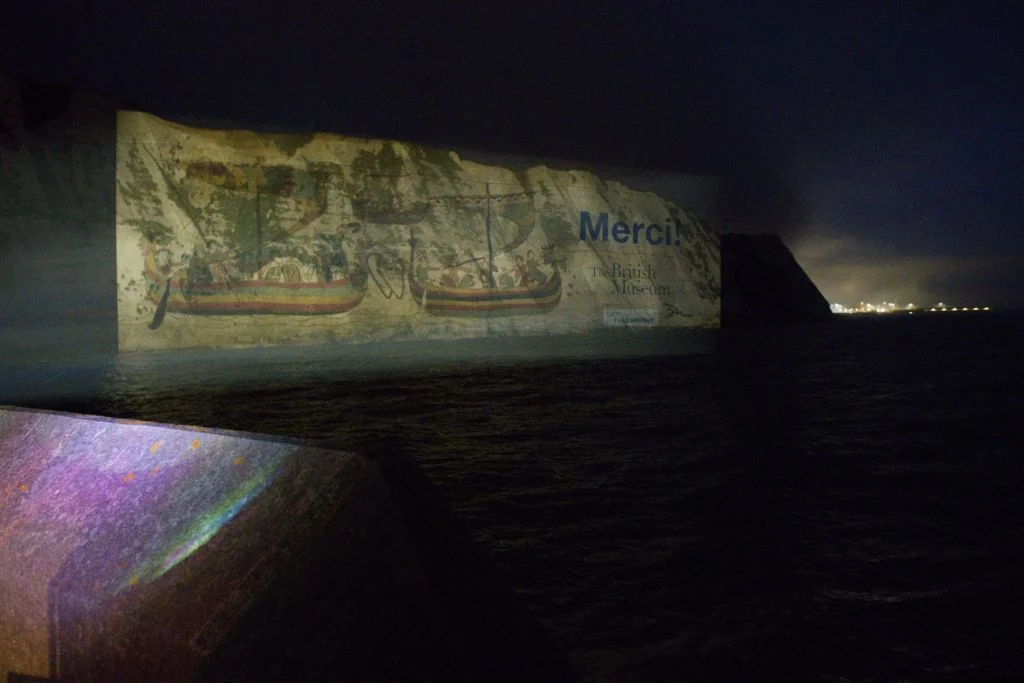
In a landmark fusion of medieval history and cutting-edge visual technology, the iconic White Cliffs of Dover were transformed into a massive outdoor cinema to celebrate the upcoming return of the Bayeux Tapestry to British soil. Commissioned by the British Museum, the technical production was spearheaded by the UK-based specialist firm Pixel Sharp, which utilized a sophisticated array of Panasonic RQ35K 4K laser projectors to beam historic motifs and messages of gratitude across the English Channel. This high-profile activation serves as the ceremonial prelude to one of the most significant cultural loans in modern history, as the 11th-century masterpiece prepares to leave France for the first time in nearly a millennium.
The Bayeux Tapestry, a 70-meter-long embroidered cloth depicting the events leading up to the Norman Conquest of England in 1066, is currently housed in the Cathédrale Notre-Dame de Bayeux in Normandy. Due to extensive renovations and expansion projects at its home museum, the French government reached a diplomatic agreement to loan the artifact to the British Museum. The projection on the Dover cliffs—the very site where many of the historical events depicted in the tapestry unfolded—marked a symbolic "welcome home" for the work, which will be on display in London through July 2027.
A Technical Triumph in Challenging Terrain
Executing a large-scale projection on a natural monument as irregular as the White Cliffs of Dover presents a unique set of logistical and engineering hurdles. Unlike the flat, controlled surfaces of urban buildings typically used for projection mapping, the cliffs are characterized by jagged edges, deep fissures, and varying levels of reflectivity. Jon Sharpe, the founder and managing director of Pixel Sharp, noted that the project required a meticulous approach to light management. "Projection is essentially the manipulation of light, and when your canvas is a porous, living rock face, you have to account for every nuance of the surface," Sharpe explained.
The team deployed four Panasonic RQ35K projectors, renowned in the industry for their high brightness and compact form factor. These units were configured in a "double-stack" arrangement—two pairs of projectors stacked vertically. This configuration serves two primary purposes: first, it doubles the lumen output to ensure the image remains vibrant against the dark night sky and the absorbent surface of the chalk; second, it provides critical redundancy. Should one unit fail, the overlapping image from the second projector ensures the show continues without interruption.
To achieve the necessary visual impact, Pixel Sharp opted for 3-chip DLP (Digital Light Processing) technology. In the world of high-end projection, 3-chip DLP is favored for its superior color accuracy and uniformity. Unlike 1-chip systems, which can suffer from "rainbow effects" or inconsistent color saturation across large areas, 3-chip systems provide a seamless blend that is essential when multiple projectors are used to create a single, unified image. This was particularly important for the Bayeux project, where the subtle earthy tones of the original embroidery needed to be replicated faithfully on a massive scale.
Overcoming Environmental and Infrastructural Constraints
The location of the projection site added layers of complexity to the operation. The chosen vantage point offered the best view of the cliffs but was geographically isolated and lacked access to the national power grid. To circumvent this, Pixel Sharp integrated mobile battery power systems to run the entire projection rig. This move not only solved the power issue but also aligned with modern trends toward more sustainable and "off-grid" event production, reducing the noise and carbon footprint associated with traditional diesel generators.
The setup window was exceptionally tight. The technical crew had only a few hours to position the gear, align the optics, and perform the complex geometric mapping required to "wrap" the digital images around the cliff’s contours. The mapping process itself—the digital adjustment of the image to ensure it looks "flat" and undistorted from the viewer’s perspective despite the uneven surface—took approximately 90 minutes.
However, the British weather proved to be the most unpredictable variable. During the calibration phase, a thick coastal fog rolled in from the English Channel. Fog is the nemesis of long-distance projection, as the water droplets in the air scatter the light beams, reducing contrast and clarity. The team had to work through these conditions to finalize the alignment. Shortly after the mapping was completed, the weather took a further turn for the worse with an approaching thunderstorm. In a race against the elements, the crew successfully captured the necessary footage and photographs of the projection before safely decommissioning the sensitive electronic equipment ahead of the rainfall.
Symbolism in Light: The Content of the Projection
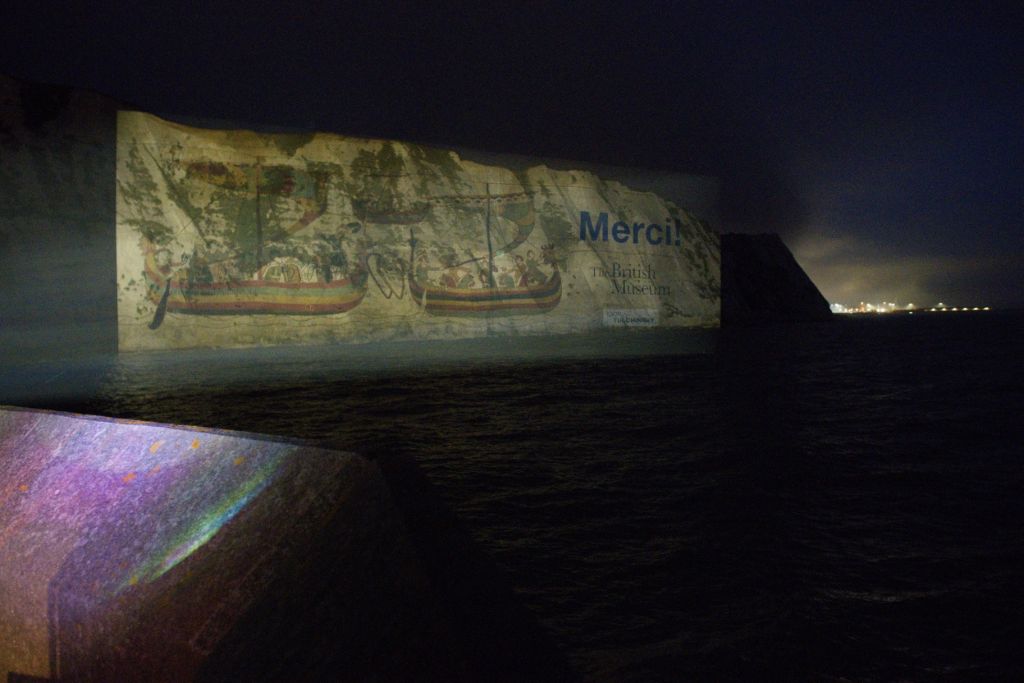
The visual content of the projection was designed to bridge the gap between the 11th and 21st centuries. The display featured iconic scenes from the tapestry, including the appearance of Halley’s Comet and the fleet of William the Conqueror crossing the sea. These images were interspersed with the logo of the British Museum and a massive, illuminated "Merci"—a gesture of diplomatic thanks to the French authorities for the unprecedented loan.

The choice of Dover as the location was deeply symbolic. For centuries, the White Cliffs have been the first sight of England for those crossing from the continent. By projecting the story of the Norman Conquest onto these rocks, the British Museum highlighted the shared history of England and France. The "Merci" message underscored a period of renewed cultural cooperation between the two nations, emphasizing that while the tapestry tells a story of conflict, its modern journey is one of partnership and mutual respect.
The Bayeux Tapestry: Historical Context and Modern Significance
The Bayeux Tapestry is not, technically speaking, a tapestry. It is an embroidery, stitched with wool yarn on a linen base. Commissioned in the years following the Battle of Hastings—likely by Bishop Odo of Bayeux, the half-brother of William the Conqueror—it serves as a primary historical source for the period. It details the death of King Edward the Confessor, the coronation of Harold Godwinson, and the subsequent Norman invasion.
The artifact has survived nearly a millennium of European history, including the French Revolution and two World Wars. Its upcoming residency at the British Museum marks the first time the work has been in England since its creation, which many historians believe took place in Canterbury. The loan was first proposed during high-level diplomatic talks in 2018 and has required years of planning to ensure the fragile textile can be transported and displayed safely.
The tapestry’s arrival is expected to be a major cultural event, drawing hundreds of thousands of visitors to London. The British Museum has indicated that the exhibition will provide a comprehensive look at the Viking age, the Norman influence on British law and architecture, and the artistic techniques used to create the embroidery.
The Future of Large-Scale Heritage Projection
The success of the Dover project highlights the growing role of projection mapping in heritage tourism and education. By using technology to bring static history to life, institutions like the British Museum can reach audiences far beyond the walls of a gallery. The use of high-lumen, 4K laser technology allows for a level of detail and brightness that was previously impossible in outdoor environments.
From a technical standpoint, the RQ35K projectors represent the current state-of-the-art for such endeavors. Their ability to deliver 30,500 lumens while maintaining a weight and size that allows for manual handling is a game-changer for "pop-up" installations in difficult locations. As battery technology continues to improve, the possibility for high-impact, low-trace visual events in protected natural areas will only expand.
As the Bayeux Tapestry begins its journey across the Channel, the memory of its image glowing on the Dover cliffs remains a testament to the power of light to connect the past with the present. The project was not just a technical showcase for Pixel Sharp and Panasonic, but a significant moment in cultural diplomacy, signaled by a giant "Merci" visible from the very waters that once carried William’s fleet toward the English shore. The exhibition at the British Museum will continue this narrative, offering a once-in-a-lifetime opportunity for the public to witness the tapestry’s return to the land it so vividly depicts.
