

The global independent music sector is currently undergoing a period of unprecedented expansion, driven by digital democratization and a fundamental shift away from traditional major label gatekeeping. As of 2024, independent artists represent the fastest-growing segment of the recorded music market, with revenues outpacing the overall industry growth rate. However, this surge in participation has created a highly saturated marketplace where technical proficiency alone is often insufficient for commercial viability. Professional networking and strategic collaboration have emerged as the primary catalysts for career advancement, transforming from social luxuries into core operational requirements for the modern "artist-entrepreneur." While the prospect of building a professional network can be daunting for those operating outside of major industry hubs, recent data suggests that localized, grassroots, and interdisciplinary partnerships are increasingly responsible for the breakthrough success of independent acts.
The Economic Imperative of Professional Networking in the Independent Sector
In the current music economy, the "lonely genius" trope has been replaced by the "collaborative collective." According to industry reports from organizations such as Midia Research and the IFPI, collaborative tracks—those featuring two or more primary artists—consistently perform better on streaming algorithms than solo releases. These collaborations provide a mechanism for audience cross-pollination, effectively doubling the potential reach of a single release by tapping into two distinct fanbases simultaneously.
Beyond the immediate metrics of streaming, networking serves as a risk-mitigation strategy. Independent musicians often lack the massive marketing budgets of major labels; therefore, they must rely on "social capital." This capital is built through reciprocal relationships with other creatives, venue owners, and technical professionals. By diversifying their professional circles, musicians gain access to shared resources, such as recording equipment, touring vans, and promotional platforms, which significantly lowers the overhead costs of production and distribution.
A Chronology of Professional Networking: From A&R to Peer-to-Peer
To understand the current necessity of networking, one must examine the historical shift in how music is discovered and promoted.

- The Traditional Era (1950s–1990s): During this period, networking was largely top-down. An artist’s primary goal was to "get noticed" by an A&R (Artists and Repertoire) executive. Networking occurred in high-barrier-to-entry environments like legendary clubs in New York, London, or Los Angeles.
- The Digital Transition (2000s–2015): The rise of MySpace and later SoundCloud introduced the concept of the "global digital scene." Networking moved online, but it remained largely siloed within the music community itself.
- The Contemporary Ecosystem (2016–Present): Networking has become holistic and interdisciplinary. The modern independent musician must navigate a complex web of social media influencers, digital platform editors, local community organizers, and cross-media collaborators (such as visual artists and game developers).
In this third era, the most successful independent artists are those who view networking not as a search for a "big break," but as the consistent construction of a supportive ecosystem.
Interdisciplinary Integration: Leveraging Local Art Scenes
One of the most underutilized avenues for musical networking is the broader local arts community. While many musicians limit their networking efforts to other bands and music venues, the most innovative partnerships often emerge from cross-disciplinary engagement. Local art galleries, independent theaters, and spoken-word poetry collectives offer a high concentration of creative energy with less "noise" than traditional music-only environments.
Data from urban development studies on "Creative Clusters" suggests that artists who operate within multi-disciplinary environments are 30% more likely to find sustainable commercial opportunities than those who remain within a single-industry silo. For instance, a visual artist hosting a gallery opening requires an atmospheric soundtrack, while a modern dance troupe may require original compositions for a performance. These engagements provide musicians with a "captive audience" that is already predisposed to valuing original art, often leading to high-quality fan acquisition and unique portfolio pieces that stand out to sync licensing agents.
Community Hubs and the Rise of the "Feedback Collective"
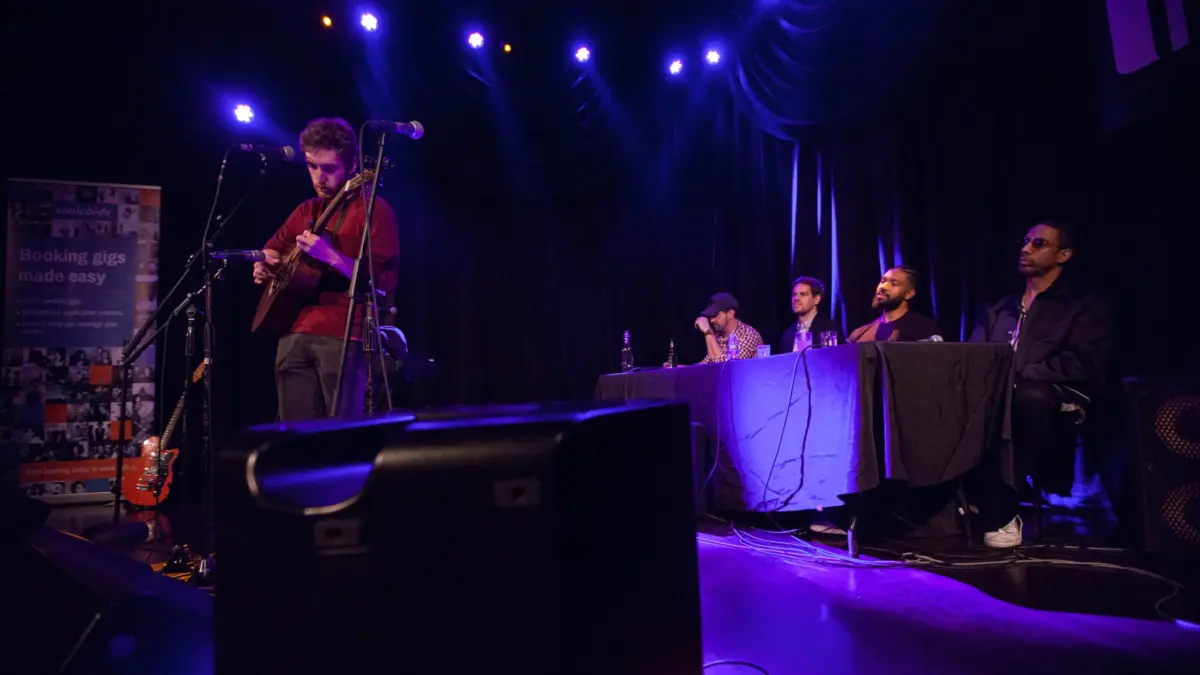
As the industry moves away from competitive models toward collaborative ones, the "jam session" and the "songwriting workshop" have been rebranded as essential professional development tools. Organizations like Sonicbids have been instrumental in formalizing these interactions through events such as the "Feedback Collective Panel Discussion" and specialized songwriting workshops.
These events serve a dual purpose. First, they provide a low-stakes environment for technical skill-sharing. A rock guitarist collaborating with a jazz saxophonist or an electronic producer results in "genre-bending," a quality highly prized by editorial playlist curators on platforms like Spotify and Apple Music. Second, these sessions act as a vetting process. In the professional world, reliability is as important as talent. By participating in or hosting local workshops, musicians can identify peers who are not only creatively compatible but also professionally disciplined.

Statements from industry consultants emphasize that the "soft skills" developed during these collective sessions—communication, compromise, and project management—are the very attributes that talent buyers look for when booking acts for larger tours or festivals.
Digital Infrastructure: Beyond the "Big Three" Social Platforms
While Instagram, TikTok, and X (formerly Twitter) are essential for broad-scale promotion, they are often suboptimal for deep professional networking due to their algorithmic focus on viral content rather than community building. Consequently, independent musicians are increasingly migrating to specialized platforms designed for creative collaboration.
Platforms such as BandLab and SoundCloud have introduced features that allow for asynchronous collaboration, enabling artists in different time zones to build tracks together in real-time. Furthermore, Discord has emerged as a primary hub for niche musical communities. These "server-based" micro-communities allow musicians to engage in deep-dive discussions about production techniques, gear, and industry trends.
A fact-based analysis of digital engagement shows that while a musician might have 10,000 followers on a major social platform, their "conversion rate" for collaborative projects is often higher within a Discord community of only 500 dedicated peers. The intimacy of these platforms fosters a level of trust that is difficult to achieve in the comment sections of mass-market social media.
Operational Immersion: The Strategic Value of Volunteering
The music festival industry, despite facing economic headwinds in the post-pandemic era, remains a critical nexus for networking. For many independent artists, the barrier to performing at a major festival is high. However, the barrier to working at one is significantly lower.

Volunteering or taking entry-level production roles at festivals provides "all-access" insights into the mechanics of the industry. It places the musician in direct proximity to stage managers, sound engineers, and festival bookers—the individuals who make the decisions for the following year’s lineup.
Industry analysts point out that the "backstage network" is often more influential than the "on-stage performance" for long-term career growth. By observing the professional conduct of headlining acts and the logistical requirements of large-scale events, independent musicians can professionalize their own operations, making them more attractive to future partners and sponsors.
The Fan-Centric Networking Model: Crowdsourcing Connection
A significant shift in the 2020s is the recognition of the fanbase as an active networking agent. The "1,000 True Fans" theory, popularized by Kevin Kelly, has evolved into a "1,000 True Connectors" model. Independent musicians are increasingly using surveys, polls, and direct-messaging to ask their audience for collaborative suggestions.
This strategy serves two functions:
- Market Research: It informs the artist about what their audience actually wants to hear, reducing the risk of a poorly received collaboration.
- Referral Power: Fans often have personal connections to other creatives that the artist does not. A fan who is a graphic designer might offer to create album art, or a fan who works at a local radio station might facilitate an introduction to a program director.
This "Direct-to-Consumer" (D2C) networking approach creates a sense of ownership among the fanbase, leading to higher levels of loyalty and advocacy. When fans feel they have played a role in a collaboration, they are statistically more likely to share the resulting content, acting as a decentralized marketing team.

Broader Impact and Future Implications
The move toward a more networked independent music industry has profound implications for the future of the creative economy. As musicians become more self-reliant through their networks, the power dynamic between artists and traditional labels continues to shift. We are seeing the rise of "micro-labels" and "artist collectives" that operate with the efficiency of a major corporation but the creative freedom of an independent.
However, this new landscape also demands a higher level of "business literacy" from musicians. To succeed, the modern artist must be a proficient communicator, a savvy digital navigator, and a community leader. The data indicates that the gap between "successful" and "struggling" independent artists is no longer defined by access to a recording studio, but by the breadth and health of their professional network.
In conclusion, networking is the infrastructure upon which modern musical careers are built. By embracing local art scenes, participating in collective workshops, utilizing specialized digital platforms, immersing themselves in event operations, and leveraging their fanbases, independent musicians can transcend the limitations of their immediate environment. The future of music is not just in the notes played, but in the connections made. For the independent musician, every handshake, comment, and collaborative session is a strategic investment in a sustainable and expansive creative future.
