

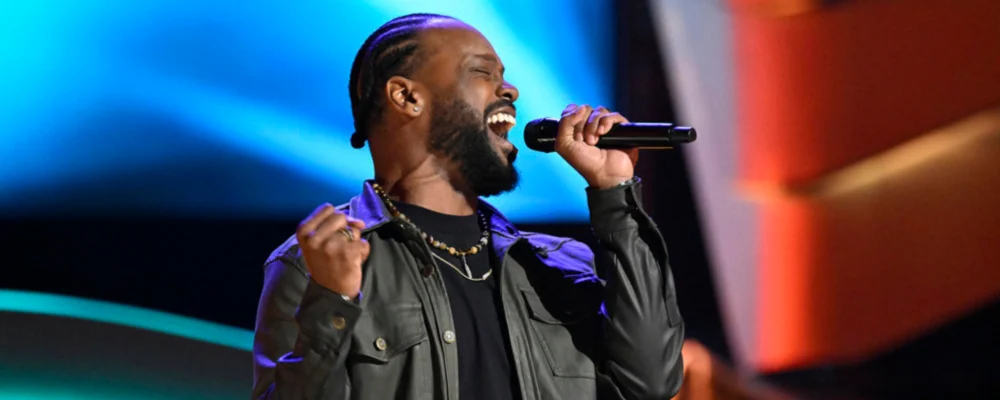
The season 29 premiere of NBC’s long-running vocal competition, The Voice, delivered an early highlight that combined technical mastery with an unexpected strategic twist during its Blind Auditions. Jeremy Keith, a 40-year-old professional backup singer, successfully transitioned from the shadows of the stage to the center spotlight, securing a coveted three-chair turn from coaches John Legend, Kelly Clarkson, and the returning Adam Levine. While the audition initially appeared to be a guaranteed victory for Legend—following a spontaneous and emotionally resonant duet between the coach and the contestant—the evening concluded with a surprising decision that left the panel stunned and the audience buzzing.
Keith took the stage with a rendition of Freddie Jackson’s 1985 R&B classic, "You Are My Lady." The performance was characterized by a sophisticated control of dynamics and a rich, velvet-like timbre that immediately commanded the attention of the coaches. Within the first verse, John Legend was the first to rotate his chair, followed in quick succession by Kelly Clarkson and Adam Levine. The three-way battle for Keith’s mentorship underscored the high level of talent present in the season 29 pool, as well as the specific appeal of a seasoned veteran like Keith, who brings decades of industry experience to the platform.
A Masterclass in R&B: The Performance and Initial Coaching Reactions
The selection of "You Are My Lady" served as a calculated risk for Keith. The song requires a wide vocal range and the ability to navigate complex melismas without losing the emotional core of the lyrics. Legend, a multi-Grammy winner known for his expertise in soul and R&B, was visibly impressed from the onset. Upon the conclusion of the performance, Legend was the first to offer his critique, specifically praising Keith’s "silky smooth" tone and his ability to maintain pitch perfection while delivering a high-energy vocal.
Adam Levine, the Maroon 5 frontman whose return to the series has been a focal point of season 29’s promotional campaign, offered a different perspective. Levine focused on the narrative arc of Keith’s career. Recognizing the professional polish in Keith’s delivery, Levine remarked that the singer was "no longer a background singer," emphasizing that his talent was "so beyond special" that he deserved to be the primary focus of any production.
Kelly Clarkson, often regarded as the most competitive coach on the panel regarding vocal technique, bypassed the technical accolades to offer a bold prediction. Clarkson told Keith directly, "I think you could win this show," a statement that carries significant weight given her track record of coaching multiple winners across her tenure on the series. The endorsement from Clarkson signaled to the other coaches that Keith was not merely a talented addition to a team, but a frontrunner for the season title.
The Personal Connection and the "Ordinary People" Duet
The momentum shifted heavily in Legend’s favor when the coaches inquired about Keith’s musical influences and personal history. Keith revealed that his musical foundation was built, in part, on Legend’s own discography. Specifically, he noted that he and his mother frequently listened to Legend’s seminal debut album, Get Lifted, during his formative years.
This revelation prompted an immediate and enthusiastic response from Legend. In an effort to solidify the connection, Legend offered to perform an impromptu duet of his breakout hit, "Ordinary People," with the contestant. The moment served as a highlight of the premiere, as Legend made his way to the stage, acknowledging Keith’s mother in the wings before sitting at the piano.
The two men performed a stripped-back version of the ballad, with their voices blending in a way that many observers noted felt like a seasoned professional duo rather than a coach and a prospective student. The chemistry was palpable, prompting Clarkson to jokingly complain that the display was "not fair" to the other coaches. Levine, sensing the disadvantage, attempted to break the spell by asking Keith if he had "gotten all that out of his system," suggesting that the emotional high of the duet might be a distraction from the long-term strategic needs of the competition. Legend quickly countered, telling Levine, "Don’t try to derail what Jeremy and I have!"
The Shocking Decision: Choosing Team Adam
Despite the emotional resonance of the duet and the shared R&B lineage with Legend, Keith delivered the season’s first major upset when it came time to select a coach. After expressing his deep respect for all three coaches, Keith announced he would be joining Team Adam.
The reaction on set was one of genuine shock. Adam Levine, who has built a reputation for theatricality, literally fell to the floor in disbelief, overwhelmed by the fact that he had managed to beat Legend for a soul singer of Keith’s caliber. Legend’s disappointment was equally visible. The "All of Me" singer admitted the rejection was a personal blow, stating, "It just broke my heart."
In a post-audition interview, Keith provided insight into his unconventional choice. While the pairing with Legend was the "obvious" route, Keith explained that his goal in the competition was not to stay within his comfort zone. "Choosing Adam, it wasn’t the obvious choice, especially after that duet," Keith said. "But I love his music and I feel like he would bring something different out of me as an artist."
Strategic Analysis: Why the Pivot to Levine Matters
Keith’s decision reflects a growing trend in reality vocal competitions where contestants prioritize artistic contrast over genre alignment. By choosing Levine, a coach rooted in pop-rock and alternative styles, Keith is signaling a desire to modernize his sound and perhaps move away from the traditional R&B lane that has defined his career as a backup singer.
For Adam Levine, securing Keith is a significant strategic win. As he re-establishes his presence on the show, having a powerhouse vocalist with Keith’s technical proficiency provides his team with a formidable anchor. Levine told the cameras following the audition, "Jeremy’s a bad, bad man. One of the best singers in this competition. Just incredible."
From a data perspective, backup singers have historically performed well on The Voice, often benefiting from the "professional polish" that younger, less experienced singers lack. However, the transition to solo stardom requires a distinct "star power" and the ability to connect with a broad voting demographic. Keith’s willingness to take a risk with a coach outside his primary genre may be the key to building that broader appeal.
Background Context: The Evolution of The Voice Season 29
Season 29 of The Voice arrives at a time when the show is undergoing significant structural changes. NBC has introduced several new elements to keep the format fresh, including adjusted "block" rules and a more streamlined knockout round. The return of Adam Levine has also shifted the dynamic of the coaching panel, reintroducing the playful but fierce rivalry between him and the other veteran coaches.
The premiere episode’s focus on Jeremy Keith highlights the show’s continued commitment to discovering "hidden gems" within the music industry. Keith’s 20-year career in the background of major tours is a narrative the show has successfully leaned into in previous seasons, resonating with viewers who appreciate stories of perseverance and late-career breakthroughs.
Broader Impact and Season Outlook
The fallout from Keith’s audition is expected to reverberate through the remainder of the Blind Auditions. For John Legend, the loss of a prime R&B talent to a pop coach may lead to a more aggressive recruiting strategy in subsequent episodes. For Kelly Clarkson, the exchange served as a reminder of the unpredictable nature of the contestants’ decision-making processes this season.
As the competition moves into the Battle Rounds, all eyes will be on how Levine handles Keith’s vocal arrangements. The challenge will be to maintain the "silky smooth" R&B essence that made him a three-chair turn while introducing the "different" elements Keith is seeking. If successful, this partnership could redefine the trajectory of the season and prove that the most unexpected pairings often yield the most compelling artistic results.
The Voice continues its season 29 run on Mondays on NBC, with streaming available the following day on Peacock. As the teams fill up, the "Jeremy Keith moment" remains a benchmark for the level of talent and the high-stakes drama that defines the series. For now, Adam Levine holds the advantage with one of the competition’s strongest vocalists, while John Legend is left to mend a "broken heart" and search for his next R&B powerhouse.
 Sri Mulyani