

The year 2005 stands as a unique nexus point in the history of modern media and popular culture, serving as the final frontier of the analog-dominated music industry before the digital revolution achieved total hegemony. It was a year defined by profound contradictions: while the Recording Industry Association of America (RIAA) reported that physical CD sales still accounted for the vast majority of domestic revenue, the technological foundations of the future were being laid in real-time. In February 2005, three former PayPal employees activated the domain for YouTube, and by April, the platform’s first video, a modest 19-second clip titled "Me at the zoo," had been uploaded. Simultaneously, Facebook was beginning its expansion beyond the Ivy League, and the concept of a "smartphone" was largely confined to the clunky, stylus-driven PDAs of the corporate elite. Within this volatile landscape of shifting formats and emerging platforms, the rock genre underwent a period of significant introspection and sonic evolution, producing a series of tracks that captured the anxiety and ambition of a world on the brink of total connectivity.
The Cultural Landscape of 2005: A Chronology of Change
To understand the musical output of 2005, one must first recognize the industry’s precarious position during that fiscal year. According to data from Nielsen SoundScan, total album sales in the United States dropped nearly 7% from the previous year, signaling a permanent decline in the traditional retail model. However, the "supergroup" phenomenon and the rise of "indie-rock-turned-mainstream" provided a lucrative counter-narrative to the doom-and-gloom projections of record executives.
The timeline of 2005 was punctuated by major releases from legacy acts and new titans alike. In May, Audioslave released their sophomore effort, Out of Exile. In June, Coldplay unleashed X&Y, which would go on to become the best-selling album of the year globally. By October, My Morning Jacket had released Z, an album that many critics now cite as the definitive turning point for the Louisville-based quintet. These releases did not exist in a vacuum; they were the soundtrack to a year marked by the tragedy of Hurricane Katrina, the escalating conflict in Iraq, and a growing sense that the "rock star" archetype was being fundamentally reshaped by the burgeoning internet culture.
Audioslave and the Refinement of the Supergroup Formula
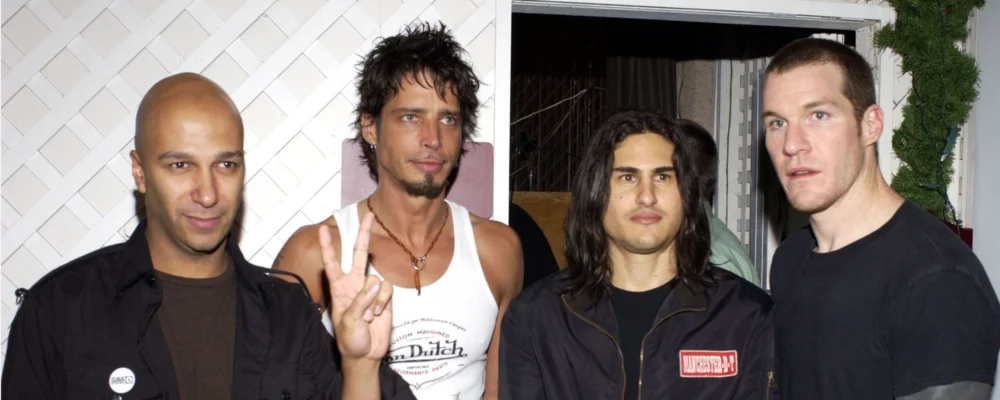
When Audioslave first emerged in 2002, the project was met with both fervor and skepticism. Comprising the instrumental backbone of Rage Against the Machine—guitarist Tom Morello, bassist Tim Commerford, and drummer Brad Wilk—and fronted by the late Soundgarden visionary Chris Cornell, the band was the ultimate "supergroup." Their self-titled debut was a masterclass in heavy, riff-driven hard rock, but by the time they entered the studio for their 2005 follow-up, Out of Exile, the internal chemistry had shifted.
The lead single "Be Yourself," released in early 2005, represented a departure from the blistering political aggression of the members’ previous incarnations. While Morello’s signature "helicopter" guitar effects and heavy grooves remained, the track prioritized Cornell’s melodic sensibilities and philosophical lyricism. In "Be Yourself," Cornell explored themes of individual resilience and the acceptance of one’s own history—a message that resonated deeply with a generation navigating the post-9/11 landscape.
The song’s success was measurable: it reached number one on the Billboard Mainstream Rock Tracks chart and remained a staple of alternative radio for the remainder of the year. Musicologists have since noted that "Be Yourself" marked the moment where Audioslave moved out of the shadow of Soundgarden and Rage Against the Machine to establish a distinct, soulful identity. The production, handled by Rick Rubin, emphasized clarity and vocal presence, allowing Cornell’s four-octave range to anchor the track’s emotional weight. In May 2005, the band further cemented their place in history by becoming the first American rock group to perform an authorized outdoor concert in Cuba, playing to an estimated 70,000 fans in Havana—a diplomatic and musical milestone that underscored the global reach of their message.
My Morning Jacket and the Evolution of Cosmic Americana
While Audioslave was refining the hard rock formula, a band from Kentucky was busy dismantling the boundaries of indie rock. My Morning Jacket had built a reputation on "reverb-drenched" anthems that sounded as though they were recorded in the rafters of a haunted silo. However, 2005’s Z saw the band, led by Jim James, seeking a more disciplined and diverse sonic palette.
The track "Off The Record" serves as the centerpiece of this transformation. Produced by the legendary John Leckie—whose work with Radiohead on The Bends and Pink Floyd on Meddle made him an ideal architect for the band’s new sound—the song introduced a tight, almost reggae-influenced groove that was entirely new to the band’s repertoire. The "haze" of their previous albums, At Dawn and It Still Moves, was replaced by sharp, interlocking guitar lines and a newfound focus on rhythmic precision.
Critical reaction to "Off The Record" and the album Z was overwhelmingly positive. Publications like Pitchfork and Rolling Stone lauded the band for their willingness to experiment with synthesizers and dub-heavy production. Data from the era shows that Z was a breakthrough for the band in terms of commercial viability, peaking at number 67 on the Billboard 200—a significant achievement for a group that had previously been confined to the "cult favorite" category. The song’s legacy lies in its bridge between the "space rock" of the late 90s and the "indie-pop" sensibilities that would dominate the late 2000s, proving that a band could maintain its soul while cleaning up its sound.
Coldplay and the Burden of the Stadium Rock Mantle
No discussion of 2005 in music is complete without addressing the polarizing dominance of Coldplay. Following the massive success of A Rush of Blood to the Head, the band faced immense pressure to deliver a follow-up that could sustain their trajectory toward becoming the biggest band in the world. The result was X&Y, an album that was both a commercial juggernaut and a lightning rod for critical debate.
The single "Talk" epitomizes the "Coldplay-as-U2" era. The track is built around a distinctive synthesizer hook that the band famously requested permission to use from the German electronic pioneers Kraftwerk. The melody, borrowed from Kraftwerk’s 1981 song "Computer Love," gave "Talk" a futuristic, mechanical pulse that contrasted with Chris Martin’s earnest, often vulnerable vocal delivery.
The song’s lyrical content—searching for connection in a world that feels increasingly disconnected—was a perfect reflection of the 2005 zeitgeist. However, the band faced a growing "Coldplay fatigue" among critics. A famously scathing review in The New York Times labeled them "the most insufferable band of the decade," arguing that their brand of emotional stadium rock was too calculated. Despite this, the data told a different story. "Talk" became a Top 10 hit in numerous countries, and X&Y went on to sell over 8 million copies worldwide within its first year. The band’s transition from the "scruffy college dudes" of the Parachutes era to the glow-stick-wielding icons of the stadium circuit was complete. They weren’t just the next Radiohead; they had successfully inherited the populist mantle of U2, prioritizing universal hooks and collective joy over avant-garde experimentation.
Market Implications and the Shift to Digital Consumption
The success of these three tracks in 2005 also highlights the changing ways in which music was consumed. 2005 was the year the "Digital Single" began to take precedence over the "Radio Edit." Apple’s iTunes Store, which had launched only two years prior, was seeing exponential growth. By July 2005, the store had sold its half-billionth song.
For Audioslave, My Morning Jacket, and Coldplay, this meant that their music was being unbundled. While they continued to release full-length albums as cohesive artistic statements, the public was increasingly engaging with them through individual downloads. This shift forced labels to prioritize "high-impact" singles like "Be Yourself" and "Talk" to drive digital sales. Furthermore, the rise of "ringtones" as a legitimate revenue stream—a bizarre but lucrative footnote in mid-2000s music history—meant that the recognizable hooks of these songs were often more valuable than the songs themselves.
Broader Impact and the Enduring Relevance of 2005
Looking back from the vantage point of the present, the rock music of 2005 represents a "last hurrah" for the traditional rock infrastructure. Within five years of these releases, the rise of streaming services like Spotify would fundamentally alter the economics of the industry, and the dominance of the "rock band" on the Billboard charts would begin to wane in favor of hip-hop and electronic-influenced pop.
However, the songs "Be Yourself," "Off The Record," and "Talk" remain vital because they captured a specific moment of transition. They were created by artists who were aware of their history but were not afraid to look toward a digital, interconnected future. Audioslave provided a blueprint for how legacy musicians could evolve; My Morning Jacket showed that "indie" was a mindset, not a genre; and Coldplay proved that sincerity, when scaled to the size of a stadium, could still move the world.
The year 2005 may be remembered by some for the birth of YouTube or the expansion of social media, but for those who were listening, it was a year where rock music attempted to find its voice in a rapidly changing world. These tracks serve as more than just nostalgia; they are the sonic artifacts of an era that bridged the gap between the physical past and the digital present, reminding us that even as technology changes the way we listen, the human need for resonance and melody remains constant.
