

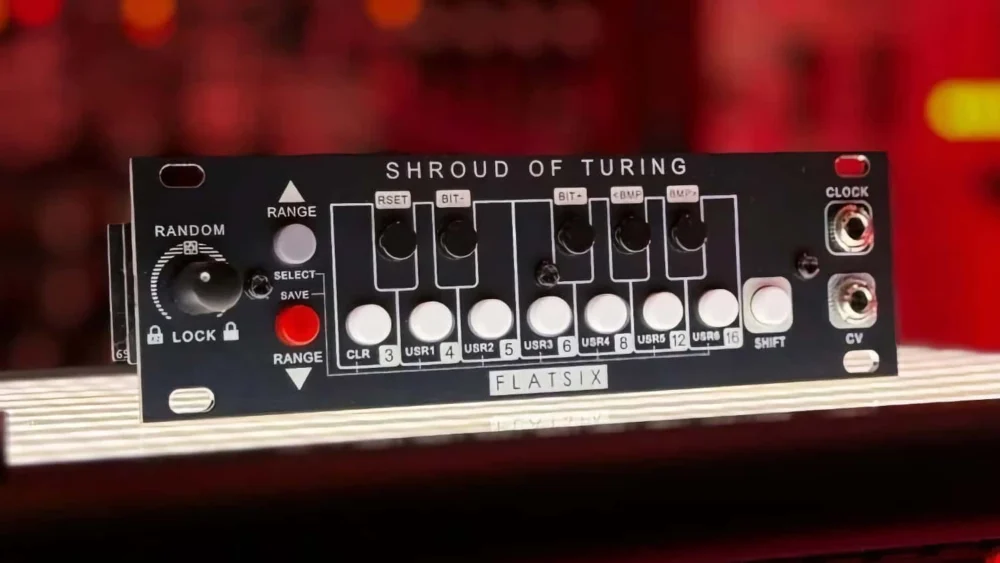
FlatSix Modular has officially announced the release of the Shroud of Turing, a specialized Eurorack module designed for the Intellijel 1U format that integrates the generative power of a shift register with the melodic precision of a note quantizer. This new entry into the modular synthesis market represents a significant expansion of the company’s Nocturne Alchemy Platform, a hardware ecosystem built upon an Arduino-based architecture. By combining pseudo-random sequence generation with a user-definable scale interface, the Shroud of Turing aims to provide musicians with a bridge between unpredictable sonic "accidents" and structured, harmonic composition. Priced at $225 USD and available immediately, the module addresses a growing demand for multi-functional, space-efficient utilities within the increasingly popular 1U utility row of modern Eurorack cases.
The Convergence of Generative Logic and Melodic Quantization
At its core, the Shroud of Turing is an evolution of the classic Turing Machine concept, originally popularized in the DIY modular community by Music Thing Modular. A Turing Machine in the context of synthesis is a shift register that generates a sequence of voltages based on random data. These sequences can be "locked" into repeating loops or allowed to "evolve" by introducing a probability of bit-flipping. While traditional shift registers output raw control voltage (CV) that often requires external quantization to sound musically traditional, the Shroud of Turing integrates this step directly into the hardware.
The integration of a built-in keyboard for scale definition is the module’s most prominent feature. Users can interactively select notes to create custom scales, ensuring that the pseudo-random voltages generated by the shift register always conform to a specific musical key or mode. This eliminates the need for a secondary quantization module, saving valuable 3U rack space and streamlining the signal path for generative patches. The module includes six dedicated save slots, allowing performers to store and recall different scales instantly, a feature designed specifically for live performance environments where manual scale adjustment is often impractical.
Technical Specifications and the Nocturne Alchemy Platform
The Shroud of Turing is built on FlatSix Modular’s Nocturne Alchemy Platform. This platform utilizes an Arduino-compatible microcontroller, which provides a flexible foundation for complex digital signal processing (DSP) and logic operations. By using a standardized hardware backend, FlatSix Modular is able to maintain a consistent development cycle while offering users a reliable digital interface.
The 1U form factor is specifically designed to fit the Intellijel standard, which has become a benchmark for modular case manufacturers such as Stealth7 and 4ms, in addition to Intellijel’s own Performance and Palette cases. This 1U orientation allows the "utility" row of a case to handle complex sequencing tasks, leaving the primary 3U rows free for oscillators, filters, and amplifiers.
Key performance tools included in the Shroud of Turing include:
- Pattern Rotation: Allows the user to shift the start point of the sequence, effectively changing the rhythmic feel or melodic emphasis without altering the underlying data.
- Bit Editing: Provides granular control over the shift register’s internal state, allowing users to manually flip specific bits to "sculpt" the sequence.
- Loop Reset: A vital tool for synchronization, enabling the sequence to return to its starting point via manual trigger or external clock.
- Pseudo-Random CV Generation: The module generates evolving patterns that can transition from total chaos to strict repetition based on the user’s settings.
Historical Context: From Buchla to the Modern Shift Register
To understand the significance of the Shroud of Turing, one must look at the history of shift registers in electronic music. The concept of using digital logic to create "controlled uncertainty" dates back to the 1960s and 1970s, most notably with Don Buchla’s Model 266 Source of Uncertainty. Buchla’s designs sought to move away from the traditional keyboard interface, favoring "stored program" sources that could generate complex, non-repeating, or semi-repeating patterns.
The "Turing Machine" module, designed by Tom Whitwell of Music Thing Modular, brought this concept to the modern Eurorack format as an open-source project. It became a staple for "West Coast" style synthesis, where generative processes often take precedence over manual melodic input. However, the original Turing Machine was a purely analog-style digital emulation that produced a "stepped" random voltage. The Shroud of Turing represents the "next generation" of this philosophy by adding the digital "shroud" of quantization and memory, making it more accessible to "East Coast" composers who require strict adherence to chromatic or diatonic scales.
The Rise of the 1U Format in Modular Synthesis
The decision to release the Shroud of Turing in the 1U format reflects a broader shift in the Eurorack industry. For years, the 1U row was reserved for simple utilities like mults, attenuators, or basic MIDI-to-CV converters. However, as the popularity of small, portable "skiff" cases has grown, manufacturers have begun to pack more sophisticated functionality into these slim modules.
By offering a full-featured sequencer and quantizer in 1U, FlatSix Modular is catering to the "Palette" case user—musicians who work with extremely limited space and need every module to perform multiple roles. The $225 price point places the Shroud of Turing in competition with other high-end 1U modules, such as those from Intellijel or Plum Audio, but its specific combination of shift-register logic and scale-saving memory gives it a unique niche in the market.
Functional Analysis: Bridging Chaos and Musicality
The primary appeal of the Shroud of Turing lies in its ability to balance two opposing forces in synthesis: randomness and structure. In a typical generative patch, a musician might use a random voltage generator to trigger an oscillator. Without quantization, the result is often microtonal and dissonant. By incorporating a playable keyboard interface, the Shroud of Turing allows the user to "curate" the randomness.
The "bit editing" and "pattern rotation" features are particularly noteworthy for live performers. In a studio setting, a musician can wait for a generative sequence to evolve into something pleasing. In a live setting, however, the performer needs the ability to intervene. The Shroud of Turing’s interface allows for "real-time sculpting," where the performer can lock a sequence once it becomes interesting, then use bit editing to introduce subtle variations that keep the performance from becoming static.
Industry Reactions and Market Implications
The announcement has been met with interest from the modular community, particularly from those who utilize 1U-heavy systems. Early reactions from synthesists suggest that the integration of the keyboard into the 1U strip is a major ergonomic victory. Most 1U modules rely on tiny trimmers or menu diving; the Shroud of Turing’s physical layout, though compact, emphasizes "playability."
Industry analysts note that FlatSix Modular’s use of an Arduino-based platform may also hint at future firmware updates or community-driven modifications. The "Nocturne Alchemy Platform" branding suggests that this is part of a larger series of modules, potentially indicating a move toward a unified ecosystem of 1U tools that share similar design languages and internal logic.
From a market perspective, the Shroud of Turing arrives at a time when "generative ambient" music is seeing a surge in popularity on platforms like YouTube and Bandcamp. Tools that allow for "happy accidents" while maintaining harmonic cohesion are in high demand. FlatSix Modular appears to have identified a gap in the 1U market where most sequencers are either simple "baby-8" style step sequencers or basic clock dividers.
Availability and Pricing
FlatSix Modular has confirmed that the Shroud of Turing is currently in production and available for purchase through their official website and authorized modular synthesis retailers. The retail price of $225 USD includes the module, a power cable, and mounting screws. Given the ongoing global supply chain challenges in the semiconductor industry, the company’s ability to launch with immediate availability is a positive sign for its manufacturing capabilities.
As modular systems continue to shrink in size while growing in complexity, the Shroud of Turing stands as a testament to the engineering ingenuity currently driving the boutique synthesizer market. It offers a sophisticated solution for generative composition that respects both the history of stochastic music and the practical needs of the modern modular performer. By condensing a Turing Machine, a quantizer, and a preset manager into a single 1U tile, FlatSix Modular has provided a powerful new tool for those looking to find order within the chaos of voltage-controlled sound.
