

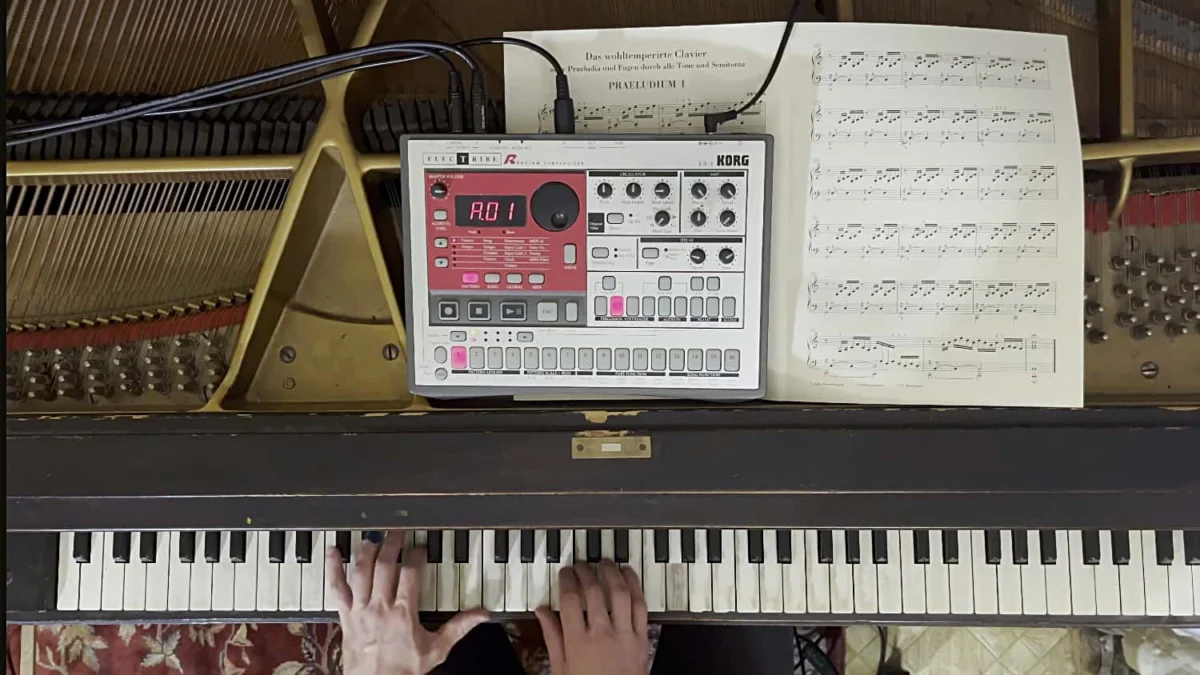
The intersection of 18th-century baroque counterpoint and turn-of-the-millennium digital synthesis has reached a new milestone through the work of musician and programmer Hank Mason, who recently debuted a complete arrangement of Johann Sebastian Bach’s Prelude and Fugue in C Major (BWV 846) performed on a Korg Electribe ER-1. This unconventional performance utilizes a vintage rhythm synthesizer—a device originally engineered for percussive sequencing—to articulate the intricate melodic and harmonic structures of one of Western classical music’s most foundational compositions. By leveraging custom Python scripts and deep-level MIDI parameter manipulation, Mason has successfully bridged the gap between rigid rhythmic hardware and the fluid tonal requirements of Bach’s "The Well-Tempered Clavier."
The performance serves as both a technical demonstration of hardware hacking and a musicological exploration of temperament. The Korg Electribe ER-1, released in 1999, was part of Korg’s first generation of Electribe "grooveboxes," designed primarily for the burgeoning techno and house music scenes of the era. Its architecture is centered on virtual analog synthesis tailored for drum sounds, lacking the standard chromatic keyboard tracking found in traditional synthesizers. Mason’s ability to extract a four-voice fugue from a machine with no native melodic interface represents a significant departure from the intended use of the hardware.
Technical Architecture and Algorithmic Translation
The primary challenge in adapting BWV 846 for the Electribe ER-1 lies in the machine’s internal design. Unlike a melodic synthesizer where a MIDI note corresponds directly to a specific frequency (such as A440), the ER-1 treats its four Voltage Controlled Oscillators (VCOs) as percussion triggers. Each of the four synth parts is fixed to a specific MIDI note meant to trigger a drum hit. To produce varied pitches, a user must manually adjust the "pitch" knob, which operates on a non-linear scale of 0 to 127.
To overcome these hardware limitations, Mason developed a sophisticated workflow involving automated data translation. The process began with the acquisition of the score in MusicXML format, a standard for digital sheet music notation. Because the ER-1 cannot interpret MusicXML or even standard MIDI note data as pitch instructions, Mason authored a Python script to act as a translator. This script parsed the musical data and mapped the frequencies of the 12-tone equal temperament (12TET) scale to specific combinations of the ER-1’s internal parameters: pitch, modulation speed, and modulation depth.
By modulating these three variables simultaneously via MIDI Control Change (CC) messages, the script forced the ER-1’s oscillators to approximate specific musical notes. However, because the ER-1’s internal resolution is limited to 128 steps per parameter, the resulting pitches do not always align perfectly with modern tuning standards. This inherent "lo-fi" resolution creates a microtonal character that Mason suggests adds a layer of historical authenticity, albeit through a digital lens.
Historical Context: The Well-Tempered Clavier and Temperament
The choice of Bach’s Prelude and Fugue in C Major is particularly symbolic within the context of tuning challenges. BWV 846 is the opening piece of "The Well-Tempered Clavier," a collection of two series of Preludes and Fugues in all 24 major and minor keys. When Bach composed the first book in 1722, the musical world was in a state of transition regarding tuning systems.
Before the universal adoption of 12-tone equal temperament (where the interval between every semitone is mathematically identical), various "well-tempered" systems were used. These systems, such as those proposed by Andreas Werckmeister, allowed musicians to play in all keys without the dissonant "wolf intervals" found in mean-tone temperament, yet they retained unique "key colors." Each key sounded slightly different because the intervals were not perfectly uniform.
Mason’s arrangement on the ER-1 inadvertently mirrors this historical reality. Because the ER-1’s 0-127 parameter scale does not divide perfectly into the logarithmic frequencies required for 12TET, the "strange tunings" produced by the machine evoke the character of pre-modern temperaments. Mason noted that the resulting pitches are rarely "squarely correct," creating a sonic palette that might have felt familiar to an 18th-century ear, despite the futuristic timbre of the virtual analog oscillators.
Environmental Variables and Hardware Performance
The recording of the performance was also influenced by external physical conditions, highlighting the intersection of digital hardware and environmental reality. During the recording session in New York City, the region was experiencing a significant heat wave. Mason observed that the ER-1 began to "glitch out" during the performance, a phenomenon occasionally seen in aging digital-analog hybrid hardware when internal temperatures exceed optimal operating ranges.
These glitches manifested as unexpected fluctuations in tuning and timing, adding an element of unpredictability to the performance. In a professional recording context, such errors are typically viewed as failures; however, in the realm of experimental electronic music, these "ghosts in the machine" are often embraced as a form of "glitch art." The heat-induced instability served to further distance the performance from the sterile precision often associated with modern digital recreations of classical works.
To provide a grounding element to the electronic synthesis, the arrangement also features a Krakauer Bros. Grand Piano. The juxtaposition of the traditional acoustic instrument with the struggling, overheated circuitry of the ER-1 creates a dialogue between two different eras of keyboard technology. The Krakauer piano, a staple of American piano manufacturing known for its robust tone, provides a resonant harmonic foundation that highlights the thin, industrial textures of the Korg rhythm synthesizer.
Chronology of the Project
The development of the project followed a multi-stage timeline, beginning with Mason’s initial exploration of the ER-1’s synthesis capabilities.
- Initial Hardware Experimentation: Mason identified that the four independent VCOs of the ER-1 could theoretically function as a four-part polyphonic ensemble, provided a method for pitch control could be established.
- Script Development: During a period of professional transition, Mason focused on the software engineering aspect of the project, writing the Python script to translate MusicXML data into the specific hex values and MIDI CC messages required by the Korg hardware.
- Frequency Mapping: A painstaking calibration process was required to match the ER-1’s 0-127 parameter values to the Hertz values of the Western scale.
- Composition and Arrangement: The Prelude was added to the Fugue to complete the BWV 846 pairing, ensuring that the four-voice structure of the Fugue was properly allocated across the ER-1’s four synth parts.
- Recording under Extreme Conditions: The final performance was captured during the aforementioned NYC heat wave, resulting in the unique tonal drift and technical artifacts present in the final video.
Broader Implications and Industry Impact
Mason’s work contributes to a growing movement within the electronic music community that seeks to repurpose "obsolete" or limited hardware for complex compositional tasks. The Korg Electribe series, while beloved for its hands-on interface and "knob-per-function" workflow, has long been relegated to the category of "dance music gear." By forcing the ER-1 to perform Bach, Mason challenges the industry’s categorization of instruments based on their intended genre.
Furthermore, the project highlights the increasing role of custom coding in musical performance. As MIDI-enabled hardware ages, the use of external software like Python to extend the functionality of these devices is becoming more common. This "algorithmic orchestration" allows musicians to bypass the physical limitations of old hardware, such as the lack of a keyboard or limited onboard memory, without sacrificing the unique sonic character of the original circuits.
From a musicological perspective, the project invites a re-evaluation of how we perceive "correct" tuning. In an era where digital pitch correction (Auto-Tune) and perfect 12TET are the default, the "drifting" pitches of the ER-1 serve as a reminder of the organic, often imperfect nature of sound. The fact that a drum machine from 1999 can approximate the "well-tempered" nuances of the 1720s suggests that the evolution of musical technology is not a linear path toward perfection, but rather a cycle of varying forms of expression.
Conclusion
Hank Mason’s rendition of Bach’s Prelude and Fugue in C Major on the Korg Electribe ER-1 stands as a testament to the enduring versatility of both Bach’s compositions and early digital music hardware. By navigating the technical constraints of a non-chromatic drum machine through modern programming and embracing the environmental hazards of a New York summer, Mason has produced a work that is simultaneously a technical feat and a poignant piece of performance art. The project reinforces the idea that instruments are defined not by their labels, but by the ingenuity of those who play them, proving that even a rhythm synthesizer can find its place within the hallowed halls of high Baroque counterpoint.
