

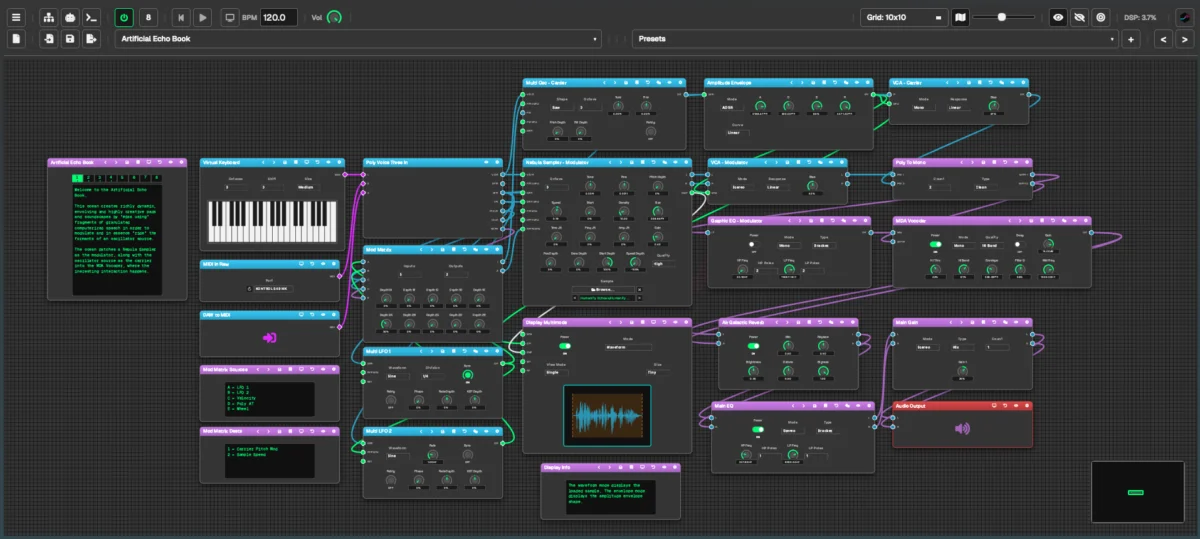
Ocean Swift has officially announced the release of DevOcean Modular, an expansive and modern modular synthesis environment designed to serve the needs of professional sound designers, electronic musicians, and experimental composers. This new platform arrives as a comprehensive solution for virtual modular synthesis, featuring an initial library of 145 modules that span the spectrum of traditional subtractive synthesis, advanced digital techniques, and unconventional data-driven modulation. The software is positioned as a high-performance alternative in the increasingly competitive virtual modular market, emphasizing visual feedback, ease of use, and a vast internal ecosystem that reduces the need for third-party plugins.
A Comprehensive Ecosystem of 145 Modules
The core appeal of DevOcean Modular lies in its sheer volume of internal components, which allow users to build complex signal chains from scratch. The 145 modules included at launch cover a diverse array of synthesis methods. Among the primary sound sources are wavetable oscillators, FM (Frequency Modulation) voices, and additive banks, which provide the building blocks for rich, evolving textures. For those seeking classic electronic sounds, the platform includes "supersaw" oscillators capable of producing the dense, detuned waveforms popular in trance and modern cinematic scores.
Beyond standard synthesis, DevOcean Modular incorporates physical modeling modules, specifically tailored for string sounds. This technology uses mathematical algorithms to simulate the physical properties of acoustic instruments, offering a level of realism and articulation that traditional sampling often struggles to achieve. The platform also features "granular clouds," allowing users to deconstruct audio into tiny fragments or "grains" and reassemble them into atmospheric pads or glitchy rhythmic textures.
The filtering section is equally robust, offering nine distinct families of filters. These range from standard low-pass and high-pass designs to more exotic resonant structures, providing users with significant control over the harmonic content of their patches. To round out the signal chain, the suite includes studio-grade temporal effects, such as high-fidelity reverbs and delays, ensuring that sound design can be completed entirely within the DevOcean environment.
Innovation Through Unconventional Modulation Sources
One of the most distinguishing features of DevOcean Modular is its inclusion of non-traditional modulation sources and sound generators. In a move toward aleatoric and generative composition, the software includes modules capable of pulling live market data and shortwave radio signals into the synthesis environment. By converting fluctuating financial data or atmospheric radio interference into control voltages (CV) or audio signals, Ocean Swift provides composers with tools to create music that is literally connected to real-world events and chaotic natural phenomena.
Furthermore, the platform integrates a dedicated game controller modulation rig. This allows performers to use hardware peripherals—such as joysticks and triggers—to manipulate synthesizer parameters in real-time. This focus on gestural control reflects a broader trend in the music technology industry toward more expressive and tactile interfaces, bridging the gap between the rigid mouse-and-keyboard workflow and the fluid movement of live performance.
Visual Interface and User Experience
Ocean Swift has placed a heavy emphasis on the visual aesthetics and functional feedback of the DevOcean Modular interface. In complex modular environments, "cable spaghetti"—the visual clutter of numerous overlapping patch cables—can often become a barrier to creativity. To mitigate this, DevOcean Modular utilizes an intelligent cabling system where cables pulse in real-time to represent the signal moving through them.
The system also provides immediate visual cues regarding signal types. Cables automatically shift color depending on whether they are carrying monophonic or polyphonic data. This distinction is crucial for sound designers working on intricate patches, as it allows them to identify signal flow and potential routing errors at a glance. The interface is designed to be high-definition and scalable, catering to modern high-resolution displays and ensuring that the modular "rack" remains legible even when hundreds of modules are in use.
Historical Context and Evolution of Virtual Modular Synthesis
The launch of DevOcean Modular occurs during a renaissance for modular synthesis. Historically, modular systems were the province of large research universities and wealthy enthusiasts, characterized by the massive Moog and Buchla systems of the 1960s and 70s. The 21st century saw a shift toward the Eurorack hardware standard, which democratized the medium to some extent by making modules smaller and more affordable.
However, the true democratization of modular synthesis occurred in the software domain. Platforms like VCV Rack, Softube Modular, and Cherry Audio’s Voltage Modular have proven that there is a massive global market for "in-the-box" modularity. These digital versions offer several advantages over hardware: infinite instances of modules, the ability to save and recall complex patches instantly, and a significantly lower cost of entry.
Ocean Swift, a company already known for its specialized wavetable synthesizers and Kontakt instruments, has leveraged this historical momentum. By releasing a platform with 145 modules from day one, they are positioning DevOcean Modular as a "mature" ecosystem that rivals established competitors who have spent years building their module libraries.
Pricing, Availability, and Market Strategy
DevOcean Modular is available immediately through the Ocean Swift website. In a move to capture market share and encourage early adoption, the company has introduced an aggressive introductory pricing structure. The software is currently priced at €129.99, representing a 35% discount from the standard Manufacturer’s Suggested Retail Price (MSRP) of €199. Notably, this introductory period is exceptionally long, set to remain in effect until September 1, 2026.
To lower the barrier to entry further, Ocean Swift has released a full demo version of the software. This version includes all 145 modules and full functionality, with the sole restriction being that saving is disabled. This "try before you buy" strategy allows potential users to stress-test the platform on their specific hardware and explore the vast module library before committing to a purchase.
Technical Analysis and Industry Implications
The inclusion of 145 modules in a single package suggests a shift in the business model of virtual modular synthesis. While competitors often use a "freemium" model—where the base software is free but individual modules or bundles must be purchased separately—Ocean Swift is opting for a "complete suite" approach. This model appeals to professionals who prefer a fixed cost and a predictable set of tools without the distraction of an internal marketplace.
From a technical standpoint, the integration of live data (market trends) and external hardware (game controllers) indicates that Ocean Swift is targeting the experimental and "New Media" art sectors. These features allow for the creation of installation art and data-sonification projects that were previously difficult to implement without custom coding in environments like Max/MSP or Pure Data. By bringing these capabilities into a standard modular synth format, DevOcean Modular makes advanced generative techniques accessible to a wider range of musicians.
Anticipated Impact on the Sound Design Community
Initial reactions from the sound design community suggest that the "live market data" and "shortwave radio" modules are among the most anticipated features. These tools offer a way to break out of the "perfect" digital environment and introduce organic unpredictability into recordings.
"The ability to map the volatility of a stock market index to a filter cutoff or a granular spray parameter is more than a gimmick," noted one industry analyst. "It provides a conceptual layer to music production that aligns with the current interest in stochastic and algorithmic composition."
Furthermore, the focus on polyphonic cabling suggests that DevOcean Modular is built with modern MPE (MIDI Polyphonic Expression) controllers in mind. As more musicians adopt controllers like the Roli Seaboard or the LinnStrument, the demand for synthesis environments that can handle complex, multi-dimensional polyphonic data has surged.
Conclusion and Future Outlook
With the release of DevOcean Modular, Ocean Swift has established a significant presence in the software synthesis landscape. By combining a massive library of traditional synthesis tools with cutting-edge data-integration modules, the platform serves both the "purist" modular enthusiast and the forward-thinking experimentalist.
As the industry moves toward the 2026 deadline for the introductory pricing, it is expected that Ocean Swift will continue to expand the platform through firmware-style updates and potentially new module expansions. For now, the 145 modules provided offer a nearly inexhaustible playground for sonic exploration. The success of DevOcean Modular will likely be measured by its adoption in professional film scoring and the experimental electronic scene, where its unique modulation sources can be utilized to their full potential.
The software is compatible with major operating systems and is designed to run within modern Digital Audio Workstations (DAWs) as a plugin, as well as in a standalone capacity for live performance and dedicated sound design sessions. As the boundaries between music, data, and technology continue to blur, tools like DevOcean Modular represent the next step in the evolution of the digital instrument.
